[pageLogInLogOut]

#Textile processing

The company presents its latest innovations at PI Apparel Europe

Jeanologia showcases the future of product development

AI, digital design and data-driven sustainability converge in a new approach to fashion production
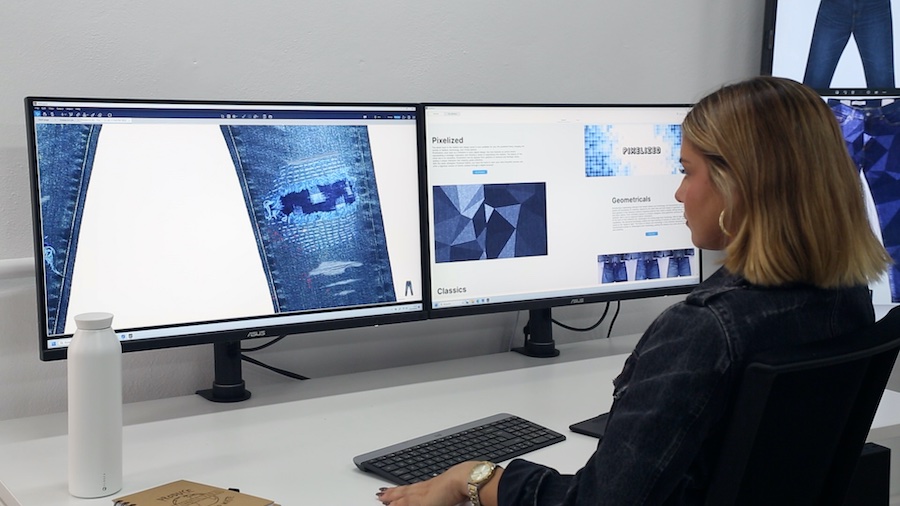
eDesigner © 2026 Jeanologia
Jeanologia is showcasing how software is transforming product development in the fashion industry at PI Apparel Europe: The Fashion Technology Show, taking place on March 30–31 in London.


At this year’s event, the company presents its latest software developments, focused on two key areas shaping the future of the industry: digital product development and environmental impact measurement.

Digital product development: from image to production

Jeanologia introduces a new paradigm in product development, where design and production are seamlessly connected through software, reducing time, increasing accuracy, and eliminating inefficiencies.

At the core of this transformation is Billy, recently launched by Jeanologia as the first artificial intelligence developed specifically for denim design. Billy is being showcased live at PI Apparel Europe, where visitors can see how the system transforms any garment image into a production-ready laser design in seconds.

By analyzing a simple photograph, Billy interprets contrasts, creases, and natural wear patterns, automatically extracting the design of the fabric and converting it into a precise laser file ready for execution. What traditionally required hours—or even days—of manual work by skilled designers can now be achieved almost instantly, with accuracy, consistency, and no need for manual retouching.

More than a tool, Billy represents a breakthrough in the creative process, connecting inspiration, digital design, and industrial execution in a single step.

This innovation builds on Jeanologia’s extensive expertise in laser technology and denim finishing, with AI trained on thousands of real production designs developed over more than 25 years.

Complementing this is eDesigner, Jeanologia’s digital design platform for denim digital product development, which allows designers and developers to create and refine finishes in a fully virtual environment before physical production.

Through hyper-realistic simulations, users can visualize washes, adjust effects, and validate results in real time, significantly reducing the need for physical samples and shortening development timelines. eDesigner also enables seamless collaboration across teams and suppliers, ensuring alignment between design intent and final production.

Together, Billy AI and eDesigner redefine product development, enabling brands to move from concept to production faster, with greater precision and creative freedom.

Measuring impact: from perception to data

Alongside its digital design solutions, Jeanologia presents EIM (Environmental Impact Measuring platform), the industry standard for assessing the environmental impact of garment finishing processes.

EIM provides measurable data on water, energy, chemical use, and worker impact, enabling brands and manufacturers to evaluate processes, compare results, and track improvements over time.

By integrating measurable parameters into product development, EIM addresses the growing demand for transparency, traceability, and compliance across the fashion industry.

“The industry is moving towards a new model where creativity, efficiency, and sustainability must coexist within the same workflow,” says Carmen Silla, Marketing Director at Jeanologia. “Technology is what makes that integration possible.

Jeanologia’s proposal at PI Apparel EU reflects a broader industry shift, where digitalization and data are redefining how fashion is designed, produced, and evaluated. By combining AI-driven design tools with impact measurement, the company presents a model in which creativity, efficiency, and sustainability are fully connected within the same workflow.
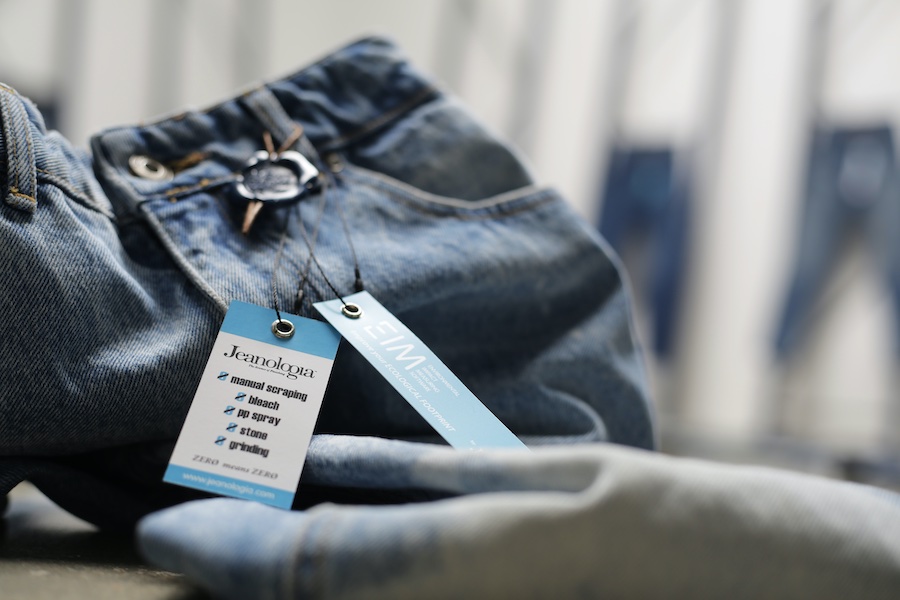
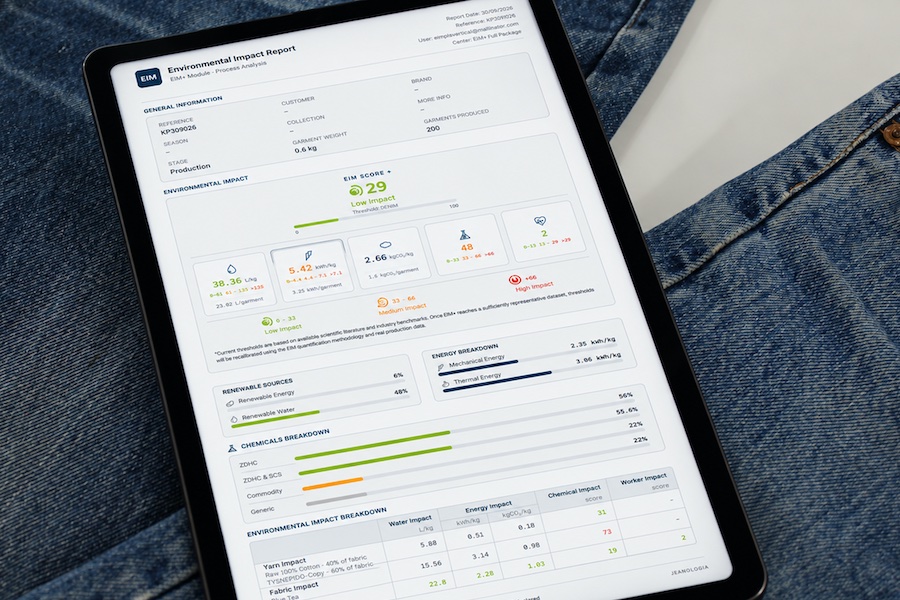
EIM (Environmental Impact Measuring platform) label on jeans © 2026 Jeanologia


More News from JEANOLOGIA S.L.

#Recycling / Circular Economy

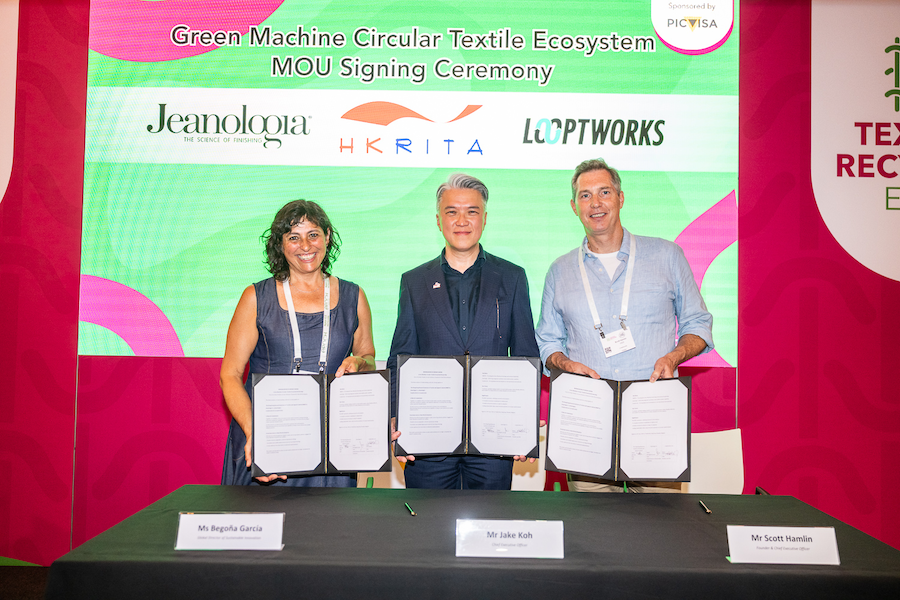
HKRITA signs MoU with Jeanologia and Looptworks to establish the Green Machine Circular Textile Ecosystem

The Hong Kong Research Institute of Textiles and Apparel (HKRITA) yesterday officially signed a landmark Memorandum of Understanding (MoU) with two key global partners, Jeanologia and Looptworks, to establish the Green Machine Circular Textile Ecosystem – a first-of-its-kind collaboration to accelerate the large-scale recycling of blended textiles.

#Denim

Jeanologia brings “Billy” to China, the AI transforming denim design

The denim industry is turning its attention to Hangzhou this week, where a new edition of Kingpins, the leading international trade show for the sector, takes place on May 21 and 22. There, the Spanish company Jeanologia, a global leader in sustainable technologies for the textile industry, is introducing its latest innovation to the Chinese market: “Billy”, the first artificial intelligence specifically developed for denim finishing design.

#Denim

Denim moves towards sustainability

EIM (Environmental Impact Measurement), the global reference platform for measuring the environmental impact of garment finishing, presents the second edition of its annual report Denim Industry Progress & Insights 2025. The study analyses over 100,000 real denim finishing processes, providing an accurate and up-to-date view of the industry’s evolution towards more sustainable models.

#Denim

Jeanologia launches Billy

The new AI extracts precise laser designs from a garment image in minutes, transforming how vintage denim is recreated for production. If Jeanologia’s laser changed the way jeans were made at the end of the last century, its AI now takes the next step: moving from reproducing wear to designing it. / archive photo © 2026 Jeanologia

More News on Textile processing

#Textile chemistry

Fashion for Good launches DW(O)R-X to navigate the emerging landscape of PFAS-free finishes

Fashion for Good announced the launch of Project DW(O)R-X, a collaborative initiative designed to benchmark PFAS alternative durable water- and oil-repellent (DW(O)R) chemistries. Responding to growing market demand for alternatives to PFAS‑based finishes, the project aims to generate reliable, comparable data that can support informed sourcing decisions and the assessment of emerging chemistries.

#Textile processing

YKK develops concept EXCELLA® zipper tape using nonwoven fabric partially derived from used clothing

YKK Corporation has developed a concept version of its premium EXCELLA® zipper series made from nonwoven fabric sheets created by fiberizing used clothing and other textile materials. Based on a proposal by fashion designer Yuima Nakazato, this item was created as a result of collaboration between Nakazato, Seiko Epson Corporation and YKK. The concept zipper was incorporated as a material component for pieces in the newest YUIMA NAKAZATO Couture Collection, “INFERNO,” which was unveiled in Paris, France on July 8, 2026.

#Textile processing

Dedicated car seat model of SHIMA SEIKI’s P-CAM® R Cutting Machine unveiled

Leading Japanese textile solutions provider SHIMA SEIKI MFG., LTD. of Wakayama, Japan, showed a special version of its P-CAM® R multi-ply computerized cutting machine dedicated to the production of car seats for the first time, at a private exhibition held over two days on Thursday, July 2nd and Friday, July 3rd at the Kariya City Industrial Promotion Center in Aichi Prefecture.

#Textile processing

Pathfinder expands into Mexico to support growth across Latin America

Pathfinder Australia Pty Ltd, a global manufacturer of advanced cutting room technology for the textile and related industries, today announced the launch of Tecnología de Corte Pathfinder, S. de R.L. de C.V., its new Mexico-based subsidiary.

Latest News

#Recycled Fibers

Naia™ from Eastman strengthens western hemisphere textile connections at Apparel Sourcing Show Guatemala

As brands and retailers explore more diversified and responsive sourcing networks, the Naia™ brand from Eastman is strengthening its engagement with the textile and apparel value chain across the western hemisphere. From August 18–20, the company will participate for the first time in Apparel Sourcing Show Guatemala, a regional meeting point for apparel sourcing, manufacturing and nearshoring.

#Man-Made Fibers

Dornbirn GFC 2026 expands conference program with new thematic sessions

For 65 years, Dornbirn GFC has stood for innovation and is one of the world’s leading conferences in the fiber industry. From September 16 to 18, 2026, the international fiber community will meet in Dornbirn, Austria, to discuss current trends, technological developments, and forward-looking solutions. More than 600 experts from industry and academia from over 30 countries are expected to attend. With around 100 presentations by renowned speakers, a 2,5-day conference program, and three parallel presentation rooms with moderated sessions, Dornbirn GFC provides a first-class platform for knowledge exchange, networking, and international collaboration. Together, participants will generate ideas and impulses that will sustainably shape the future of the global fiber industry.

#Research & Development

Europe is committed to recycling end-of-life wind turbine blades

Starting in 2026, Europe’s wind energy industry has committed itself to ensuring that wind turbine blades do not end up in landfills once they reach the end of their service life. The EU-funded research project REWIND is exploring ways to reuse this composite waste. The German Institutes of Textile and Fiber Research Denkendorf (DITF) are one of 13 project partners from seven countries.

#Functional Fabrics

PERFORMANCE DAYS announces new focus topic & forums for October 2026

With its upcoming October 13–14, 2026 edition, PERFORMANCE DAYS is placing the spotlight on one of the textile industry’s most important transformations: “Bio-Based Materials – From Fiber to Fabric”, a two-part Focus Topic exploring the future of bio-based innovation across the textile value chain. Part 1, presented in October 2026, will focus on fibers and next-generation material developments, while Part 2 at the March 2027 edition will shift the perspective toward dyeing, finishing, additives, and processing technologies.

TOP