[pageLogInLogOut]

#Research & Development

Making trains and airplanes recyclable

Novel flame-retardant and recyclable fiber-reinforced composite
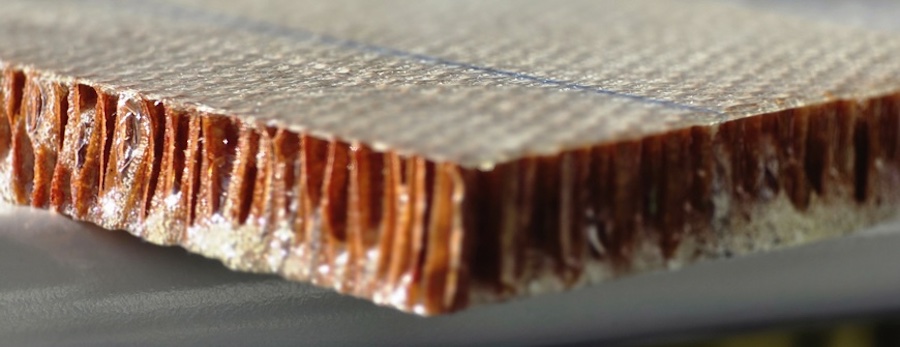
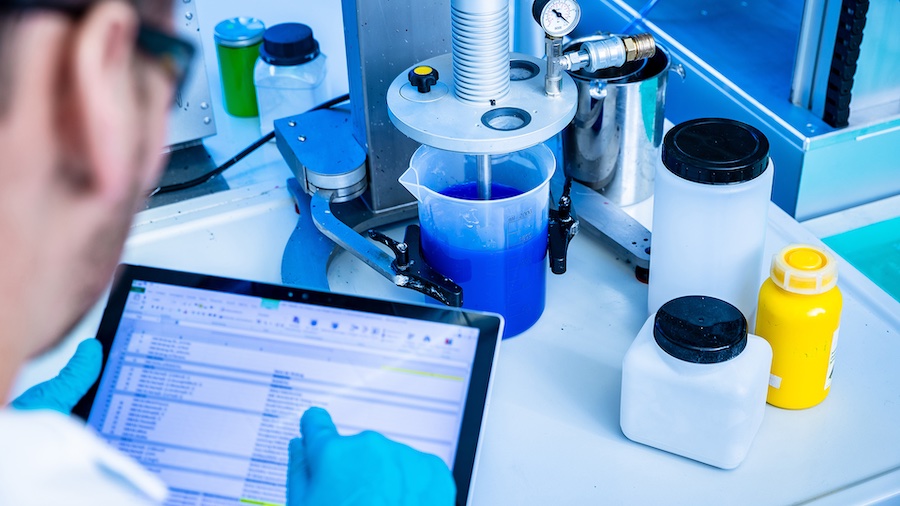
The composite made of epoxy and glass fibers not only protects against flames but can also be fully recycled. Image: Empa
Airplanes and passenger trains must meet strict safety requirements, including fire safety standards. This calls for materials that are flame-retardant, lightweight, robust, and scalable. Empa researchers, in collaboration with their industry partner Elantas, have now succeeded for the first time in making such a material – a composite – fully recyclable.


“No flying machine will ever fly from New York to Paris,” aviation pioneer Orville Wright once said. What even the visionary Wright brothers considered impossible is now a reality – thanks in part to new materials that make modern aircraft and engines possible in the first place. In the more than 100 years since the Wrights’ first flight attempts, aviation has not only become more powerful but, fortunately, also significantly safer. The materials used in aircraft construction must meet the strictest safety requirements, including fire safety standards. At the same time, they must be lightweight and mechanically robust – and, increasingly, recyclable as well.

“Bringing all these properties together under one roof is a challenge,” explains Empa researcher Sabyasachi Gaan from the Advanced Fibers laboratory. “For example, when you make a material flame-retardant, you always end up altering its other properties as well.” Gaan and his team, together with their industry partner Elantas – part of the German specialty chemicals group ALTANA – took on this challenge in a project supported by Innosuisse. Their focus was on a specific composite material used in the interior construction of airplanes and trains, such as for the floor of the passenger cabin.

Making epoxy more sustainable

The material is a multilayered “sandwich.” At the center is a honeycomb structure made of aramid, a heat-resistant polymer. This stable, lightweight core is covered on top and bottom with several flat-woven layers of glass or carbon fibers. Epoxy resin serves as the binder, as it does in many composite materials. Normally, this polymer cannot be recycled either chemically or thermally – in other words, it can neither be melted nor dissolved. “Composites containing epoxy currently end up in landfills or are incinerated,” says Gaan.

This is exactly where the Empa researchers have an ace up their sleeves. They have developed an additive for epoxy resin that makes the material flame-retardant – and recyclable at the same time. If epoxy is mixed with this phosphorus-containing molecule during production, it can be softened and reshaped under certain conditions after curing – a process known as thermomechanical recycling, which was previously impossible for epoxy.

All components recovered

In the Innosuisse project, the partners pursued a different goal: the complete recycling of the composite material. With the right solvent and a little heat, the “sandwich” can be broken down again into its individual components: the honeycomb structure and the woven fibers. Aramid honeycombs in particular – but also carbon fibers – are relatively expensive. Recycling them is therefore also economically attractive. “In principle, it’s also possible to recover the epoxy resin itself from the solution. We plan to tackle that in future projects,” says Gaan.

The recyclable epoxy resin was developed at Empa. Together with Elantas, the researchers have now explored its potential for industrial application for the first time. “Our material complies with fire safety regulations and achieves nearly the same advantageous mechanical properties as conventional epoxy,” says Gaan. “But for the first time, it allows for complete recycling of the composite material.”

The partners are satisfied with how the project is progressing. The next step is to further scale up production and recycling. “For the aerospace industry, it is crucial to combine fire protection, lightweight construction, and recyclability. This epoxy composite system demonstrates that this is now possible for the first time,” says Fiorenzo Lenzi, Head of the Aerospace/Ballistic Product Line at Elantas.

At the same time, Sabyasachi Gaan and his team are already researching additional applications for the recyclable, flame-retardant plastic, such as in the energy sector and the construction industry. The scientist emphasizes that the fact a material has come this far is also thanks to basic research. “Before we can work on the applications, we need to have a very good understanding of the material’s properties.” The Wright brothers would likely agree with him. For, as Wilbur Wright wrote in a 1900 letter to the engineer Octave Chanute, “It is possible to fly without motors, but not without knowledge and skill.”


More News from EMPA

More News on Research & Development

#Research & Development

180 years of TESTEX: From Zurich silk testing to global certification

For 180 years, TESTEX has developed alongside the textile industry while maintaining the same underlying purpose: creating trust through independent and reliable measurement. Founded in Zurich in 1846 as the Zurich Silk Conditioning Institute, TESTEX has grown from a local institution serving the silk trade into an international Swiss testing and certification institute for textiles and leather.

#Recycling / Circular Economy

Moving Advanced Recycling from Innovation to Implementation

The Advanced Recycling Conference 2026 explores technologies, markets, financing and scale-up of innovative recycling solutions for waste streams including mixed plastic waste, textiles and PVC. Europe’s chemical and materials sector faces growing pressure to close carbon loops, strengthen raw-material safety and resilience and meet increasingly ambitious EU recycling targets. Against this backdrop, the Advanced Recycling Conference (ARC) will bring together industry leaders, technology providers, researchers, innovators and policy-makers on 17–18 November 2026 in Cologne, Germany.

#Research & Development

Reducing development times for technical textiles by accelerated thermo-oxidative aging in a high-pressure autoclave

Synthetic polymers used in technical textiles can be effectively protected against degradation caused by heat, oxygen, and water through the use of stabilizer systems. This enables service lives of several decades, extending to more than 50 years. As the use of durable technical textiles continues to grow, so does the demand for reliable methods to predict their service life within economically feasible testing periods. For the first time the German Institutes of Textile and Fiber Research Denkendorf (DITF) developed methods for robust service life prediction for textiles in an IGF research project.

#Research & Development

ITA has developed a washable digital smart jacket with real-time feedback and an AI-powered app for rehabilitation

As part of the PhysioTaix research project, the Institut für Textiltechnik (ITA) of RWTH Aachen University is developing a digital smart jacket with integrated sensors. The jacket is washable and reusable; it tracks movements during rehabilitation exercises in real time and transmits the data to an app.

Latest News

#Heimtextil 2027

Therapeutic patterns and mythology as design inspiration: New Talent Area curated by Trendease at Heimtextil grows

Even more young design talent and creative ideas: at the upcoming Heimtextil, the New Talent Area returns for its second edition with stronger presence. From 12 to 15 January 2027, the curated area welcomes more than 30 participants, many of whom are presenting on the international stage for the first time. In Frankfurt, they showcase exciting textile designs, surprising materials and market-ready products.

#Associations

ITMF names five winners of the Start-up Award 2026

Five start-ups from Switzerland, Brazil, the United States and China have been selected as winners of the ITMF Start-up Award 2026. Their concepts range from new polymer chemistry and natural-fiber biocomposites to zero-waste design, 3D weaving and enzymatic PET recycling.

#Associations

HeiQ & Archroma and Lenzing & Armedangels win ITMF International Collaboration Awards 2026

The International Textile Manufacturers Federation (ITMF) has named two industry partnerships as winners of the ITMF International Collaboration Awards 2026. The awards go to collaborations between HeiQ and Archroma as well as Lenzing and Armedangels, highlighting joint approaches to innovation and sustainability across different parts of the textile value chain.

#Associations

German textile industry and retailers form alliance to shape textile EPR system

Germany’s textile and fashion industry and retail sector have joined forces to establish the “Alliance for Textile Circularity” (Allianz für textile Kreisläufe). Initiated by the German Textile and Fashion Industry Association (Gesamtverband textil+mode) and the German Retail Federation (HDE), the alliance aims to contribute industry expertise to the development of Germany’s future Extended Producer Responsibility (EPR) system for textiles and footwear.

TOP