[pageLogInLogOut]

#Recycling / Circular Economy

HKRITA signs MoU with Jeanologia and Looptworks to establish the Green Machine Circular Textile Ecosystem
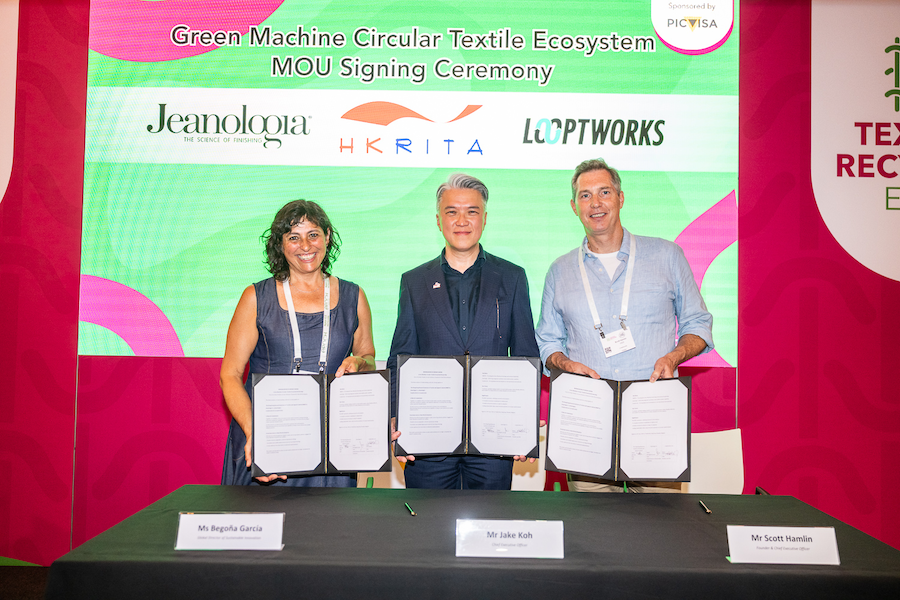
Mr Jake Koh, CEO of HKRITA (middle), Ms Begoña García, Jeanologia Global Director of Sustainable Innovation, (left) and Mr Scott Hamlin, Founder and CEO of Looptworks, (right) have signed the MoU for this landmark tripartite initiative, advancing a complete and actionable circular textile ecosystem © 2026 Jeanologia
The Hong Kong Research Institute of Textiles and Apparel (HKRITA) yesterday officially signed a landmark Memorandum of Understanding (MoU) with two key global partners, Jeanologia and Looptworks, to establish the Green Machine Circular Textile Ecosystem – a first-of-its-kind collaboration to accelerate the large-scale recycling of blended textiles.

Bringing together cutting-edge innovation, industrial machinery expertise, and real-world adoption, this tripartite initiative unites HKRITA with Jeanologia as the first official machinery partner and Looptworks as a prospective adopter. The partnership signals a decisive shift from research-driven innovation to practical, scalable deployment with industry support, creating a complete and actionable pathway for circular transformation.

At the centre of this ecosystem is HKRITA’s latest Green Machine 4.0, the newest iteration of its pioneering hydrothermal recycling technology. This advanced version recovers polyester at 98% or higher purity from cotton-polyester textiles without harmful processes. Through this collaboration, Jeanologia contributes by delivering industry-ready machinery engineered to European standards that meets the CE high-pressure requirement, enabling seamless integration and streamlined logistics. Meanwhile, Looptworks, a Certified B-Corp recycling specialist, transforms diverse pre- and post-consumer textiles into high-quality GRS-certified fibres. This cross-industry collaboration supports expandable industrial implementation across diverse settings, enabling the industry to execute circular solutions at scale.

By integrating scientific innovation, engineering excellence, and operational deployment, the Green Machine ecosystem provides a viable pathway for circular transformation. This initiative empowers textile recyclers to process previously unrecyclable materials and unlock new revenue streams, while enabling fashion brands to incorporate recycled fibres into their supply chains in commercial volumes. It also supports manufacturers in adopting more sustainable production models, helping all stakeholders close the loop on textile waste and reduce dependence on virgin resources.

Mr Jake Koh, Chief Executive Officer of HKRITA, said, “The circular economy is no longer a distant goal—it is here. With the Green Machine 4.0 now proven adoption-ready and scalable, this partnership marks a decisive shift from research to commercialisation. True innovation is defined by real-world impact, and today we are making it a reality."

Mr Enrique Silla, CEO and Founder of Jeanologia, said, “For the last 25 years, we have transformed the denim industry through technology, innovation and collaboration. Today, we are bringing that same experience to one of the industry's greatest challenges: textile-to-textile recycling. At Jeanologia, we believe recycling must become part of the industry's pre-competitive space, where companies work together to create solutions that no single organisation can achieve alone. By combining HKRITA's innovation, Jeanologia's industrial engineering and textile bleaching expertise, and Looptworks' operational deployment, we are creating a model that can help make circularity a reality at industrial scale.”

Mr Scott Hamlin, Founder and CEO of Looptworks, said, “Looptworks has had a relationship with HKRITA for over a decade. We are proud to have worked together with the research and management teams at HKRITA to further develop textile circularity innovations at scale. The Green Machine represents a shining example of what is possible for textile recycling. Blended materials have long been a major barrier to circularity, and this technology enables us to effectively realise their value at scale. By reintroducing recovered fibres into the supply chain, we are proving that circular solutions are both environmentally practical and economically viable.”

Aiming to ensure ecologically sound circularity in the industry, HKRITA invites textile recyclers, fashion brands, and manufacturing partners to join the ecosystem and explore opportunities for collaboration, adoption, and expansion.



More News from JEANOLOGIA S.L.

#Denim

Jeanologia brings “Billy” to China, the AI transforming denim design

The denim industry is turning its attention to Hangzhou this week, where a new edition of Kingpins, the leading international trade show for the sector, takes place on May 21 and 22. There, the Spanish company Jeanologia, a global leader in sustainable technologies for the textile industry, is introducing its latest innovation to the Chinese market: “Billy”, the first artificial intelligence specifically developed for denim finishing design.

#Denim

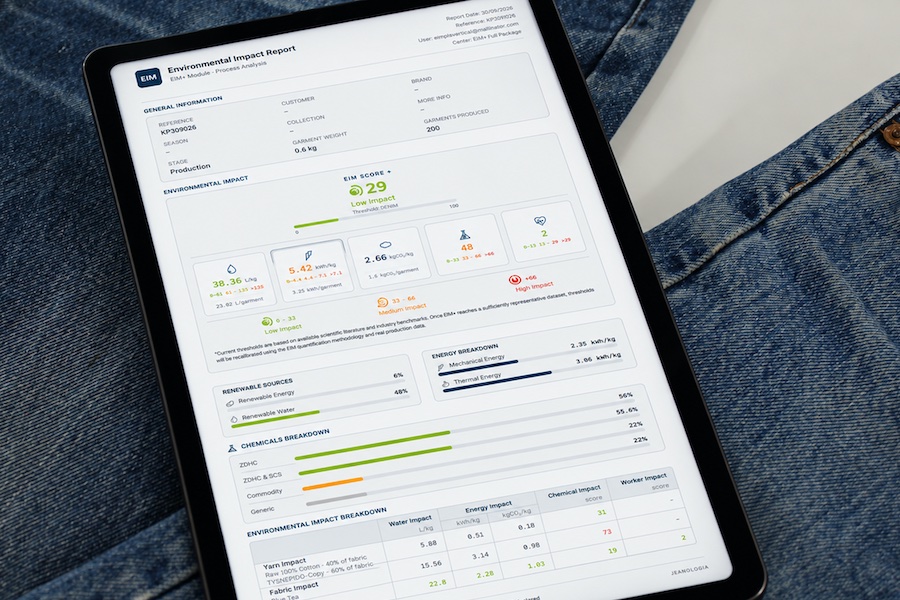
Denim moves towards sustainability

EIM (Environmental Impact Measurement), the global reference platform for measuring the environmental impact of garment finishing, presents the second edition of its annual report Denim Industry Progress & Insights 2025. The study analyses over 100,000 real denim finishing processes, providing an accurate and up-to-date view of the industry’s evolution towards more sustainable models.

#Textile processing

Jeanologia showcases the future of product development

Jeanologia is showcasing how software is transforming product development in the fashion industry at PI Apparel Europe: The Fashion Technology Show, taking place on March 30–31 in London.

#Denim

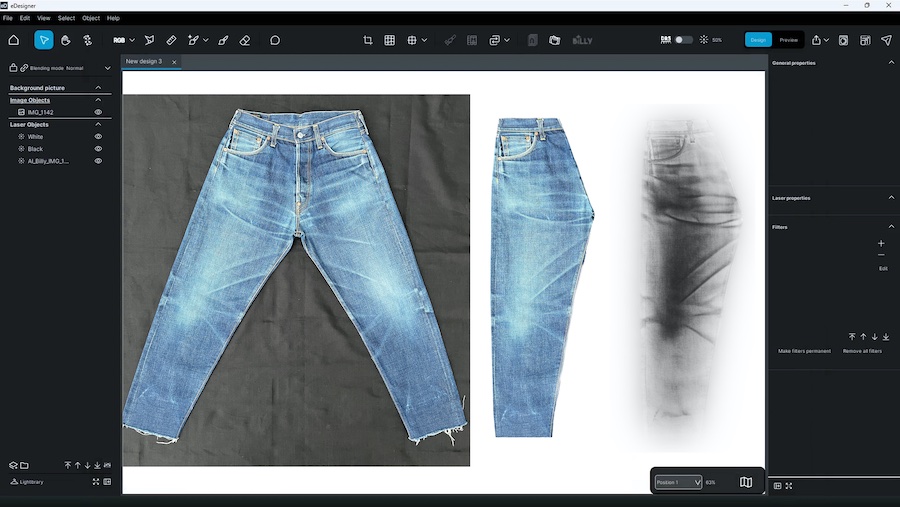
Jeanologia launches Billy

The new AI extracts precise laser designs from a garment image in minutes, transforming how vintage denim is recreated for production. If Jeanologia’s laser changed the way jeans were made at the end of the last century, its AI now takes the next step: moving from reproducing wear to designing it. / archive photo © 2026 Jeanologia

More News on Recycling / Circular Economy

#Research & Development

ALADIN paves the way for circular and demand-driven textile production in Europe

Textile production can be organized sustainably by utilizing short supply chains and preventing overproduction. This can already be achieved today by intelligently connecting and efficiently utilizing existing infrastructure. At the same time, production becomes circular when innovative technologies and materials are used that enable high-quality recycling. The ALADIN research project, launched in May 2026 and co-funded with five million euros under the EU Horizon Europe program, is creating the conditions for this.

#Recycling / Circular Economy

Ence and ShareTex begin initial testing of the ATENEA innovation project to promote textile recycling in Spain

Ence and ShareTex are making progress on the Atenea R&D project, which aims to develop a complete value chain for textile recycling in Spain. Specifically, the goal of the ATENEA project—which is funded by the Center for Technological Development and Innovation (CDTI)—is to connect all the necessary stages for the recovery of textile waste, from collection and management, through recycling and transformation into new raw materials, to their incorporation into new textile products.

#Recycling / Circular Economy

DePoly Inaugurates its Showcase Plant in Monthey Switzerland

What if used plastic bottles, PET packaging material and polyester textiles could become raw materials just as high performing as virgin resources? That is the ambition of DePoly, a circular materials company based in Sion, Switzerland which inaugurated its Showcase Plant in Monthey on July 6th & 7th. The first depolymerization facility of its kind and scale in Switzerland, this industrial Showcase Plant represents a major milestone in the company's growth and its journey toward commercialization.

#Recycling / Circular Economy

Commission clarifies rules on plastic bottles recycling

The European Commission today adopted new rules on recycling of single-use plastic beverage bottles made primarily of polyethylene terephthalate (PET bottles). These rules establish, for the first time, a methodology to calculate, verify and report chemically recycled content. This is part of the Commission’s December 2025 plastics package.

Latest News

#Nonwovens

Katharina Obergruber appointed to the Management Board of Sandler AG

The Supervisory Board of Sandler AG has appointed Katharina Obergruber to the company’s Management Board. Effective September 1, 2026, the Board will consist of Philipp Ebbinghaus (CEO), Dr. Ulrich Hornfeck (currently CCO, future COO), and Katharina Obergruber (CCO). Katharina Obergruber, currently Chief Sales Officer Hygiene and member of the Management Team of Sandler AG, will assume responsibility for all sales activities as Chief Commercial Officer. She will assume this role from Dr. Ulrich Hornfeck, who will focus primarily on production and supply chain topics.

#Sustainability

Global Standards establishes new non-profit foundation to strengthen governance

Global Standards gGmbH, the nonprofit organisation behind the globally recognised Global Organic Textile Standard (GOTS), announced a new governance structure designed to support its long-term mission and reinforce organisational autonomy of its Voluntary Sustainability Standards and programmes.

#Textile chemistry

DyStar releases FY2025 sustainability report, marking a new milestone towards its 2030 targets

DyStar, a leading specialty chemicals company with more than a century of expertise in product development and innovation, today announced the release of its FY2025 Sustainability Report, marking a significant milestone in its sustainability journey and reinforcing its commitment to long-term value creation.

#Research & Development

TERIS reaches milestone: Fraunhofer consortium develops new standards for tire analysis

In the “TERIS” project, the Fraunhofer institutes ICT, IGD, and IWM—led by the Fraunhofer Institute for Structural Durability and System Reliability LBF—have reached a decisive milestone. For the first time, the teams aim to generate, analyse, and predict tire wear in the laboratory in a standardized and practical manner. As part of this milestone, results are now available on reference abrasion, particle analysis, tribological models, AI-based surface analysis, a test bench concept, and methods for accelerated aging and VOC detection. The tire industry, testing services, and environmental agencies will in future benefit from reliable, rapid laboratory procedures for emissions assessment.

TOP