[pageLogInLogOut]

#Research & Development

ITA PhD student Kai-Chieh Kuo was awarded Best Master’s Thesis Award of Walter Reiners-Stiftung (Foundation)

Kai-Chieh Kuo, PhD student at the Institut für Textiltechnik (ITA) of RWTH Aachen University, was awarded the German Textile Mechanical Engineering 2021 Best Master's Thesis Award for his master's thesis entitled "Modification of the tube weaving process of fine yarns for the production of woven ultra-low profile stent grafts". The prize is endowed with 3,500€. Peter D. Dornier, Chairman of the Board of the Walter Reiners-Stiftung (Foundation), virtually presented the award on the occasion of the ADD International Textile Conference on 9 November 2021.

Significant advance in aortic prostheses through high-density, thin-walled tubular woven fabric

Minimally invasive endovascular aortic repair (EVAR) with textile stent-graft systems is nowadays a clinically established therapy procedure for the treatment of abdominal aortic aneurysms (AAA) – pathological bulges of the aorta. Due to the thick profile of the folded stent graft systems, there is currently a high risk of injuring narrowed or highly angulated access vessels from the inside during implantation. Stent graft systems with smaller profiles could provide an improvement, which could overcome complicated access routes through a lower bending stiffness. One possible approach for reducing the system profiles is the use of thin-walled tubular woven fabrics made of ultrafine multifilament yarns (?20 dtex) as graft material.
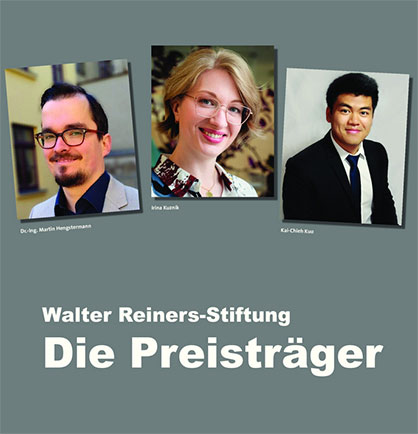
Caption: The 2021 winners (from top left to right): Dr Martin Hengstermann, Irina Kuznik, Kai-Chieh Kuo. - Image source: VDMA


Up to now, it has not been possible to process the fine yarns with the required high thread density (>200 threads/cm) and the available weaving technology in order to guarantee sufficient tightness against blood.

In his master's thesis, Kai-Chieh Kuo made high-density tubular weaving of ultra-fine filament yarns possible for the first time by means of suitable modifications to a shuttle loom as well as adaptations in the weaving preparation. In particular, he developed a new innovative reed technology that reduces warp thread friction during the shedding process and thus improves the process stability of the dense tube weaving process of fine yarns.


With the help of the process modification, it was then possible to produce high-density, thin-walled tubular woven fabrics, which were positively evaluated with regard to their suitability for a stent graft. Above all the potential of these tubular fabrics lies in their extremely thin-walled fabric profile, which seals well against blood. By using these new types of tubular fabrics as graft material for stent grafts, the system profile of the folded stent graft system can be reduced without having to compromise the blood tightness of the implant. The technology developed by Mr Kuo is not only applicable to stent graft systems, but also offers great possibilities for use in all other endovascular implants such as trans catheter heart valves, covered stents and small-lumen vascular prostheses.

Through its Walter Reiners-Stiftung (Foundation), the VDMA Textile Machinery Association is actively involved in promoting young engineers. Every year, the Foundation awards prizes for the best dissertation, diploma or master's thesis and the creativity prize for the cleverest student research project. In 2020 and 2018, ITA graduates have already been awarded promotional prizes from each category.


More News from Institut für Textiltechnik of RWTH Aachen University (ITA)

#Research & Development

Award-winning research for sustainable carbon fibre cycles

Sustainable recycling of carbon fibres is possible through targeted electrochemical surface modification, which makes the sizing of carbon fibres resistant to solvolysis. ITA PhD student Sabina Dann was awarded the MSW Award from RWTH Aachen University for her master's thesis on this development. The award ceremony took place on 12 November 2025 in Aachen.

#Research & Development

Kick-off for the Textile Production of the Future: Establishment of a Textile Technology and Development Centre in Mönchengladbach, Germany

The Institut für Textiltechnik (ITA) of RWTH Aachen University, together with its partners, is pleased to announce that it has received approval for its joint initiative, ‘Textile Factory 7.0’. The goal of the project is the establishment of a technology and development centre for the textile industry in Mönchengladbach.

#Research & Development

Exchange data between textile companies openly, securely and cost-effectively without a central platform – ITA makes it possible

The Institut für Textiltechnik (ITA) of RWTH Aachen University has launched a new demonstrator for an open and secure data space in the textile industry at the Digital Innovation Centre Europe (DICE). For the first time, the demonstrator shows directly and clearly how companies can share their data securely with each other without the need for a central platform. Data exchange is based on shared, freely usable technical foundations.

#Research & Development

Sustainable athletic wear made from bio-based Polyethylene

Conventional sports textiles made from petroleum-based synthetic fibres are to be replaced in the future by sustainable, bio-based, cooling textiles. Polyethylene, previously used mainly in the packaging industry, is thus qualified for use in textiles and, as a bio-based drop-in solution, offers a cost-effective, sustainable alternative for the future.

More News on Research & Development

#Research & Development

Bio-based fibers with good flame retardancy

Fibers made from bio-based plastics reduce dependence on fossil raw materials and promote the circular economy. The covalent bonding of flame-retardant additives can open the way for these fibers to enter the mass market.

#Research & Development

Innovation center for textile circular economy inaugurated

Just over eight months after the foundation stone was laid, the new Innovation Center for Textile Circular Economy was officially inaugurated today at TITK Rudolstadt. Thuringia's Minister President Mario Voigt, TITK Director Benjamin Redlingshöfer, and other guests of honor cut the ribbon to the modern building complex and viewed the premises, which are now ready for occupancy. The “DICE – Demonstration and Innovation Center for Textile Circular Economy” is TITK's largest single investment to date. The Free State of Thuringia supported the total cost of €11.5 million with €8 million in GRW and FTI funding.

#Research & Development

Sustainable design of Geosynthetics and roof underlayments made from recyclates

Is it possible to recover plastic recyclates from previously unused waste streams in order to produce high-quality fibers and films? How can bio-based polymer fibers be manufactured so as to allow adjustable biodegradability? These are the questions being addressed by researchers from the Fraunhofer Cluster of Excellence Circular Plastics Economy CCPE in the Zirk-Tex project.

#Research & Development

India, ITA and innovation – enhanced cooperation in research, implementation and bilateral projects such as hydrogen mobility

The Indian Consul General, Dr Shuchita Kishore, visited the Institut für Textiltechnik (ITA) of RWTH Aachen University on 15 December to inspect the joint project between the ITA, the Indian Institute of Technology (IIT) Bombay and industrial partners from India and Germany and to tour the ITA.

Latest News

#Technical Textiles

Carrington Textiles and Pincroft unite defence expertise at Enforce Tac

Carrington Textiles and Pincroft return to Enforce Tac for the third time, presenting a co-branded stand that brings together textile manufacturing and specialist finishing under one roof.

#Yarns

Eastman introduces Naia™ Lyte at Première Vision Paris, marking a major breakthrough in fiber tenacity for cellulose acetate filament yarn performance

Eastman unveils Naia™ Lyte, a new cellulose acetate filament yarn that represents an important milestone in performance for lightweight and premium fabrics, at Première Vision Paris. Presented for the first time to the international fashion and textile community, Naia™ Lyte expands the capabilities of acetate yarn by introducing enhanced tenacity, unlocking new creative and technical possibilities for designers, mills and brands.

#Functional Fabrics

“Action helps us change what we do!”

DAY 0 takes place deliberately before PERFORMANCE DAYS begins. It is conceived as a space for reflection, dialogue and active engagement — a moment to pause before the fair, rethink established systems and address sustainability not as a trend, but as a fundamental transformation challenge. Under the guiding metaphor “Turn the Tap Off”, DAY 0 focuses on root causes rather than symptoms, systemic change rather than isolated solutions, and collective responsibility rather than individual silos.

#Textiles & Apparel / Garment

Pets in fashion: functional and sustainable textiles find new market at Intertextile Apparel

China’s pet economy is booming, especially amongst younger generations, and pet apparel – from designer outfits to functional garments – was a RMB 3.5 billion (over USD 500 million) market in 2024, growing more than 20% annually¹. To help exhibitors harness this trend, Intertextile Shanghai Apparel Fabrics – Spring Edition 2026 will launch the Pet Boutique, presenting a range of innovative, sustainable materials that prioritise both functionality and comfort for pets.

TOP