[pageLogInLogOut]

#Research & Development

Vacuum insulation panels rethought - Adjustable, tailored to needs, flexible

Adaptable insulation elements can ensure that the heat transfer through the building envelope can be adjusted as required. This saves heating or cooling energy and therefore costs. Intelligent systems can regulate heat transfer according to the outside temperature and the need for heating or cooling in the interior. In the ReVaD project, the German Institutes of Textile and Fiber Research Denkendorf (DITF) and their partners are developing adaptive building envelopes that can also use concrete components as structural thermal energy storage units for temperature control in buildings.

The research project is developing adaptable insulation elements based on the Knudsen effect. The Knudsen effect describes the change in the thermal conductivity of porous structures with the prevailing gas pressure in the pore space. If there is a vacuum in the pore space, the thermal conductivity is low; if the pressure increases, the thermal conductivity also increases. In order to use the principle in an adjustable insulation element, the highest possible switching factor between the two states is required. To achieve this, the pore system and gas pressure range must be optimally matched. In the adaptable insulation panel, the pore system consists of a spacer fabric that is being developed at the DITF. A key challenge here is the compressive strength of the filling core, which must only allow minimal deformation at a surface pressure of 10 N/cm2 imprinted by a fine vacuum.

The research team at the Technology Center Knitting Technique at DITF has developed the corresponding pressure-resistant structures. Their pore size will be optimized in the next steps by inserting textured yarns into the pole thread space. The basic thermal conductivity of the structure should be increased as little as possible. With the knitted structures in the panel, a switching factor, i.e. the ratio of maximum to minimum thermal conductivity achieved, of 5 has already been demonstrated. Current work involves optimizing the spacer structures and setting up a demonstrator.

In the joint project, the Institute of Technical Thermodynamics at the German Aerospace Center (DLR) in Stuttgart is developing a thermochemical reactor component that enables precise and energy-efficient gas pressure adjustment in the vacuum insulation panel. Metal hydride-hydrogen reaction systems are used, which allow the gas pressure in the insulation panel to be set through temperature control.
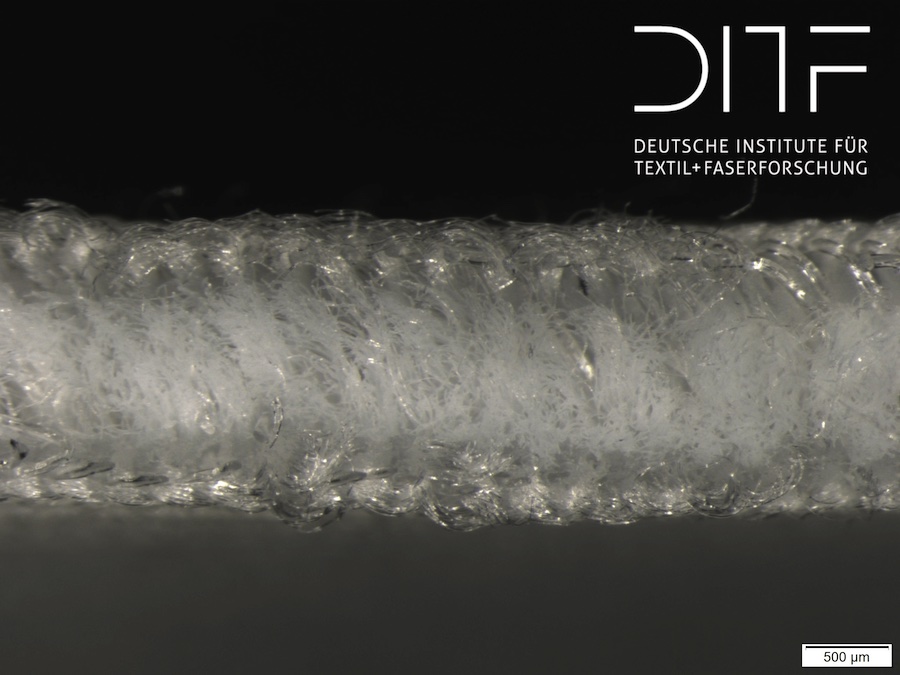
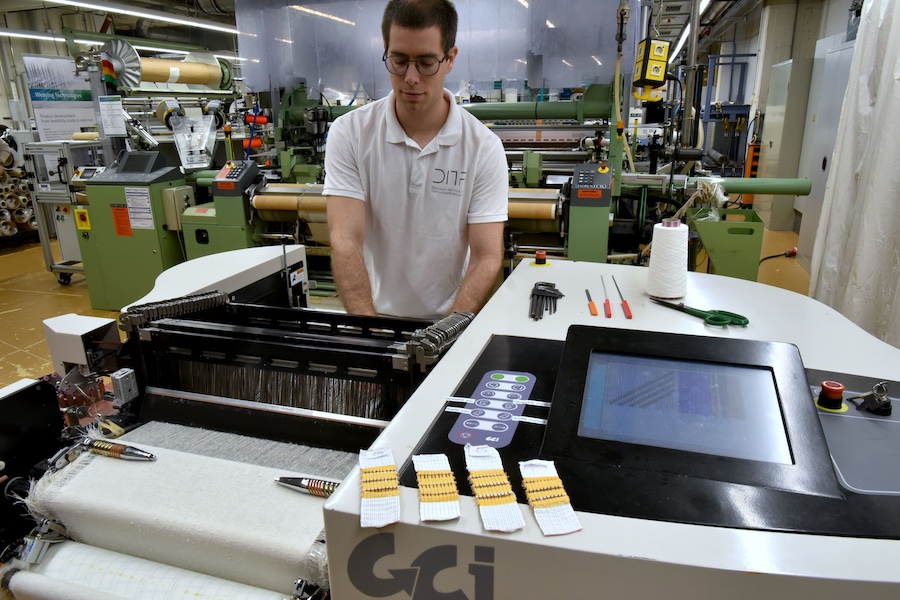
Pressure-resistant spacer fabrics are used as textile filling cores for vacuum insulation elements. In the knitting process, the pore properties can be flexibly adjusted by yarn and weave selection. Photo: DITF


The Institute for Building Energetics, Thermal Engineering and Energy Storage (IGTE) at the University of Stuttgart is investigating the integration possibilities of the panels in the wall composite using simulations and experiments. The thermal-energetic simulations make it possible to assess the energy-saving potential of the technology in different scenarios and under different boundary conditions. A demonstrator is used to test the adaptable thermal insulation in an application-oriented manner.

The ReVaD project (development of adaptable vacuum insulation elements for the needs-based adaptation of heat transfer in building envelopes and structures as well as the thermal activation of storage masses) is funded by the Federal Ministry of Economics and Energy as part of joint industrial research (IGF) (FKZ: 22617 N).
More News from Deutsche Institute für Textil- und Faserforschung Denkendorf

#Research & Development

Panty liners prevent bacterial vaginosis

Worldwide, almost one third of women of childbearing age suffer from bacterial vaginosis. This is when the sensitive microbiome of the vagina becomes unbalanced. Such a disorder of the vaginal flora can cause urogenital infections, abscesses on the ovaries or fallopian tubes or premature births. This significantly increases the risk of infertility in women and of contracting a sexually transmitted disease or HIV.

#Research & Development

DITF send a signal for climate protection

The German Institutes of Textile and Fiber Research Denkendorf (DITF) have successfully implemented extensive investments in photovoltaic systems at their site in Denkendorf. The systems installed on the roofs of the buildings and covered parking lots have a total installed capacity of 840 kilowatt peak (kWp). The DITF invested 1.6 million euros in this with the support of the state of Baden-Württemberg. The system was ceremonially put into operation on September 17, 2025.

#Research & Development

4.2 million Euros for research into textile recycling

Around the world, used textiles are still rarely recycled and pile up into huge mountains of waste. A recent study by the Boston Consulting Group (BCG) drew attention to this problem. However, the low recycling rate is also due to the fact that only a small percentage of used textiles are actually suitable for recycling into high-quality materials and for demanding applications. The German Institutes of Textile and Fiber Research Denkendorf (DITF) are addressing this problem with their research.

#Research & Development

Denkendorf fiber chart revised

A companion during studies and for practical use in the workplace: generations of textile experts have used the Denkendorf Fiber Chart to keep track of all the important characteristic values of textile raw materials. Following the first two editions in the 1970s and 1980s, Denkendorf scientists have comprehensively revised the Fiber Chart. The third edition is now available in digital form for the first time.

More News on Research & Development

#Research & Development

The region of renewable raw materials: Central German Alliance for Bioplastics

The development of sustainable plastic solutions is rapidly gaining importance in light of global environ- mental pollution, dwindling fossil resources and ambitious climate protection targets. As part of the re- gional alliance RUBIO, which brings together 18 partners from central Germany and the Berlin-Branden- burg area, the bio-based and biodegradable plastic polybutylene succinate (PBS) was comprehensively investigated, starting with the raw material, through the manufacturing process, to industrial application.

#Nonwoven machines

Cooperation in the field of meltblown laboratory technology

The Nonwoven Institute (NWI) at North Carolina State University and Oerlikon Nonwoven will be collaborating in the field of meltblown laboratory technology in the future. This was announced by Professor Raoul Farer, Executive Deputy Director of the NWI and Professor at the Wilson College of Textiles at North Carolina State University, and Dr. Ingo Mählmann, Sales Director Nonwoven at Oerlikon Neumag, during this year's ITMA Asia and CITME in Singapore.

#Recycling / Circular Economy

European research project addresses textile waste through integrated recycling technologies

A major European research initiative coordinated by Fraunhofer UMSICHT has been launched to develop integrated solutions for textile waste recycling. The AUTOLOOP project aims to create a comprehensive system that could process 1.24 million tonnes of textile waste annually by 2050, whilst potentially creating over 130,000 green jobs across the EU. This project aims to develop, test and integrate automated sorting, tracing, and closed-loop recycling technologies for polyester-based textiles (NRT), addressing the pressing challenge of textile waste management.

#Research & Development

Feasibility study shows potential to convert textile waste into PHB bioplastic

Textile waste could serve as a valuable source of raw materials for sustainable plastics in the future, according to the joint TexPHB feasibility study conducted by the Fraunhofer Institute for Applied Polymer Research IAP, Beneficial Design Institute GmbH and matterr GmbH. The study will be presented to the public for the first time at a network meeting on 25 November 2025 at the State Chancellery in Potsdam.

Latest News

#Recycling / Circular Economy

Advanced Recycling Conference 2025 fuels innovation across key waste streams

The Advanced Recycling Conference (ARC) 2025 brought together nearly 220 experts from 28 countries to spotlight pioneering advancements and foster industry collaboration in recycling across diverse waste streams including plastics, textiles, automotive and other materials.

#Dyeing, Drying, Finishing

Navis TubeTex announces U.S. partnership with Icomatex

Navis TubeTex, a global leader in advanced dyeing and finishing machinery solutions, is pleased to announce a new partnership with Icomatex (www.icomatex.com), a respected European manufacturer of high-quality stenters and textile finishing equipment. Under this agreement, Navis TubeTex will exclusively represent the Icomatex stenter line in the United States.

#Recycling / Circular Economy

ADVANSA launches ADVA®tex: A new step toward textile-to-textile recycling

ADVANSA has introduced ADVA®tex, a new filling fibre made entirely from recycled pre-consumer textile waste, positioning the material as a significant step forward in textile-to-textile (T2T) recycling. The fibre is designed for use in duvets, pillows, mattresses, and furniture applications and is available in three versions.

#Knitting & Hosiery

KARL MAYER celebrates 35 years of EL pattern drive

KARL MAYER is celebrating an anniversary this year: on 30 November 1990, the first warp knitting machine with electronic guide bar control, the KS 4 EL, was delivered – another milestone for patterning. As early as 1980, the SU gearbox with the MRS42SU had initiated the transition from mechanical chains to digital data.

TOP