[pageLogInLogOut]

#Research & Development

ITA researchers win two JEC Innovation Awards for sustainable textile-based composites
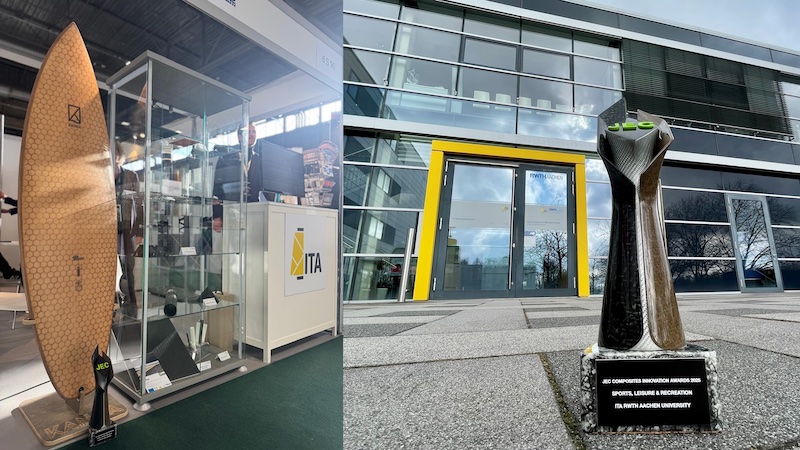
Researchers from the Institut für Textiltechnik (ITA) of RWTH Aachen University have been honored with two JEC Innovation Awards at JEC World 2025 in Paris, recognizing their groundbreaking contributions to sustainable construction and sports equipment.
JEC-Composites Innovation Awards 2025 “Sport, Leisure & Recreation” © 2025 ITA


40% CO? savings with carbon fibre stone in construction

In the "Building and Civil Engineering" category, ITA was awarded for its development of Carbon Fibre Stone (CFS), an eco-friendly material that significantly reduces CO? emissions in house wall construction.

+ Up to 40% CO? savings compared to conventional concrete

+ Innovative combination of stone and bio-based fibers

+ Each square meter of CFS binds 59 kg of CO?, whereas traditional cement walls release 98 kg of CO?

This innovation offers a sustainable alternative to CO?-intensive concrete, supporting the construction industry's transition toward low-carbon materials.

Bio-based recyclable 3d laminate for sustainable surfboards

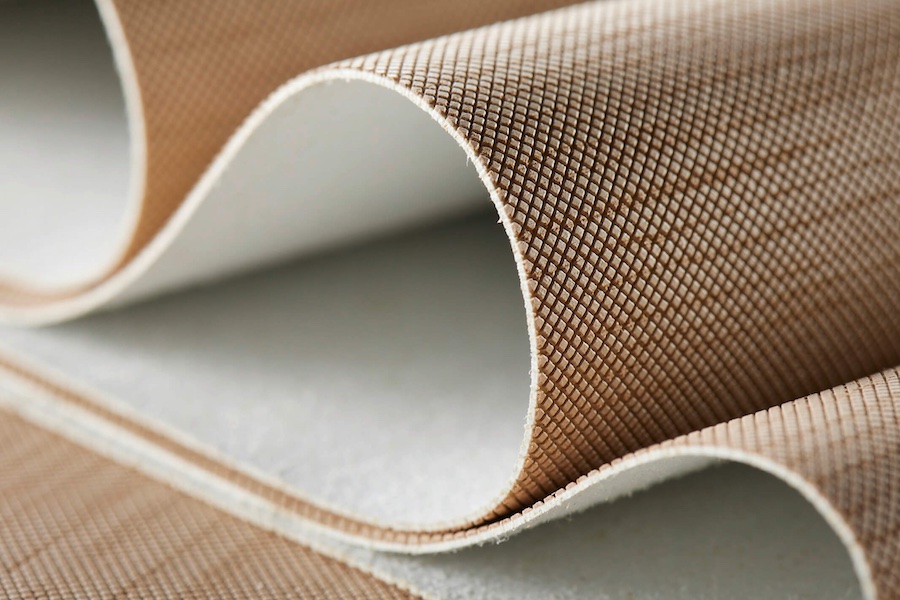
ITA also secured an award in the “Sports, Leisure & Recreation” category for its Honey Roots technology, a revolutionary bio-based and recyclable 3D laminate used in surfboard manufacturing.

+ Enhances mechanical performance while eliminating the need for consumables in the infusion process

+ Made from bio-based or recycled materials, reducing environmental impact

+ Lightweight and durable, offering improved surfboard longevity and performance

This innovation was developed in collaboration with Techno Carbon Technologies GbR and Kanoa Surfboards, combining advanced textile engineering with sustainability-driven design.

Recognition for ita’s commitment to sustainable innovation

PhD student and project leader Lars Wollert emphasized the significance of these awards, stating:

"These awards are a recognition of our research activities and show what the ITA stands for the development of innovative products and processes together with a great network of industrial partners, openness for versatile application areas in which fibres of all kinds bring advantages and research in the context of sustainability."

With these achievements, ITA continues to push the boundaries of textile-based composite materials, contributing to sustainable advancements in both the construction and sporting goods industries.
More News from Institut für Textiltechnik of RWTH Aachen University (ITA)

#Research & Development

IRG Polymer Recycling wraps up productive 2025 project cycle

The Industry Research Group (IRG) Polymer Recycling has completed another successful project year. Last week, partners from across the textile value chain met at the Institute for Textile Technology (ITA) at RWTH Aachen University for the full-term project meeting.

#Research & Development

Aachen Summer School: Strengthening German-Korean cooperation in 4D and robotics

The Aachen Summer School has established itself as an important platform for promoting cooperation between RWTH Aachen University and Seoul National University. The focus is on practice-oriented research projects in the field of 4D and robotics technologies, which have been successfully implemented for years at the Institut für Textiltechnik of RWTH Aachen University.

#Research & Development

ITA postdoc Dr Leonie Beek is revolutionising oil filtration with a bionic textile

On various biological surfaces, oil is adsorbed from water surfaces and transported along the leaf. In her dissertation, ITA Postdoc Dr Leonie Beek transferred this effect to a technical textile using her Bionic Oil Absorber (BOA), which can remove up to 4 litres of diesel per hour from water at technological readiness level 4. For this development, Dr Beek was awarded the Paul Schlack Prize 2025 for her dissertation ‘Bionic textiles for oil-water separation modelled on superhydrophobic biological surfaces’ on 10 September 2025. The award ceremony took place during the opening event of the Dornbirn GFC Global Fiber Congress in Austria.

#Research & Development

Cooperation between Germany and India (Tamil Nadu) in the field of AI-supported manufacturing, robotics and smart textiles

The Tamil Nadu Industrial Development Corporation (TIDCO) and the Institut für Textiltechnik (ITA) of RWTH Aachen University are planning to cooperate in the future in the field of AI-supported manufacturing, robotics and smart textiles. At the same time, the aim is to promote talent exchange and a sustainable Indian-German partnership.

More News on Research & Development

#Research & Development

The region of renewable raw materials: Central German Alliance for Bioplastics

The development of sustainable plastic solutions is rapidly gaining importance in light of global environ- mental pollution, dwindling fossil resources and ambitious climate protection targets. As part of the re- gional alliance RUBIO, which brings together 18 partners from central Germany and the Berlin-Branden- burg area, the bio-based and biodegradable plastic polybutylene succinate (PBS) was comprehensively investigated, starting with the raw material, through the manufacturing process, to industrial application.

#Nonwoven machines

Cooperation in the field of meltblown laboratory technology

The Nonwoven Institute (NWI) at North Carolina State University and Oerlikon Nonwoven will be collaborating in the field of meltblown laboratory technology in the future. This was announced by Professor Raoul Farer, Executive Deputy Director of the NWI and Professor at the Wilson College of Textiles at North Carolina State University, and Dr. Ingo Mählmann, Sales Director Nonwoven at Oerlikon Neumag, during this year's ITMA Asia and CITME in Singapore.

#Recycling / Circular Economy

European research project addresses textile waste through integrated recycling technologies

A major European research initiative coordinated by Fraunhofer UMSICHT has been launched to develop integrated solutions for textile waste recycling. The AUTOLOOP project aims to create a comprehensive system that could process 1.24 million tonnes of textile waste annually by 2050, whilst potentially creating over 130,000 green jobs across the EU. This project aims to develop, test and integrate automated sorting, tracing, and closed-loop recycling technologies for polyester-based textiles (NRT), addressing the pressing challenge of textile waste management.

#Research & Development

Feasibility study shows potential to convert textile waste into PHB bioplastic

Textile waste could serve as a valuable source of raw materials for sustainable plastics in the future, according to the joint TexPHB feasibility study conducted by the Fraunhofer Institute for Applied Polymer Research IAP, Beneficial Design Institute GmbH and matterr GmbH. The study will be presented to the public for the first time at a network meeting on 25 November 2025 at the State Chancellery in Potsdam.

Latest News

#Recycling / Circular Economy

Advanced Recycling Conference 2025 fuels innovation across key waste streams

The Advanced Recycling Conference (ARC) 2025 brought together nearly 220 experts from 28 countries to spotlight pioneering advancements and foster industry collaboration in recycling across diverse waste streams including plastics, textiles, automotive and other materials.

#Dyeing, Drying, Finishing

Navis TubeTex announces U.S. partnership with Icomatex

Navis TubeTex, a global leader in advanced dyeing and finishing machinery solutions, is pleased to announce a new partnership with Icomatex (www.icomatex.com), a respected European manufacturer of high-quality stenters and textile finishing equipment. Under this agreement, Navis TubeTex will exclusively represent the Icomatex stenter line in the United States.

#Recycling / Circular Economy

ADVANSA launches ADVA®tex: A new step toward textile-to-textile recycling

ADVANSA has introduced ADVA®tex, a new filling fibre made entirely from recycled pre-consumer textile waste, positioning the material as a significant step forward in textile-to-textile (T2T) recycling. The fibre is designed for use in duvets, pillows, mattresses, and furniture applications and is available in three versions.

#Knitting & Hosiery

KARL MAYER celebrates 35 years of EL pattern drive

KARL MAYER is celebrating an anniversary this year: on 30 November 1990, the first warp knitting machine with electronic guide bar control, the KS 4 EL, was delivered – another milestone for patterning. As early as 1980, the SU gearbox with the MRS42SU had initiated the transition from mechanical chains to digital data.

TOP