#Europe
Spring 2024 Economic Forecast: A gradual expansion amid high geopolitical risks
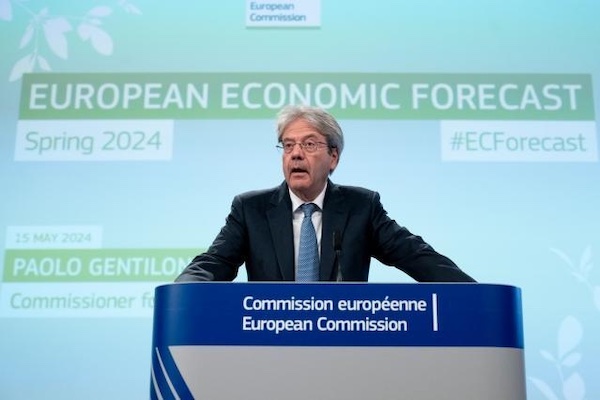
The European Commission's Spring Forecast projects GDP growth in 2024 at 1.0% in the EU and 0.8% in the euro area. In 2025, GDP is forecast to accelerate to 1.6% in the EU and to 1.4% in the euro area. EU HICP inflation is expected to fall from 6.4% in 2023 to 2.7% in 2024 and 2.2% in 2025. In the euro area, it is projected to decelerate from 5.4% in 2023 to 2.5% in 2024 and to 2.1% in 2025.
Return to growth on the back of accelerating private consumption
According to Eurostat's preliminary flash estimate, GDP edged up by 0.3% in both the EU and the euro area in the first quarter of 2024. This expansion, which was broad-based across Member States, marks the end of the prolonged period of economic stagnation that started in the final quarter of 2022.
Growth of economic activity this year and next is expected to be largely driven by a steady expansion of private consumption, as continued real wage and employment growth sustain an increase in real disposable incomes. A strong propensity to save is, however, still partially holding back private consumption.
In contrast, investment growth appears to be softening. Dragged down by the negative cycle of residential construction, it is expected to pick up only gradually. While credit conditions are set to improve over the forecast horizon, markets now expect a slightly more gradual path of interest rate cuts compared to winter.
Amid a resilient global economy, a rebound in trade is set to support EU exports. However, as domestic demand resumes in the EU, an acceleration in imports will largely offset the positive contribution of exports to growth.
Inflation to continue declining
HICP inflation has continued declining sharply from the 10.6% (year-on-year) peak recorded in October 2022 in the euro area. In April this year, it is estimated to have reached a two-year low of 2.4%.
Starting from a lower-than-expected turnout in the first months of this year, inflation is forecast to continue declining and reach target slightly earlier in 2025 than projected in the Winter interim Forecast. Disinflation is set to be mainly driven by non-energy goods and food, while energy inflation edges up and services inflation declines only gradually, alongside moderation in wage pressures. Inflation in the EU as a whole is expected to follow a similar path, though remaining slightly higher.
Labour market remains strong despite modest growth
Despite the slowdown in activity, the EU economy created more than two million jobs in 2023, with activity and employment rates of people aged 20-64 hitting new record highs of 80.1% and 75.5% respectively in the last quarter of the year. Many labour markets across the EU remain tight. In March, the unemployment rate in the EU stood at its record low of 6.0%. This robust labour market performance owes to both strong labour supply - supported, amongst other factors, by migration - and labour demand.
Employment growth in the EU is projected to ease to 0.6% this year, before moderating further to 0.4% in 2025. The unemployment rate in the EU is expected to remain broadly stable around its historical low.
In line with the expected continued disinflation, nominal wage growth in the EU has started to decelerate after peaking at 5.8% in 2023. Going forward, it is set to decelerate further.
Withdrawal of exceptional energy-support measures set to reduce government deficits
After a sizeable reduction in 2021 and 2022, the fall in the EU government deficit came to a halt in 2023 as economic activity weakened. The decline is projected to resume in 2024 (3.0%) and 2025 (2.9%) notably on the back of the phase-out of energy-support measures.
Amid higher debt servicing costs and lower nominal GDP growth, the debt-to-GDP ratio in the EU is set to stabilise this year at 82.9%, before edging up by around 0.4 pps. in 2025.
Increased uncertainty amid geopolitical tensions
Uncertainty and downside risks to the economic outlook have further increased in recent months, mainly stemming from the evolution of Russia's protracted war of aggression against Ukraine and the conflict in the Middle East. Broader geopolitical tensions also continue to pose risks. Moreover, the persistence of inflation in the US may lead to further delays in rate cuts in the US and beyond, resulting in somewhat tighter global financial conditions.
On the domestic front, the decline of inflation may be slower than projected, possibly leading EU central banks to delay rate cuts, until the decline in services inflation firms. Furthermore, some Member States may adopt additional fiscal consolidation measures in their 2025 budgets – not currently factored into this forecast – which could impact economic growth next year. At the same time, a decline in saving propensity could spur consumption growth, while residential construction investment could recover faster. Risks associated to climate change increasingly weigh on the outlook.
Background
This forecast is based on a set of technical assumptions concerning exchange rates, interest rates and commodity prices with a cut-off date of 25 April. For all other incoming data, including assumptions about government policies, this forecast takes into consideration information up until, and including, 30 April. Unless new policies are announced and specified in adequate detail, the projections assume no policy changes.
The European Commission publishes two comprehensive forecasts (spring and autumn) and two interim forecasts (winter and summer) each year. The two comprehensive forecasts cover a broad range of economic indicators for all EU Member States, candidate countries, EFTA countries and other major advanced and emerging market economies. The interim forecasts cover annual and quarterly GDP and inflation for the current and following year for all Member States, as well as EU and euro area aggregates.
The European Commission's Summer 2024 Economic Forecast will update the GDP and inflation projections in this publication and is expected to be presented in September 2024.
"The EU economy has held steady in the face of exceptional challenges over the past years and we can now look forward to a return to modest growth rates, picking up further in 2025. Labour markets continue to hold up well with high employment rates, and private consumption is up. However, the global landscape remains fraught with risks for the EU, with rising and persistent geopolitical tensions. In this volatile environment, it is crucial that we use all available levers to boost our resilience and competitiveness. First, Member States should focus on sustainable growth-enhancing reforms and investments in combination with more prudent fiscal policies, to bring down high debt ratios. Second, we must take every possible step to boost investment. NextGenerationEU is already playing an important role, but we can do much better to stimulate private investment – breaking down cross-border barriers and completing the Capital Markets Union remain essential. Third, we must continue to reap the benefits of our open trade model, including by concluding trade agreements with trusted partners", says Valdis Dombrovskis, Executive Vice-President for an Economy that Works for People.
Paolo Gentiloni, Commissioner for Economy, states: "The EU economy perked up markedly in the first quarter, indicating that we have turned a corner after a very challenging 2023. We expect a gradual acceleration in growth over the course of this year and next, as private consumption is supported by declining inflation, recovering purchasing power and continued employment growth. Government deficits should inch lower following the withdrawal of almost all energy support measures, but public debt is set to increase slightly next year, pointing to a need for fiscal consolidation while protecting investment. Our forecast remains subject to high uncertainty and – with two wars continuing to rage not far from home – downside risks have increased."
For More Information
Full document: Spring 2024 Economic Forecast
https://economy-finance.ec.europa.eu/economic-forecast-and-surveys/economic-forecasts/spring-2024-economic-forecast-gradual-expansion-amid-high-geopolitical-risks_en