[pageLogInLogOut]

#Research & Development

Textile climate control system in workwear – exhibition at the 2026 SME Innovation Day!

Conventional protective workwear often reaches its limits during strenuous physical activity. In particular, the transport of sweat and excess body heat poses a problem. The German Institutes of Textile and Fiber Research (DITF) conducted research on flow-optimized, air-conducting textile structures that enable targeted climate control directly on the body. These structures can be integrated straight into protective work garments. The textile climate control system supports the body’s natural thermoregulation. This contributes to improved workplace safety and comfort.

To power the air-conducting structures, pneumatic pressure generators were developed that utilize the body’s everyday movements. For example, a compressible insole in the shoe generates compressed air from the normal act of walking. This allows the system to operate independently without an external compressed air connection. The air volume generated while walking is routed via a hose system in work protective pants to the climate control element in the upper garment. A specially designed belt buckle allows the pants to be intuitively detached from the upper garment during the workday, thereby interrupting the airflow.
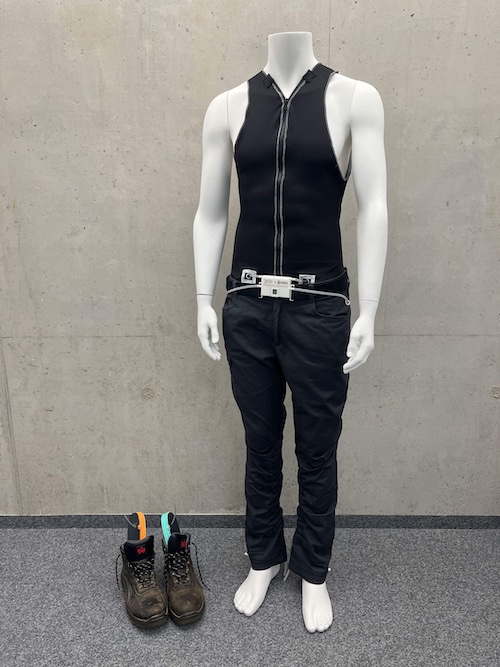
Demonstrator featuring insoles that function as pneumatic air compressors, pants with an integrated air conduit, a top with air-conducting structures for climate control, and a belt buckle to separate the pants from the top. Photo: DITF © 2026


The project demonstrated that combining air-conducting textile structures with pressure generators significantly improves heat and moisture management. This not only reduces the risk of overheating but also has a positive effect on wearing comfort and work performance.

The project was carried out in cooperation between DITF and Hero Textil AG. It was funded as part of the Central Innovation Program for SMEs (ZIM) by the Federal Ministry for Economic Affairs and Energy on the basis of a decision by the German Bundestag.

The StAirS textile climate control system was selected as a successful project example for the 2026 SME Innovation Day in Berlin and will be presented there on June 11 jointly by DITF and Hero. With the Innovation Day, the Federal Ministry for Economic Affairs and Energy is creating a meeting place to showcase innovative projects, new technologies, and creative ideas.

More News from Deutsche Institute für Textil- und Faserforschung Denkendorf

#Research & Development

Europe is committed to recycling end-of-life wind turbine blades

Starting in 2026, Europe’s wind energy industry has committed itself to ensuring that wind turbine blades do not end up in landfills once they reach the end of their service life. The EU-funded research project REWIND is exploring ways to reuse this composite waste. The German Institutes of Textile and Fiber Research Denkendorf (DITF) are one of 13 project partners from seven countries.

#Research & Development

Smart textiles reversibly change shape in an energy-efficient manner in response to ambient temperature

Self-actuating textile structures are used in a wide range of applications, such as medical technology, automation, architecture, agriculture, and the apparel industry. An example is the use of shading nets in greenhouses, which can be deployed and retracted depending on the sunlight intensity. The German Institutes of Textile and Fiber Research Denkendorf (DITF) are developing textiles based on shape-memory polymers with reversibly controllable geometry.

#Research & Development

ALADIN paves the way for circular and demand-driven textile production in Europe

Textile production can be organized sustainably by utilizing short supply chains and preventing overproduction. This can already be achieved today by intelligently connecting and efficiently utilizing existing infrastructure. At the same time, production becomes circular when innovative technologies and materials are used that enable high-quality recycling. The ALADIN research project, launched in May 2026 and co-funded with five million euros under the EU Horizon Europe program, is creating the conditions for this.

#Techtextil 2026

Stylish design made from sustainable materials – two DITF research projects receive Techtextil Innovation Awards

Materials made from domestic, renewable raw materials reduce CO₂ emissions, prevent microplastics from entering the environment, and close the material cycle. The German Institutes for Textile and Fiber Research Denkendorf (DITF) are developing nature-based alternatives to synthetically produced and predominantly petroleum-based materials. Two research projects have received a prestigious Techtextil Innovation Award. NUO Flexholz and the lignin-coated material FormLig demonstrate that sustainable concepts can meet high standards of functionality and design. Both projects were carried out in close collaboration with industry.

More News on Research & Development

#Research & Development

MELANGE starts with a co-creative design workshop at Aalto University to shape the visual identity of this new project transforming colouration in textiles

Over the next three years, MELANGE will lower the environmental impact of interior textile production by moving colour design to the beginning of the manufacturing process. This Horizon Europe project officially started on 1 August 2026, and will be publicly launched on 27 August 2026.

#Research & Development

Outdoor Industry Association completes Clean Heat CoLab initiative

The Outdoor Industry Association (OIA) has completed its multi-year Clean Heat CoLab initiative, bringing together outdoor brands and technology experts to accelerate the adoption of electrified process heating in textile manufacturing. The collaboration focused on reducing emissions from thermal processes such as dyeing, washing and finishing, which remain among the most carbon-intensive stages of textile production.

#Research & Development

ADD-ITC 2026 publishes preliminary conference program

The organizers of the Aachen-Dresden-Denkendorf International Textile Conference (ADD-ITC) 2026 have released the preliminary program for this year's event, which will take place on November 26–27, 2026, at the International Congress Center Dresden. The conference is expected to attract between 500 and 700 participants from industry, research, and academia.

#Research & Development

Networking Day 2026: Industry stakeholders unite around textile recycling

In 2026, the Industry Research Group (IRG) Polymer Recycling once again brought together some of the key stakeholders in textile recycling for its annual Networking Day. This year, the event took place at EREMA’s premises in Ansfelden, Austria. It brought together key players from across the textile recycling value chain for a day of structured exchange and in-depth discussions.

Latest News

#Textiles & Apparel / Garment

Première Vision Paris expands innovation focus across fashion and beauty

From September 1–3, 2026, Première Vision Paris will bring together more than 900 exhibitors from across the global fashion value chain. This year's edition places a strong emphasis on Innovation-Tech, highlighting technologies and materials that are reshaping product development, manufacturing and sustainability.

#Knitting & Hosiery

SHIMA SEIKI to exhibit at Première Vision Paris

Leading digital textile solutions provider SHIMA SEIKI MFG., LTD. of Wakayama, Japan will exhibit at Première Vision Paris in Paris, France next month. The company will exhibit in the "Smart Creation" area, dedicated to showcasing cutting-edge technologies that integrate sustainability and innovation. The knitting expert will be demonstrating solutions that optimize product development workflows and enhance sustainability through proposals in Digital Product Creation (DPC).

#Spinning

Rieter prepares leadership transition in Components & Technology

Roger Albrecht, Head of the “Components & Technology” Division, has decided to pursue a new opportunity outside the Rieter Group. Roger has worked for the Group for 11 years and has been instrumental in maintaining Rieter’s position as a technology leader in the short-staple business.

#Knitting & Hosiery

Small stitches, big impact

KARL MAYER machines enable the highly efficient production of mosquito net fabrics with maximum protective performance.

TOP