[pageLogInLogOut]

#Associations

The StitchTogether National Seminar in Poland delivers the Warsaw Declaration to enhance social dialogue for the Polish textile industry
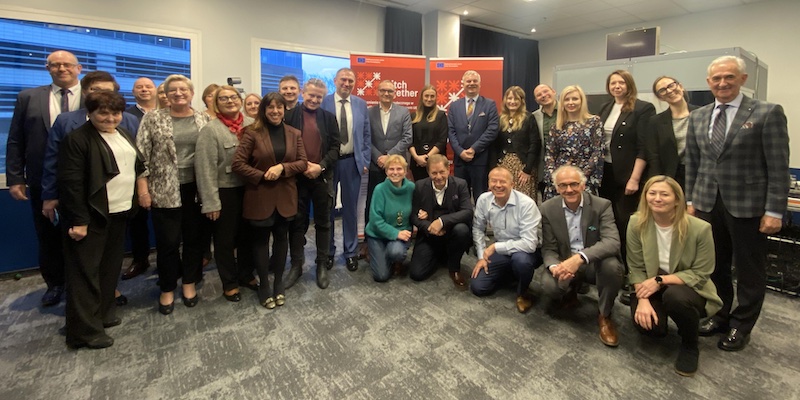
On 6 December 2024, social partners from the Polish textiles industry adopted the Warsaw Declaration, a joint commitment to work on the competitiveness of their industry. The declaration is the outcome of a 2 day meeting, organised under the EU co-funded StitchTogether project, which aims at promoting social partnerships in the European Textiles and Clothing Industry. The meeting in Warsaw brought together representatives of the Polish textile industry, including employer associations, trade unions, education institutes and the government to discuss the future of the industry.
© 2024 EURATEX
© 2024 EURATEX


Poland has a long and proud tradition in textiles and clothing manufacturing, with 130,000 people employed in the sector, and 20,000 companies of which the vast majority are SMEs. But the sector is struggling due to tough global competition and price pressures. In this context, the Polish textile and clothing social partners are united in ensuring the sector can successful face the digital and green transition, while remaining competitive and resilient, with decent jobs for all.

The Warsaw Declaration includes a series of priorities, confirming social partners’ commitment in working together, but asking support of the Polish government to upgrade industrial strategies, making the textile industry more attractive with a qualified and trained workforce.
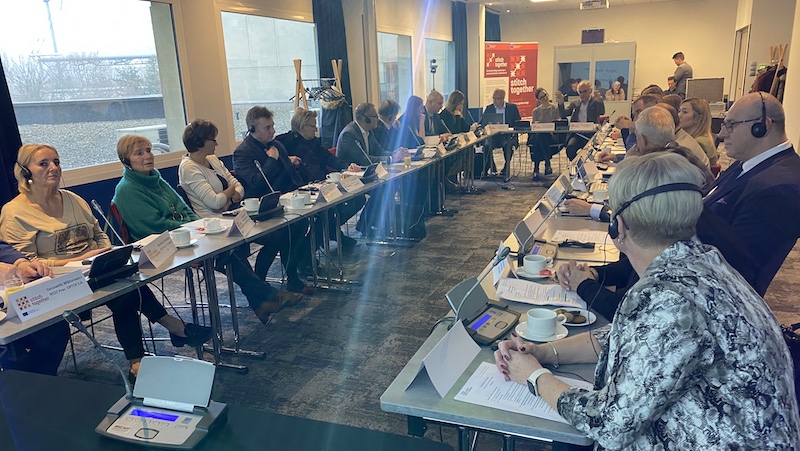
During the seminar, social partners adopted the Warsaw Declaration, a joint commitment to work on the competitiveness of their industry © 2024 EURATEX


“In times of transition social dialogue is more vital than ever, employers and trade unions need to work together to anticipate the change and prepare for the future in this case to more sustainable textiles and clothing production in Poland. It is essential that the transition is a Just Transition that leaves no worker behind, and we want the transition to safeguard jobs in the sector and create new jobs, which must be decent jobs with decent pay. The transition requires support and we call on the Polish government to work with the social partners for a new sectoral industrial policy to support the sector and good industrial jobs.’’ Says Judith Kirton-Darling, IndustriAll Europe's general secretary.

Dirk Vantyghem, EURATEX Director General, stressed that “the incoming Polish presidency of the EU is a unique opportunity to shape a Clean Industrial Deal that will strengthen the competitiveness of our companies. As our Polish textile companies clearly expressed during the event, they want to see changes on the energy costs and fair competition, instead of adding new regulations. ”
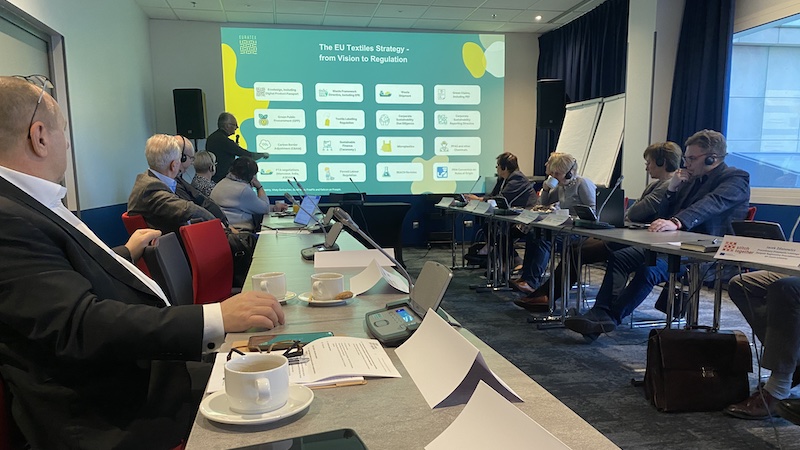
Also the EU Textile Strategy has been a topic at the seminar © 2024 EURATEX


More News from European Apparel and Textile Confederation (EURATEX)

#Associations

European Business Coalition welcomes provisional application of EU–Mercosur Agreement and calls for Swift and full implementation

With the European Commission’s decision to provisionally apply the EU–Mercosur Interim Trade Agreement, a process spanning more than 25 years now moves decisively into its implementation phase.

#Europe

Antwerp Declaration community urges EU leaders to deliver emergency measures as Europe’s competitiveness crisis deepens

EURATEX, representing the European textile and fashion industry, joins the Antwerp Declaration Community’s call on EU Heads of State and Government to adopt emergency measures that restore industrial competitiveness and deliver tangible results for Europe’s manufacturing base in 2026.

#Europe

FITA, ABIT and EURATEX underline strategic importance of Mercosur – EU Partnership Agreement for the textile and apparel industry

The Argentine Textile Industry Federation (FITA), the Brazilian Textile and Apparel Industry Association (ABIT), and the European Apparel and Textile Confederation (EURATEX) continue to monitor the process of internalizing the Mercosur-European Union Partnership Agreement. This agreement is essential for the competitiveness of our industries, on both sides of the Atlantic.

#Associations

Industry associations warn against state-run EPR models in the EU

European industry associations, led by Euratex, have raised concerns over a growing trend in several EU Member States to introduce state-run Producer Responsibility Organisations (PROs) within Extended Producer Responsibility (EPR) schemes.

More News on Associations

#Associations

EDANA joins industry coalition urging a strong internal market legal basis for the New Circular Economy Act

EDANA has joined 67 European industry associations in a joint industry statement calling on the European Commission and co-legislators to anchor the forthcoming New Circular Economy Act (CEA) in the Internal Market legal basis (Article 114 TFEU).

#Associations

EDANA warns of consequences of misclassification of PET spunbond imports

EDANA would like to remind its members and industry stakeholders of the legal requirement to comply with the EU rules on customs classification when importing nonwovens from third countries outside the EU. In this regard, it was recently discovered that there appears to be a high level of customs misclassification occurring in our industry. This could have dangerous and costly consequences for importers.

#Associations

Engineering depth and diversity for composites

Airbond is the latest member of the British Textile Machinery Association (BTMA) to receive recognition for contributions to the composites industry. The engineering firm based in Pontypool, South Wales, has just received the Make UK Energy and Sustainability Award for its Lattice 3D Printing project.

#Composites

Alliance for European Flax-Linen & Hemp expands bio-materials presence at JEC World 2026

The Alliance for European Flax-Linen & Hemp is pleased to announce its participation at JEC World 2026, featuring a significantly expanded presence and an enhanced offering for the global composites industry.

Latest News

#Techtextil 2026

DIENES at Techtextil 2026: Flexible pilot lines for bio-based fiber development

The growing relevance of bio-based materials in technical textiles is accompanied by increasing demands for reproducibility, high-quality data, and scalable process routes. Especially when working with cellulose and its derivatives, chitosan, lignin-based approaches, or bio-based PAN as a carbon-fiber precursor, R&D teams face variable feedstock quality, tighter process windows, and the need for reliable comparability across trials. This calls for flexible, data-driven experimental setups that can be reconfigured efficiently when recipes, solvents, and raw-material batches change.

#Texprocess 2026

Gunold showcases embroidery product range and services at Texprocess

At Texprocess 2026, GUNOLD will present numerous hands-on examples related to embroidery in Hall 8, Booth E20. The focus is on creative embroidery designs as well as the extensive product range of threads, nonwovens, and accessories for embroidery and embellishment. “Trade visitors can once again look forward to many new and creative embroidery designs. Of course, we will also showcase the matching products required to bring these ideas to life,” announces Marketing Manager Stephan Gunold.

#Nonwovens

EDANA and more than 70 industry organisations call for consistent exemptions in EU packaging regulation

EDANA, together with more than 70 industry associations and organisations, has issued a joint statement commenting on the European Commission’s Delegated Act under Article 29 of the Packaging and Packaging Waste Regulation (PPWR).

#Raw Materials

A Powerful Opening: Global thought leaders launch the International Cotton Conference Bremen

The International Cotton Conference Bremen will open on 25 March 2026 in the Parliament building of the Free Hanseatic City of Bremen with a keynote session of exceptional calibre. Distinguished international experts will set the stage for the conference by offering incisive perspectives on the most pressing challenges and the defining trends shaping the future of the global cotton trade. Their insights will span a broad spectrum — from geopolitically driven disruptions affecting global supply chains to the opportunities emerging from innovation-led agriculture capable of supporting a growing world population. Together, these opening keynotes will frame the dialogue of the conference, highlighting both the complexity of today’s market environment and the pathways toward a resilient and forward-looking cotton sector.

TOP