[pageLogInLogOut]

#Associations

Tracing production costs and carbon footprint in the primary textile industry

The new edition of the International Production Cost Comparison (IPCC) from ITMF has been published. The report benchmarks manufacturing costs for a range of textile products along the primary textile value chain, disaggregated by key cost components at each production stage.

This edition of the IPCC covers cost data for the year 2023. Given the high level of expertise and detailed industry input required to produce the report, the process was extended to allow for the necessary engagement of industry specialists under exceptionally demanding conditions in the last two years.

This extended timeline eventually provided an opportunity to deepen the analysis as the report now includes Uzbekistan and introduces a detailed calculation of the carbon footprint associated with each textile product covered, assessed across the full value chain. The report still presents comparative insights on cost structures, covering cost factors, manufacturing costs, and total production costs, across the spinning, draw texturing, weaving, knitting, and finishing segments.

For example, the publication reveals that producing one meter of woven fabric from cotton 1-1/8" in a continuous open width process (COW) in the controlled condition of the study cost 0.94 USD/m on average in 2023 (see Figure 1, amounts exclude raw material cost and range between 0.70 UDS/m in Bangladesh and 1.54 USD/m in Italy). Spinning the yarn required for this meter of finished fabric cost 0.31 USD/m on average (range between 0.23 USD/m in Bangladesh and 0.54 USD/m in Italy). Weaving this yarn added an extra 0.25 USD/m the average production cost of the fabric (range between 0.14 USD/m in Pakistan and 0.41 USD/m in Italy). Finally, finishing this meter of woven fabric increased the final production cost by 0.38 USD/m on average (range between 0.30 USD/m in Bangladesh and 58 USD/m in Italy).
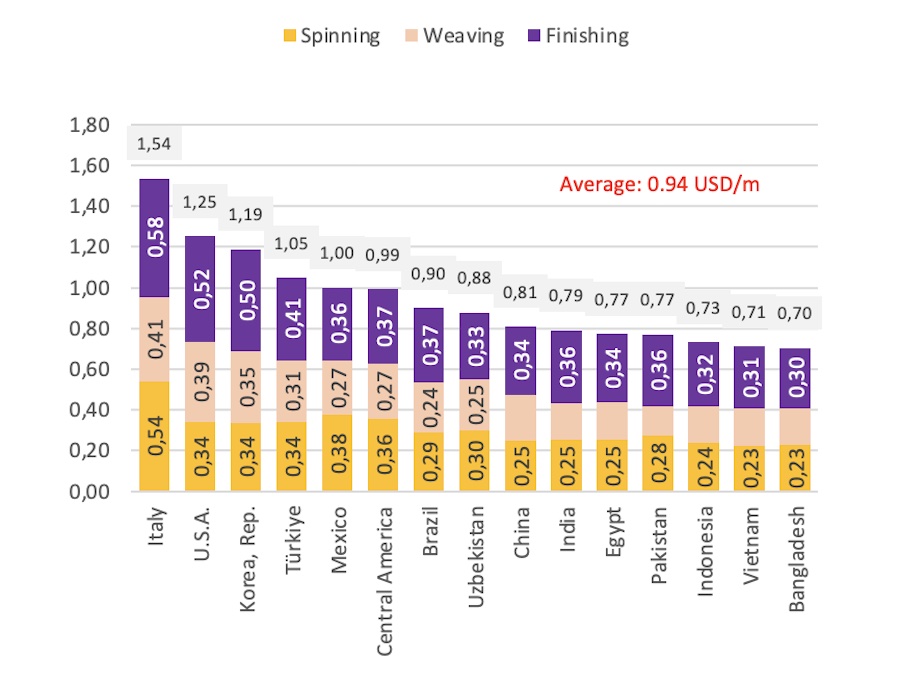
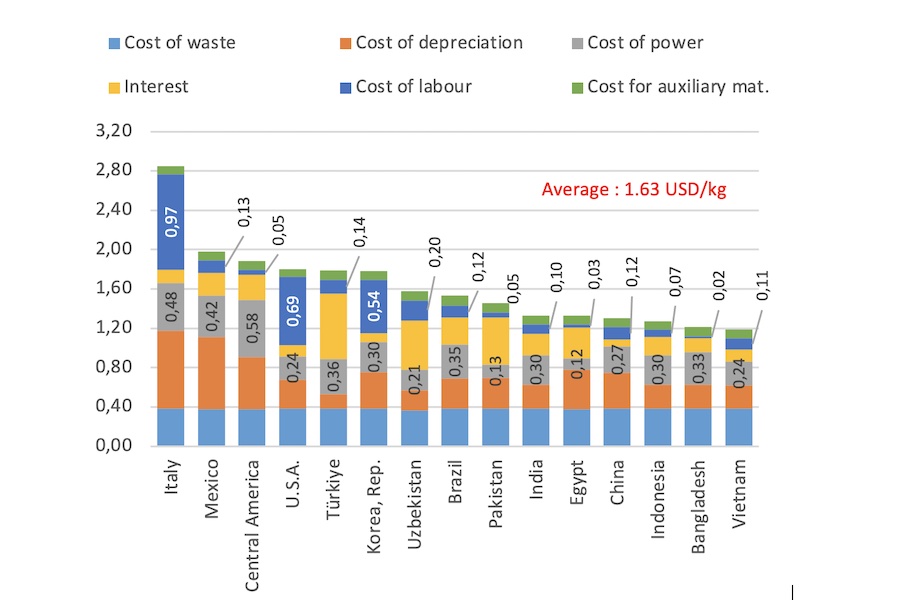
Figure 1: Total cost of producing a finished meter of woven fabric (CO, COW), by segment (UDSD/m), excluding raw material © 2025 ITMF


Figure 2: Manufacturing cost of spinning Ring/NE30, by cost element (USD/Kg) © 2025 ITMF


The publication also shows that spinning 1 kg of ring yarn NE/30 in the same controlled conditions cost 1.63 USD/kg on average in 2023, with wide differences amongst countries. This cost was 1.19 USD/kg in Vietnam and reached 2.85 USD/kg in Italy, at the top of the list (see Figure 2). The cost of labor was also highest in Italy (0.97 USD/kg), followed by the USA (0.69 USD/kg) and Korea (0.54 USD/kg). In contrast, labor costs were below 0.10 USD/kg in Indonesia (0.07 USD/kg), Egypt (0.03 USD/kg), and Bangladesh (0.02 USD/kg). The cost of power was higher in Central America, Italy, and Mexico (0.58, 0.48, and 0.42 USD/kg, respectively) and was below 0.20 USK/kg in Pakistan (0.13 USD/kg) and Egypt (0.12 USD/kg).

Figure 3: Country-specific Carbon Footprint [kg CO2e/kg tex] for producing 1 meter of finished cotton woven fabrics (CO - Woven - Continuous Open Width - COW), by process © 2025 ITMF


The carbon footprint analysis for woven fabrics finished using continuous open width (COW) processes also reveals significant variation across countries, reflecting differences in energy efficiency, production technologies, and energy sources. Among all countries studied, India reports the highest total carbon footprint, with combined emissions from spinning, weaving, and finishing reaching over 12.5 kg CO?e per kg of textile, driven particularly by high-intensity spinning (4.4 kg) and weaving (4.3 kg) stages. China also ranks among the highest emitters, notably in the finishing stage (3.9 kg), highlighting the energy demands of downstream processing. In contrast, Brazil stands out with the lowest total carbon footprint, at just under 4 kg CO?e per kg, benefiting from low-emission spinning and weaving processes, supported by its renewable energy mix. The United States and Italy also demonstrate relatively low emissions in the early stages of production, reflecting advanced process efficiencies. The newly added Uzbekistan enters the comparison with moderate emissions across all segments, showing potential for improvement in line with global best practices. These findings underscore the critical role of energy source and process optimization in reducing the environmental impact of textile production.

Find more about this extensive study and the reference products—such as NE?30 ring yarn, textured polyester yarn, woven and knitted fabrics, and various cotton and polyester finishing processes—on www.itmf.org/publications.


More News from International Textile Manufacturers Federation (ITMF)

#Associations

Business situation weakens slightly, but the industry stays cautiously optimistic

The International Textile Manufacturers Federation (ITMF) has published the results of its 39th Global Textile Industry Survey (GTIS), conducted from 14 to 22 July 2026 among companies along the entire global textile value chain. Worldwide, 10% of participants rated their business situation as good, 53% as satisfactory and 37% as bad — a balance of -26pp, down from -17pp in May but still well above the 2023 lows. All regions are now in negative territory, from South Asia at -3pp to North & Central America at -58pp.

#Associations

Consolidation amidst difficult market conditions

The International Textile Manufacturer Federation has published its International Textile Industry Statistics (ITIS) on productive capacity and raw materials consumption in the short-staple organized (spinning mill-) sector in virtually all textile-producing countries in the world.

#Associations

Meadow Grove Research joins ITMF as Corporate Member

Meadow Grove Research is a commodity research firm specializing in supply, demand, and trade analysis in cotton and other soft commodities. Providing clarity to the complex nature of the global fiber supply chain is one of its most formidable services. The firm thrives on customer engagement and providing the best framework for critical decisions.

#Associations

Results of the 38th ITMF Global Textile Industry Survey

The global textile industry appears to be turning a corner, but this is more likely a fragile and possibly temporary improvement than the start of a durable recovery. According to the 38th ITMF Global Textile Industry Survey, conducted worldwide during the second half of May 2026, business sentiment, order intake, order backlogs and capacity utilization all improved versus March — yet every indicator remains weak by historical standards, and rising costs cast doubt on how long the upturn can last.

More News on Associations

#Associations

IVGT membership: expertise that pays off

For energy-intensive textile companies, government compensation mechanisms are an important economic factor. The IVGT successfully supports its member companies in applying for state aid and thereby regularly contributes to significant financial relief.

#Associations

Italian textile machinery orders show quarterly recovery in Q2 2026

In the period between April and June 2026, order intake for Italian textile machinery manufacturers showed mixed but encouraging signals for the second half of the year. The order index at constant prices stood at 46.6 points (taking 2021=100 as the base year), showing a slight decrease of 3% compared to the same quarter of 2025. This trend was largely due to the contraction recorded in the domestic market, which fell by 25% compared to the corresponding period of the previous year.

#Recycling / Circular Economy

ReSpin joins TMAS to advance textile recycling technology

Swedish textile recycling company ReSpin has joined the Textile Machinery Association of Sweden (TMAS) as a new member. The company develops a patented mechanical recycling technology designed to transform textile waste into new fibres suitable for yarn production.

#Associations

Sustainability: European industry calls on EU to keep Single-Use Plastics Directive unchanged

A broad coalition of European industry associations, including EDANA, Euratex and Plastics Europe, has urged EU institutions to maintain the current legal framework of the Single-Use Plastics Directive (SUPD). In a joint statement, the organisations argue that reopening the Directive at this stage would create legal uncertainty, increase regulatory complexity and undermine investment, while its implementation across the European Union is still incomplete.

Latest News

#Knitting & Hosiery

SHIMA SEIKI brings new flat knitting technologies to FEBRATEX 2026

Leading flat knitting solutions provider SHIMA SEIKI MFG., LTD. of Wakayama, Japan, together with its Brazilian representative BRASTEMA TECNOLOGIA TEXTIL LTDA., will exhibit at the Brazilian Textile Industry Fair (FEBRATEX 2026) this month. On display will be a roundup of SHIMA SEIKI computerized flat knitting technology, represented by WHOLEGARMENT® knitting machines, computerized flat knitting machines featuring a brand-new model with high productivity and excellent cost performance, a glove knitting machine and the latest digital solutions.

#Man-Made Fibers

Lenzing reports improved half-year results and advances strategic transformation

Despite a persistently challenging market environment in the first half of 2026, characterized by volatile energy and raw material prices, subdued global consumer demand and intensified competition from Asia, the Lenzing Group significantly improved its financial performance. Net result after tax more than doubled to EUR 35.6 million, compared with EUR 15.2 million in the first half of 2025. Free cash flow increased to EUR 45.8 million, while EBITDA amounted to EUR 239.2 million. Revenue totaled EUR 1.27 billion, compared with EUR 1.34 billion in the previous year.

#Recycling / Circular Economy

German 'ZOLL' turns end-of-life uniforms into valuable raw materials

Together with CWS Workwear, the German Customs Administration is extending the life cycle of service uniforms through reuse, recycling and material recovery, demonstrating how circular economy principles can be successfully implemented in the public sector while delivering significant savings.

#Spinning

Trützschler’s latest spinning and card clothing innovations at CAITME 2026

From September 8 to 10, 2026, Trützschler will present its latest innovations in spinning and card clothing for state-of-the-art fiber processing at CAITME in Tashkent, Uzbekistan. Visitors are invited to meet the experts at Pavilion 2, Booth D50 and explore solutions designed to increase productivity, streamline processes, and ensure consistently high yarn quality. Key topics include the next-generation card TC 30i, the integrated draw frame IDF 3, the high-performance comber TCO 21XL as well as Trützschler Card Clothing’s new flat top series STEELTOP®.

TOP