#Associations
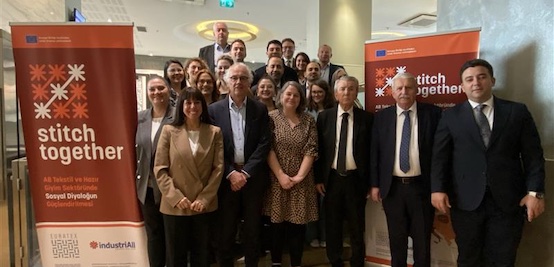
The StitchTogether national seminar in Italy presents the Rome Declaration to the Italian Government and the European Union
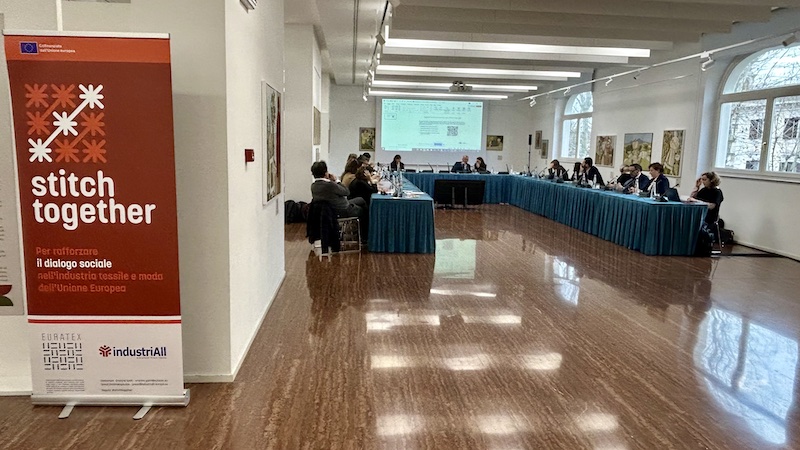
The meeting in Rome brought together representatives of the Italian textile industry, including the Italian employer association (Confindustria Moda), national trade unions (Femca-Cisl, Filctem-Cgil and Uiltec-Uil), regional clusters and companies to discuss the future of the industry. Together, they discussed the proposal for a sectoral industrial policy strategy to present to the Italian Government and the EU Commission for the support, consolidation and development of the textile-clothing supply chain.
The Rome Declaration includes a series of priorities, confirming social partners’ commitment in working together for a more competitive and fair Italian textile industry. The Declaration also calls upon the Italian Government and the European Union to support the upcoming transformation of the textile and clothing industries, technology and skills upgrades, regional development and just transition.
Says Judith Kirton-Darling, IndustriAll Europe's general secretary stated that “the Italian textile industry employs around 300,000 workers, or 24% of the European workforce in the textile and clothing sector, making it the largest in Europe. In a context of numerous challenges for the European textile industry, such as unfair globalization, green and digital transition, social dialogue is a real lever for improving working conditions and job security. We are committed alongside our Italian partners to a resilient and attractive textile industry in Italy”.
Dirk Vantyghem, EURATEX Director General, stressed that “Italy represents 36% of the total European textile and fashion industry; it is critically important therefore to maintain a strong Italian textile industry, which can be a benchmark for other countries. Combining quality, creativity and innovation is the recipe for success. This requires a dynamic company spirit, where employers and employees work hand in hand.”
Rome Declaration
Adopted at the Italian National Seminar on 20 February 2025
Innovation, sustainability, circularity, training, credit: these are the proposals of Confindustria Moda and the national trade unions Femca-Cisl, Filctem-Cgil and Uiltec-Uil in their dialogue to define a sectoral industrial policy strategy within the European context to propose to the Italian Government and the European Commission for the support, consolidation and development of the textile and clothing supply chain.
The Italian textile and clothing industry confirms itself as the most important value chain at European level, capable of providing all global markets a vast range of products that combine Italian style and creativity with high quality workmanship and the functionality of finishes and materials.
All this is made possible by the presence in the country of a vast network of companies, also organized in historic industrial districts but over time capable of renewing themselves and of overseeing all the production phases of the textile, clothing , and fashion supply chain: approximately 40,000 companies (60,000 if we include the other fashion sectors), of all sizes, from large international brands to medium-sized supply chain companies, to SMEs specialized in the individual phases of the production process. Approximately 400,000 direct employees (580,000 at the fashion sector level in general). An annual turnover of approximately 64 billion euros, largely the result of exports to international markets.
But all these records are not acquired forever. They require investments capable of continually renewing products and processes and of maintaining the high quality that has distinguished Italian manufacturing over time, both on the part of companies and of the entire national system. This is especially true in the current difficult international post-pandemic reality, in which the uncertainties deriving from the precarious geopolitical situation are added to the unknowns inherent in the great technological and digital revolution already underway and the ever-looming threats brought by unfair competition from low-cost markets.
In addition to this, the Italian textile and clothing industry, together with the European one, will soon go through a major transformation that will affect both companies and workers, both products and production methods. The textile industry is the second industry for pollutant emissions with specific reference to CO2 emissions, to which must be added the environmental impacts deriving from the use of water and the use of chemical reagents. The EU strategy, which has already indicated the right path through the Green Deal, aims to ensure that by 2030 textile and clothing products placed on the EU market are durable, reusable, repairable and/or recyclable for sustainable and circular textiles; the sector will move from a linear to a circular business model. The strategy covers the green and digital transitions, while underlining the need to ensure competitiveness in the global context.
In this context, the social partners of the textile and clothing sector are united in the effort to safeguard the sector and ensure a successful transition of the Italian industry towards a more sustainable dimension, from an environmental and social point of view, while ensuring that the sector remains economically competitive and resilient, able to continue to guarantee good jobs from all points of view.
To do all this, we believe it is important to intensify the dialogue between the social parties and to encourage the direct involvement of workers in the transformations of the new production process, starting with the sharing of sustainability reporting, which sets out the commitment to the true sustainable development of the company.
The EU-funded project "Stitch Together" is part of a long-term cooperation, where attention has been paid to developing strategies for industrial development and social progress, strengthening the representativeness of employers' and workers' associations, developing skills and capacities and spreading social dialogue and collective bargaining between the most representative employers' and trade unions' social partners at national level to be applied along the entire supply chain.
At the Italian national seminar on 19-20 February 2025 in Rome, the participating social partners agreed on the following points:
• The commitment to work together to ensure a successful green and digital transformation of the sector, taking advantage of growth opportunities and ensuring a socially just transition that creates decent work for all.
• The commitment to quickly define a joint document of priority proposals for the definition of a serious industrial policy, to be submitted to the Italian Government in order to implement a coordinated strategy to support and develop the sector on the key themes of competitiveness: innovation, sustainability, circularity, training, credit. This within the scope and in coherence with the new transition path outlined at European level.
• The joint williness to collaborate with national and local institutions, and schools, accredited and recognized training bodies to provide the necessary means to guide, attract and train young people in accessing the workforce in our sector; to stimulate continuous training and the identification of appropriate tools to retrain already active workers, to safeguard their acquired professionalism but at the same time update their skills, also through the concrete support of the EU TCLF Pact for Skills.
• The commitment to collaborate in the promotion of legality and decent work along the entire supply chain, both nationally and internationally, in compliance with and for the global promotion of European regulations and practices of responsible trade and due diligence.
• The joint request to the Government and the European Union to support, both at a managerial and economic level, the upcoming transformation of the textile and clothing industries, technological and skills updates, regional development and the just transition.
• The commitment to social dialogue at European level that can support an effective and lasting process of sectoral change.