[pageLogInLogOut]

#Raw Materials

Better Cotton convenes Brazil’s agricultural and textile sectors for unique collaborative action
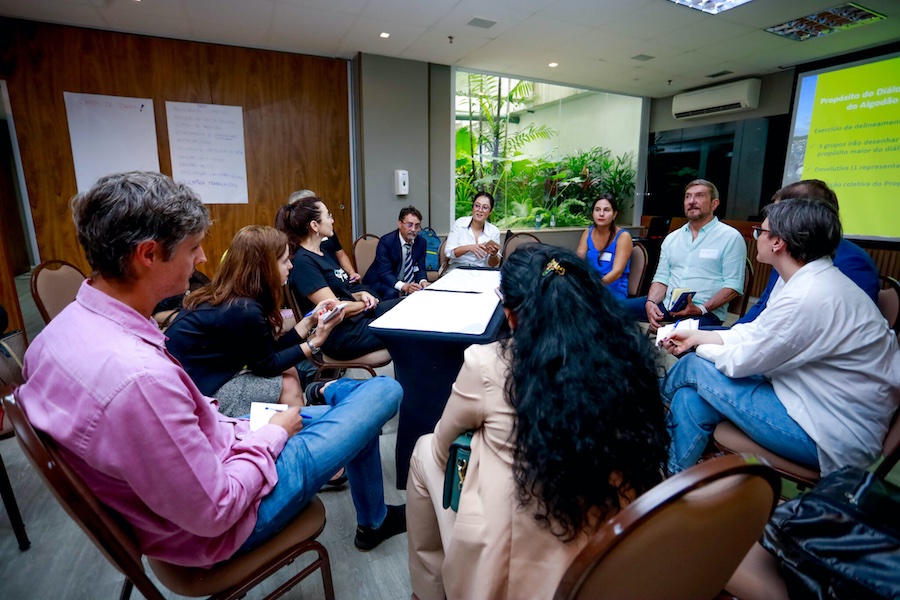
Better Cotton, the world’s largest cotton sustainability initiative, has launched a new effort uniting key stakeholders across Brazil’s agricultural and textile sectors to build an ambitious vision for more sustainable cotton production.
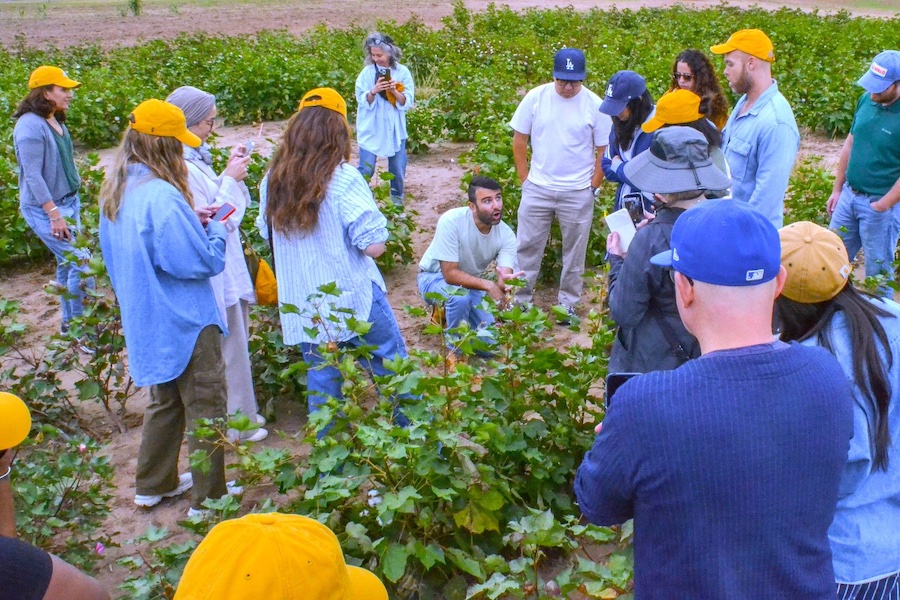
Attendees of Better Cotton’s Multistakeholder Dialogue during an interactive session. © 2025 Photo credit: Better Cotton / Bárbarah Queiroz.


The inaugural Multistakeholder Dialogue, held in Brasília on 26 March, brought together representatives from cotton producers and exporters, textile associations, retailers, brands, civil society, researchers, government agencies, financial institutions, and NGOs. 

Together, participants identified climate resilience, traceability, and greater collaboration as priority areas to shape future actions, help define best practices and tackle systemic agricultural challenges. 

Lena Staafgård, COO at Better Cotton, said: “Brazil’s agricultural industry is vast and is not only a leading producer and exporter of cotton, but of many other commodities. By bringing together key stakeholders across Brazil, we create a platform to overcome mutual challenges and champion best practices. Together, I’m confident we can accelerate change, and I look forward to future meetings.” 

Better Cotton has worked in Brazil’s cotton sector for more than a decade in collaboration with its Strategic Partner ABRAPA, the country’s association of cotton producers. Márcio Antonio Portocarrero, Executive Director at ABRAPA, said: “I see dialogue as a way for us to build a coalition of ideas and solutions together with diverse sectors that often tend to isolate themselves and think differently. This can only lead to progress and improvement.” 

As cotton is grown in rotation with other crops, closer collaboration across sectors is essential to addressing shared challenges and driving best practice adoption. 

This initiative offers Brazilian cotton growers a platform for stronger engagement with industry stakeholders, to gain insights into their work and perceived risks, and for increased innovations to address sector-wide challenges.

Kamila Garantizado, Sustainability Specialist at Brazilian clothing department store Lojas Renner, noted: “This was a highly educational environment, with very active listening. It became very clear that the needs [of others] are relatively similar to ours—like improving communication.” 

Participants committed to continuing their collaboration and will reconvene in the coming months to drive further progress towards a more sustainable cotton production in Brazil.
More News from Better Cotton

#Raw Materials

Better Cotton Initiative marks certification anniversary with progress update and accreditation

One year since becoming a certification scheme, the Better Cotton Initiative (BCI) has announced that more than 3,000 supply chain actors have been certified. At farm level, more than 30% of farms and producer units supplying BCI Cotton have received a positive audit outcome.

#Raw Materials

Better Cotton Initiative opens enrollment in the US with promising opportunities for producers

Producer enrollment for the US Program of the Better Cotton Initiative (BCI) is open until May 15 for the 2026-2027 season. With over 2,600 members spanning the cotton supply chain and more than 11,000 users of its Better Cotton Platform (BCP) as of 2025, BCI’s standard is implemented in 15 countries and covers one fifth of global cotton production.

#Natural Fibers

Better Cotton Initiative partners with Uzbek government agency to offset certification costs

The Better Cotton Initiative (BCI) has today announced a strategic agreement with Uzbekistan’s Light Industry Agency to increase financial support for cotton farming clusters adopting sustainable agricultural practices.

#Natural Fibers

Better Cotton Initiative surpasses 50% traceable BCI Cotton milestone

Two years since the launch of its traceability solution, the Better Cotton Initiative (BCI) has announced that over 50% of BCI Cotton volumes entering global fashion and textile supply chains are now traceable, deriving from 15 countries.

More News on Raw Materials

#Raw Materials

ICAC projects slight decline in production, relative stability for consumption

Global cotton production is projected to decline by 4% in the 2026/27 season to 24.8 million tonnes, while consumption is expected to remain relatively steady at 25.0 million tonnes, according to the March 2026 edition of Cotton This Month.

#Raw Materials

Beyond the wardrobe – innovative cotton takes the spotlight

Cotton can do more – a lot more. Cutting-edge textiles and high-tech products made from 100% cotton prove just how powerfully performance and sustainability can come together. That very surge of innovation is front and centre at the 38th Bremen Cotton Conference, taking place March 25–27, 2026, at Bremen’s Parliament on the historic market square – culminating in a bold and dedicated closing session on Friday. In the spotlight: performance upgrades for pure cotton, smart strategies for circular textile waste solutions, and pioneering concepts for demanding technical applications. From natural fibre–reinforced composites to highly effective flame-retardant solutions, cotton steps out of the closet and shows the future potential woven into every fibre.

#Raw Materials

Esquel Group adds two new extra-long staple cotton varieties approved

Esquel Group’s Xinjiang Research & Development Center has successfully developed two new Sea Island cotton (Extra-Long-Staple cotton, ELS cotton) varieties named “Yuan Loong 37” and “Yuan Loong 42,” which have been officially approved and granted registration numbers. Both varieties have also obtained Plant Variety Rights certificates, marking another significant breakthrough for the Group in cotton breeding and commercial application.

#Raw Materials

Aid by Trade Foundation reaches new milestones in supply chain transparency

The Aid by Trade Foundation (AbTF) is reaching new milestones as it leads the way towards greater physical traceability for Cotton made in Africa® (CmiA) cotton. With around 700 suppliers and producers in a total of 25 countries, the Aid by Trade Foundation has reached a new record number of partners who can trace CmiA cotton from the product back to its origin. This is more than double the previous year’s figure.

Latest News

#Spinning

Barmag presents the next generation of POY production – energy-efficient and partial-automated

With POY 2.0, Barmag is introducing a completely redesigned spinning concept that takes the production of partially oriented yarn (POY) to a new level in terms of technology and economy. The solution, which was presented to a selected audience of experts for the first time at ITMA Asia + CITME 2025, was met with great enthusiasm: several yarn producers worldwide immediately expressed their interest in a pilot plant.

#Composites

More affordable, environmentally friendly hydrogen pressure tanks at ITA-JEC booth

As a highlight of the JEC, the Institut für Textiltechnik (ITA) of RWTH Aachen University will be presenting hydrogen pressure tanks manufactured using multifilament winding processes at the NRW joint booth in Hall 5, Stand G65.

#Textile chemistry

DyStar Group Announces Board Transition to Drive Innovation

DyStar, a leading specialty chemical company with a heritage of more than a century in product development and innovation, announced today the appointment of Ruan Cunfan to its Board of Directors, effective 20 February 2026.

#Recycling / Circular Economy

Textile‑to‑textile recycling leader Circulose joins Spinnova’s ecosystem to accelerate technology scale‑up

Textile‑to‑textile recycling leader Circulose joins Spinnova’s ecosystem (consortium) to help advance the scale‑up of Spinnova’s technology. Spinnova has actively sought partners to accelerate commercial scale‑up, and Circulose, as a key player in textile recycling, strengthens the ecosystem by providing a raw material that is in high demand across the industry.

TOP