[pageLogInLogOut]

#Natural Fibers

Better Cotton Initiative partners with Uzbek government agency to offset certification costs
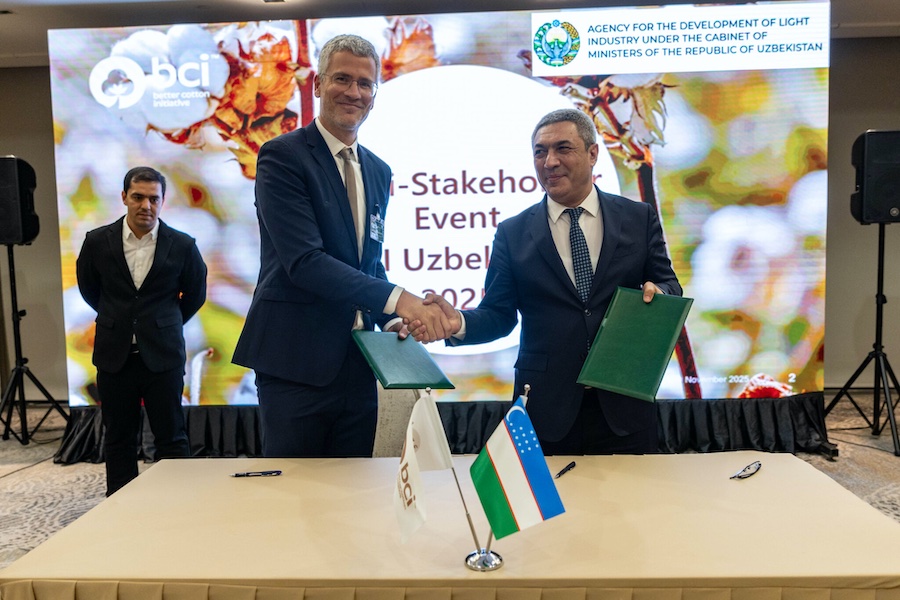
Photo credit: Better Cotton Initiative. Location: Tashkent, Uzbekistan, 2025. Jannis Bellinghausen, Senior Director of Systems Integrity at the Better Cotton Initiative (left) and Nozim Kholmuradov, Director at the Light Industry Agency (right).
The Better Cotton Initiative (BCI) has today announced a strategic agreement with Uzbekistan’s Light Industry Agency to increase financial support for cotton farming clusters adopting sustainable agricultural practices.

The agency, established this year by the Uzbek government to drive improvements in the country’s textile sector, will manage a new fund to reimburse the cost of farm and supply chain-level certification against BCI standards, in order to incentivise compliance. 

Katerina Gorbunova, head of the Better Cotton Initiative’s Uzbekistan programme, said: “Our continued engagement with the Government of Uzbekistan and its entities is testament to their collaborative spirit and commitment to transforming the country’s cotton sector. The cost of certification can be a barrier to entry not only for cotton clusters in Uzbekistan but farms around the world, so the launch of this fund will be pivotal to accelerating sustainability efforts.” 

The agreement updates the roadmap BCI signed last year with Uzbekistan’s Ministry of Agriculture and the Textile and Garment Industry Association (Uztekstilprom). It represents a transition from planning to operationalising sustainability systems via programme financing, institutional roles, and policy incentives within national structures. 

Nozim Kholmuradov, Director at the Light Industry Agency, said: “Our strategic focus is to boost cotton-producing enterprises’ income and grow the number of Uzbekistan companies positioned to compete confidently on the global textile stage. A close partnership with the Better Cotton Initiative will be essential to reaching this ambition.” 

The collaboration was announced at BCI’s annual multistakeholder meeting in the Uzbekistan capital, Tashkent. The event convened cotton producers, government representatives, civil society, knowledge partners, donors, brands, and retailers to discuss challenges and opportunities in both field and market, from strengthening social due diligence to championing regenerative practices. 

Among the participants were government ministers, BCI staff, and representatives from the National Commission on Combating Human Trafficking and Decent Work, the International Labour Organization, the Cotton Campaign, Food & Agriculture Organization, and Uztekstilprom.

More News from Better Cotton

#Raw Materials

Better Cotton Initiative strengthens regenerative focus in standard update

The Better Cotton Initiative (BCI) has strengthened the regenerative focus of its field-level standard with the launch of a new version of its Principles & Criteria (P&C), which marks the next step in the organisation’s journey to becoming a regenerative standards system.

#Raw Materials

Better Cotton Initiative marks certification anniversary with progress update and accreditation

One year since becoming a certification scheme, the Better Cotton Initiative (BCI) has announced that more than 3,000 supply chain actors have been certified. At farm level, more than 30% of farms and producer units supplying BCI Cotton have received a positive audit outcome.

#Raw Materials

Better Cotton Initiative opens enrollment in the US with promising opportunities for producers

Producer enrollment for the US Program of the Better Cotton Initiative (BCI) is open until May 15 for the 2026-2027 season. With over 2,600 members spanning the cotton supply chain and more than 11,000 users of its Better Cotton Platform (BCP) as of 2025, BCI’s standard is implemented in 15 countries and covers one fifth of global cotton production.

#Natural Fibers

Better Cotton Initiative surpasses 50% traceable BCI Cotton milestone

Two years since the launch of its traceability solution, the Better Cotton Initiative (BCI) has announced that over 50% of BCI Cotton volumes entering global fashion and textile supply chains are now traceable, deriving from 15 countries.

More News on Natural Fibers

#Raw Materials

New study shows low environmental impact by Cotton made in Africa Organic Cotton from Tanzania

Today, the Aid by Trade Foundation (AbTF) is announcing the results of a comprehensive life-cycle analysis (LCA) for cotton produced in Tanzania under the Cotton made in Africa Organic (CmiA Organic) standard. The study emphasises the small ecological footprint of CmiA Organic verified cotton. This can largely be traced back to the absence of synthetic pesticides, artificial fertilisers, and artificial irrigation. Consequently, CmiA Organic cotton can help the textile industry meet regulatory requirements as well as science-based targets. The results also show that the consequences of climate change threaten the livelihoods of these cotton farmers, even though the type of agriculture they practise barely contributes to climate change.

#Natural Fibers

Global Standard gGmbH launches second public consultation for GRTS Draft 2 for the textile industry (1–30 April 2026)

Global Standard gGmbH is pleased to announce the release of Draft 2 of the Global Responsible Textile Standard (GRTS) for its second public consultation. The consultation will be open from 1 April 2026 to 30 April 2026, inviting stakeholders across the textile and apparel value chain to provide input and contribute to the further development of this new Standard.

#Raw Materials

Global production expected to decline in 2026/27 as policy shifts and weak demand reshape trade

Early projections for the 2026/27 season indicate that global cotton lint production will decline by 4% to 24.9 million tonnes, while world consumption is expected to remain stable at approximately 25 million tonnes, according to the April 2026 issue of Cotton This Month.

#Raw Materials

Textile Exchange publishes cotton Life Cycle Assessment study to strengthen impact data

Textile Exchange has published the first in a series of seven Life Cycle Assessment (LCA) studies designed to improve the quality and robustness of environmental impact data for raw material production across the fashion, textile, and apparel industry. The first LCA study focuses on cotton and addresses critical data gaps and methodology variability through new high-quality data across key producing countries. The study includes organic, regenerative, recycled, and country averages for conventional cotton production systems, providing a clearer picture of the associated environmental impact.

Latest News

#Techtextil 2026

Techtextil 2026 recognition for the UK’s FET

Fibre Extrusion Technology (FET) will receive the Techtextil 2026 New Production Technology Innovation Award at next week’s Techtextil in Frankfurt (April 21-24). The Leeds-based member of the British Textile Machinery Association (BTMA) has developed the FET-500, a new toxic solvent-free gel small scale system for the production of ultra-high-molecular-weight polyethylene (UHMWPE).

#Techtextil 2026

Lower CO2, stronger bonds: Indorama Ventures enables customers’ performance at Techtextil

At Techtextil 2026 in Frankfurt am Main, Indorama Ventures presents its latest material innovations aimed at supporting customers in achieving both performance and sustainability targets. The company highlights solutions based on recycled and bio-based raw materials as well as advanced binder fibers, addressing current market demands for lower CO₂ emissions, improved efficiency, and reliable supply.

#Digital Printing

Kornit Digital redefines apparel production for the on-demand era unveiling Atlas MATRIX at Konnections 2026

Kornit Digital Ltd. (NASDAQ: KRNT, “Kornit Digital”, “Kornit”, or the “Company”), a global pioneer in sustainable, on-demand digital fashion and textile production, today unveiled its Atlas MATRIX at Konnections 2026, redefining apparel production in the on-demand era.

#Recycled Fibers

Recover™ and Prosperity Textile announce strategic denim partnership

Recover™, a global producer of low-impact, high-quality recycled cotton fiber at scale, has announced a strategic partnership with Prosperity Textile, a vertically integrated denim fabric manufacturer operating at industrial scale.

TOP