[pageLogInLogOut]

#Yarn & Fiber

Combing – the supreme discipline in yarn engineering
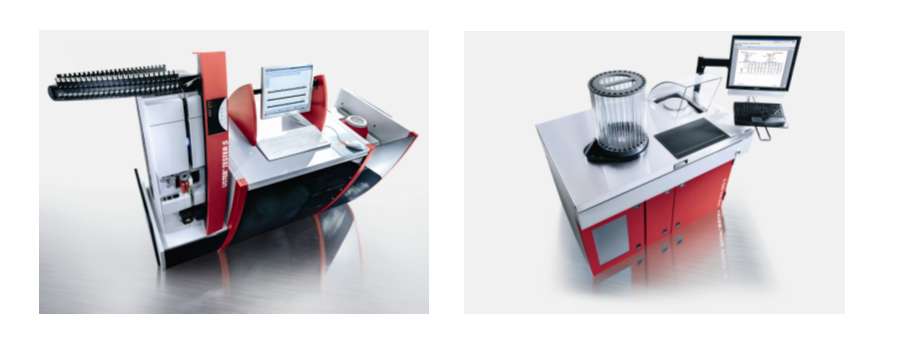
USTER® TESTER 5 – at the heart of the quality laboratory and USTER® AFIS PRO 2 – fiber testing for process optimization (c) 2014 Uster
Yarn quality and production cost are influenced by many factors, from raw material selection to the various processes in the spinning mill. If there is one process which is most closely identified with added quality in yarns, it is combing. Yet the combing operation demands careful attention, if the potential quality benefits are not to be outweighed by its high cost and excessive levels of wasted fiber.
Achieving the full potential of a complex and risky process requires a dedicated testing regime

Proper testing is essential, preferably double testing with USTER® AFIS PRO 2 and USTER® TESTER 5, to ensure the optimum balance between cost and quality.

Yarn engineering describes how spinning mills apply their know-how to create the ‘ideal’ yarn, with the combination of quality and performance their customers demand. It is a complex task, made even more difficult by the obvious need to ensure that each part of the process is as cost-effective as possible for the mill.

Of all the mill processes, combing is the supreme discipline for successful yarn engineering. Apart from carding, no other production step has the same influence on product quality and cost, while maximizing the raw material. In combing, the critical decisions center on the amount of waste fiber – that’s where the quality-cost balance is established. The parameters here are fiber length, short fiber content, and neps and this data is provided by testing with the USTER® AFIS PRO 2. The AFIS® test results allow an initial prediction of yarn quality to be produced. They can also be used to analyze combing machine performance – an important facet of the entire production process.

Double check testing The crucial need to control the combing operation properly means that a double check testing procedure is strongly recommended. Firstly, the comber noil should be tested with the USTER® AFIS PRO 2. The goal here is to check that no quality-enhancing long fibers are lost. Spinners will want to find only short fiber content of less than ½ inch (12.7mm) in this waste material.

To gain a full picture of the yarn quality, the USTER® TESTER 5 is also required. This system, trusted worldwide at the heart of the quality laboratory, provides values for all the most important yarn parameters. Values for evenness (CVm) and hairiness from the USTER® TESTER 5 give a clear view of the yarn quality being produced, and allow spinners to forecast how the yarn will perform in the finished fabric. It’s a kind of early-stage predictor of customer satisfaction. This same data also confirms that the combing machine is running well – another useful double check of this process.

Avoiding the risks Every spinning mill process has its costs, but combing is both the most complex and the most expensive. The aim is difficult: to comb out as much as necessary – but as little as possible. The risks are significant: too many short fibers remaining at spinning will impact badly on fabric appearance, making it look uneven, cloudy and neppy. At this stage, the damage is done and it’s too late to correct it.

To avoid this outcome, spinners supplying demanding customers often choose to balance their combing settings more towards quality. Spinners taking this option need to be aware that an increased level of noil removal does not produce a proportionate increase in quality. In this respect, recent mill trials by USTER produced some interesting conclusions.

Mill trial results The objective of the test was to investigate the influence of short fiber content on the spinning process and subsequent processes. Sliver was combed in five different levels (A to E) from 10.30 to 22.22 noil percentage.  
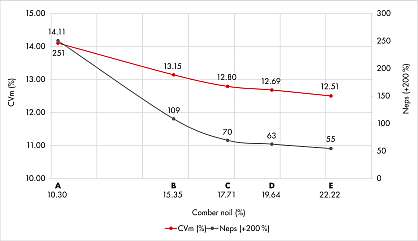
Graph 1 shows the test results for CVm and neps. The biggest change came when comparing the examples with the lowest and second-lowest (15.35%) noil percentage. Here, the nep quantity was reduced from 251 to 109. From the second-highest (19.64%) to the highest noil percentages, the change was only from 63 to 55. Other significant changes are seen within the values for evenness. Again comparing the examples with the lowest and the second-lowest noil percentages, the CVm varies from 14.11% to 13.15%. The improvement of CVm between the second-highest and the highest noil percentages is comparably low (going from 12.69% to 12.51%) and not worth the raw material loss.

Graph 1: CVm and neps measured in a Ne 30 yarn

With regard to noil percentage, the mill trials confirmed that there is a point of diminishing returns, where quality is not impacted significantly. The correct balance between quality and raw material waste is key.

Cost aspects The cost to a mill by not optimizing combing comes at the expense of waste and quality. In a typical mill with 50,000 spindles and a raw material cost for a Ne30 yarn of 1.43 USD/kg, even a small increase in waste of 0.1% has a notable impact on production costs – amounting to about USD 1.43 per 1000kg yarn produced. With insufficient or no short fiber and nep testing on USTER® AFIS PRO 2, defects in the final fabric would cost such a mill USD 3,000 per 1000kg yarn produced. In contrast, a Turkish mill with optimized AFIS® testing reported a reduction of comber noil by 2-3% with no loss in yarn quality.

Challenges and opportunities The key to keeping customers happy is consistent quality – which is the main objective of good yarn engineering. Part of this is a regular testing program. USTER recommends weekly tests on fiber length, short fiber content and neps with the USTER® AFIS PRO. For a full list of these tests, see (www.uster.com/combingposter). Routine test plans with the USTER® TESTER 5 should also be in place for evenness, imperfections and hairiness. (www.uster.com/ringspinningposter).

The benefits of a proper testing regime will obviously include optimized yarn quality, with a consequent reduction in the risk of claims. Applying the test reports with a special emphasis on combing will also point the way to correct machine settings, with a further positive impact on production cost and profit. Getting the balance right in these processes enables the mill to make the most of its raw materials and the best of Profit.
More News from Uster Technologies AG

#Spinning

Measure and control the fiber – optimize yarn quality

Producing consistent yarn quality is an everyday challenge – and a very difficult one. Detailed knowledge and understanding of the fiber raw material is absolutely critical to achieving the best possible quality in the yarn. To help spinners, Uster experts have put together guidelines for avoiding yarn irregularity claims, in a special edition of the Uster News Bulletin.

#ITMA Asia + CITME Singapore 2025

Uster presents novelties at ITMA Asia + CITME 2025

There’s news from Uster Technologies to be announced for the industry’s upcoming event in Singapore. The Uster 360Q universe is growing with new products, solutions and services. Innovation developments can also be recorded in the fields of man-made fiber testing and fabric inspection. Uster innovations address the industry’s trending topics as mill management and process control, optimization of delivered fabric quality and yield.

#Spinning

Uster Technologies marks 150 years of empowering quality excellence

Uster Technologies marks 150 years of excellence – a milestone that reflects continuous adaptation to customer needs and industry change. Over the decades, Uster has evolved from manufacturing quality testing instruments into a trusted partner shaping the future of textile production.

#Recycling / Circular Economy

Challenges of making yarn from recycled fibers

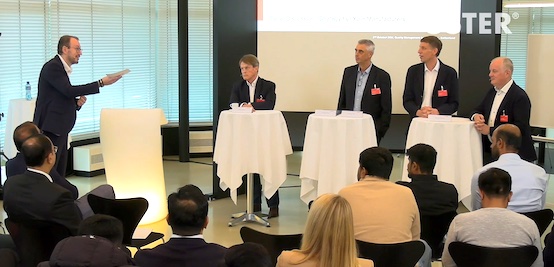
What does it take to spin quality yarn from recycled fibers? Uster Technologies brought textile industry leaders together to discuss the role of technology, data and automation – as well as the current challenges in using recycled raw material. Experts from Rieter, Säntis Textiles, Otto Yarns, and TVU commented on the current situation and looked into the future of spinning in a panel discussion organized at Uster headquarters.

More News on Yarn & Fiber

#Yarns

Yarn Expo Spring 2026 concludes, connecting buyers with innovative selection of sustainable yarns and fibres

Yarn Expo Spring 2026 wrapped up successfully on 13 March, as a record-high of over 600 exhibitors from 12 countries and regions welcomed more than 25,000 visitors from 113 countries and regions. Held across 27,000 sqm in Hall 8.2 of the National Exhibition and Convention Center (Shanghai), the fair highlighted the textile industry’s accelerating shift toward a lower-impact, more functional future. Exhibitors presented eco-friendly organic, regenerated and recycled yarns and fibres, alongside innovative options such as sweat-resistant and high-performance materials. A comprehensive fringe programme further enriched the event, offering practical market insights and new networking opportunities.

#Man-Made Fibers

Lenzing advances its transformation: Higher EBITDA, stronger free cash flow and more than EUR 200 million in cost savings

The business performance of the Lenzing Group in 2025 was affected particularly in the second half of the year by external factors such as international tariff measures, subdued demand and declining market prices. As a result, revenue decreased slightly by 2.3 percent to EUR 2.6 billion, primarily due to lower fiber sales volumes and lower prices for fibers and pulp, which were further negatively impacted by currency developments. Nevertheless, thanks to the comprehensive Performance Program, Lenzing was able to improve its operating performance and key financial indicators compared with the previous year.

#Man-Made Fibers

“Lead Transformation – Generate Impact”: Lenzing presents its 2025 Annual and Sustainability Report

The Lenzing Group has published its 2025 Annual and Sustainability Report, entitled LEAD TRANSFORMATION – GENERATE IMPACT. The report shows how Lenzing is actively shaping change in the industry and making a lasting impact: economically, ecologically, and socially. Lenzing is consistently focused on the future: with targeted investments in premiumization, excellence, innovation, and sustainability, the company is strengthening its position as a leading provider of sustainable, cellulose-based premium fibers. The combined report is available in digital format.

#Raw Materials

Lenzing Group positions bio‑based materials as a strategic asset for Europe’s economic security

The Lenzing Group, a leading supplier of regenerated cellulose fibers for the textile and nonwovens industries, hosted a high‑level roundtable in Brussels to discuss how bio‑based materials can strengthen Europe’s economic security and support the shift toward a fossil‑free future. Organized in cooperation with Euractiv, the event brought together representatives of the European Commission, the UK Mission to the EU, academia, civil society, and industry.

Latest News

#Raw Materials

New study shows low environmental impact by Cotton made in Africa Organic Cotton from Tanzania

Today, the Aid by Trade Foundation (AbTF) is announcing the results of a comprehensive life-cycle analysis (LCA) for cotton produced in Tanzania under the Cotton made in Africa Organic (CmiA Organic) standard. The study emphasises the small ecological footprint of CmiA Organic verified cotton. This can largely be traced back to the absence of synthetic pesticides, artificial fertilisers, and artificial irrigation. Consequently, CmiA Organic cotton can help the textile industry meet regulatory requirements as well as science-based targets. The results also show that the consequences of climate change threaten the livelihoods of these cotton farmers, even though the type of agriculture they practise barely contributes to climate change.

#Raw Materials

Better Cotton Initiative strengthens regenerative focus in standard update

The Better Cotton Initiative (BCI) has strengthened the regenerative focus of its field-level standard with the launch of a new version of its Principles & Criteria (P&C), which marks the next step in the organisation’s journey to becoming a regenerative standards system.

#Man-Made Fibers

Selenis and Kintra Fibers partner to scale 100% bio-based synthetic fiber technology

Selenis, a leading global specialty polyester manufacturer, today announced a strategic manufacturing partnership with materials science company Kintra Fibers to scale Kintra’s patented fiber-grade PBS resin - a 100% bio-based and biodegradable material designed for textile applications.

#Functional Fabrics

PERFORMANCE DAYS proves its relevance as the industry’s key meeting point

Held on March 18–19, 2026, PERFORMANCE DAYS once again confirmed its position as a leading international platform for functional textiles. A total of 3.366 trade visitors and around 560 exhibitors gathered in Munich, with the event already kicking off successfully on DAY 0, which received highly positive feedback for its interactive format. Despite challenging conditions caused by the public transport strike in Munich, the event saw strong attendance and a consistently high level of activity across both exhibition days.

TOP