[pageLogInLogOut]

#Research & Development

Fraunhofer IAP paves the way for "Green" carbon fibers
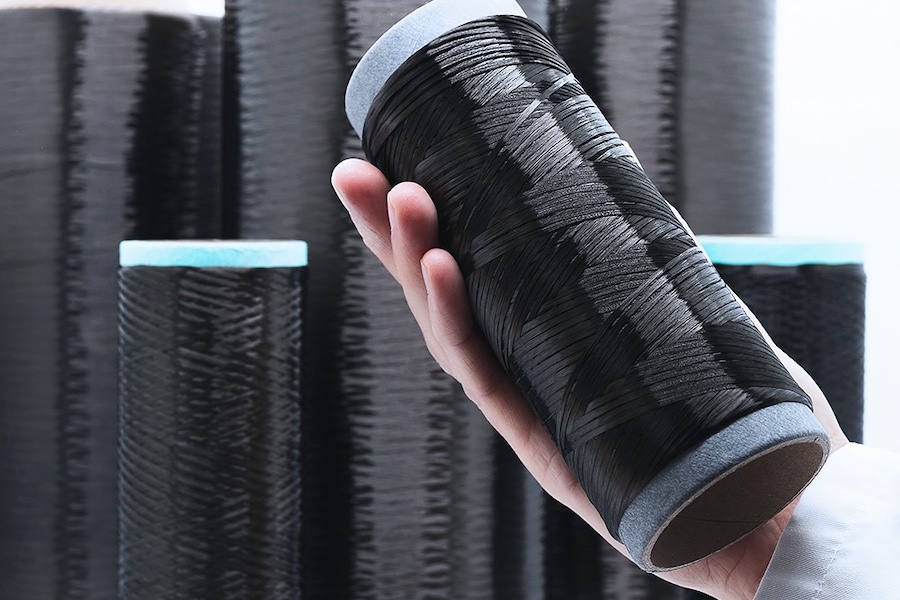
As part of the Carbon Lab Factory Lausitz, a pilot plant for the production of sustainable, cost-effective, and competitive carbon fibers will be established at the Guben site. © Fraunhofer IAP / Kristin Stein
A new pilot plant in Guben is set to enable the production of bio-based carbon fibers. The plant is part of the Carbon Lab Factory Lausitz and will make an important contribution to the transformation of the Lausitz region—from a traditionally raw material- and basic industry-oriented region to a hub for innovative high-performance materials. The German federal government and the state of Brandenburg are providing the Fraunhofer Institute for Applied Polymer Research IAP with 53.3 million euros for this purpose.

Carbon fibers are high-performance materials that combine lightness with high strength and stiffness. They are particularly in demand in lightweight construction, which is a key factor for developing efficient and resource-saving materials for future industries. The lighter cars, airplanes, wind turbines, or bicycles are, the more energy-efficiently they can be operated. Carbon fibers are also increasingly important for energy generation, conversion, and storage, for example in batteries, fuel cells, or other components of modern energy systems.

Conventional carbon fibers are predominantly produced from fossil raw materials. To expand the raw material base with sustainable alternatives, bio-based carbon fibers are gaining increasing attention. They conserve resources, have a better CO2 balance, and make the value chain more resilient. In addition, their properties can be specifically tailored to different applications. The industry already shows strong demand for such alternatives.

Concentrated expertise in bio-based carbon fibers

The production of bio-based carbon fibers is a specialty of Fraunhofer IAP: In a first step, raw materials such as cellulose or lignin from wood are dissolved and spun into precursor fibers. These are then converted into carbon fibers through carbonization.

To scale these processes for industrial applications, a pilot plant will be established in Guben as part of the Carbon Lab Factory Lausitz. The project is financed with 53.3 million euros by the Brandenburg Ministry of Science, Research, and Culture through Wirtschaftsregion Lausitz GmbH (WRL) and the federal government. The positive decision on funding by the Interministerial Working Group (IMAG) on March 12, 2026, marks an important milestone for implementation. The city of Guben is investing around 20 million euros in the construction of the building in the Guben Industrial Park. Fraunhofer IAP will use the remaining funds for plant technology, equipment, and initial setup. The plant is expected to start operation at the end of 2029.

Dr. André Lehmann, Head of the Polymer Processing Research Division and Fiber Technologies Department at Fraunhofer IAP, explains: "With the Carbon Lab Factory Lausitz in Guben, we are creating the conditions for a research and pilot infrastructure where various innovative precursor fibers can be produced up to the ton scale."

Dr. Jens Erdmann, Head of the Polymer Engineering Division at Fraunhofer IAP, adds: "We are also establishing a laboratory-scale carbonization facility that converts the new precursor fibers into carbon fibers at the kilogram scale. This allows us to efficiently evaluate process behavior and potential, optimize the processes, and gather valuable insights for larger scales. We can also provide industry with sample quantities for testing."

In close cooperation with partners in the Lausitz, Fraunhofer IAP is further developing precursor and carbon fibers for various lightweight and energy applications, thereby strengthening the transfer to industrial use.

Carbon Lab Factory Lausitz—Pioneering cross-state collaboration complementing

Fraunhofer IAP's initiative, a pilot plant for ton-scale carbon fiber production is being established in the Saxon Lausitz. Operated by the Technical University of Chemnitz, this plant can process both conventional and Fraunhofer IAP-provided precursor fibers. In cooperation with the Institute for Lightweight Design and Value Chain Management at Brandenburg University of Technology (BTU) Cottbus-Senftenberg, carbon fiber-reinforced composite materials are tailored for diverse lightweight applications. Together with regional companies, the partners test demonstrators and prototypes under real-world conditions. This accelerates the transfer of research results into industrial applications and strengthens the region as a hub for high-performance materials.

The Carbon Lab Factory Lausitz is embedded in the Lausitz research infrastructure, where the Lausitz Science Park will serve as a future hub for joint initiatives with local innovation drivers, for example.

"By combining the expertise of the participating institutions, the Carbon Lab Factory Lausitz creates a globally unique complete value chain in the region and beyond, ranging from renewable raw materials to components for lightweight applications," says Professor Böker, Director of Fraunhofer IAP, who initiated the Carbon Lab Factory Lausitz together with Professor Kroll from the Technical University of Chemnitz. The cross-state cooperation is considered a flagship project for sustainably produced carbon fibers.
More News from Fraunhofer Institute for Applied Polymer Research (IAP)

#Research & Development

Sustainable design of Geosynthetics and roof underlayments made from recyclates

Is it possible to recover plastic recyclates from previously unused waste streams in order to produce high-quality fibers and films? How can bio-based polymer fibers be manufactured so as to allow adjustable biodegradability? These are the questions being addressed by researchers from the Fraunhofer Cluster of Excellence Circular Plastics Economy CCPE in the Zirk-Tex project.

#Research & Development

Feasibility study shows potential to convert textile waste into PHB bioplastic

Textile waste could serve as a valuable source of raw materials for sustainable plastics in the future, according to the joint TexPHB feasibility study conducted by the Fraunhofer Institute for Applied Polymer Research IAP, Beneficial Design Institute GmbH and matterr GmbH. The study will be presented to the public for the first time at a network meeting on 25 November 2025 at the State Chancellery in Potsdam.

#Recycling / Circular Economy

Closing the Loop in the Textile Industry: Value Creation in the State of Brandenburg

How can the state of Brandenburg benefit from a circular textile industry? This question is addressed in the new policy paper "Closing the loop in the textile industry: Value creation in the state of Brandenburg." Based on the „TexPHB“ feasibility study funded by the Brandenburg Ministry of Climate Protection, it shows how textile waste can be integrated into new value chains.

#Research & Development

Better, faster, bio-based: Functional new Plastic alternatives

How can new bio-based and biohybrid materials with improved features be developed faster? Six Fraunhofer institutes are jointly exploring this question in the SUBI²MA flagship project, using an innovative bio-based polyamide developed by Fraunhofer researchers as a model. Its specific properties make it a promising alternative to fossil-based plastics.

More News on Research & Development

#Research & Development

Hof University develops sustainable textile coating for the fashion of tomorrow from mushrooms

Clothing is often treated as disposable: T-shirts for events, general merchandise, or short-term campaigns frequently end up in the trash after only a few uses. This is particularly problematic given that their production still largely relies on fossil-based materials. This is precisely where a new research project at Hof University of Applied Sciences comes in.

#Research & Development

Textilfabrik 7.0 launched: Mönchengladbach becomes a real-world lab for sustainable textile production

With the official kick-off event of the Textilfabrik 7.0 (T7), a major transformation project for the German textile and apparel industry has been launched in the Monforts Quarter in Mönchengladbach. At the “Textile Roundtable,” an event format organized by the Zukunftsagentur Rheinisches Revier, representatives from industry, research, politics, and the regional economy came together to jointly lay the foundation for CO₂-neutral, circular, and economically viable textile production in Germany.

#Techtextil 2026

STFI presents concepts for the textile circular economy and solutions for a healthy and safe life at Techtextil

Sächsisches Textilforschungsinstitut e.V. (STFI) has been supporting companies in developing marketable innovations for over 30 years. With a clear focus on sustainability, the environment, health and protection, the STFI offers future-oriented research, textile testing for tailor-made solutions and certification of per- sonal protective equipment. At Techtextil 2026, the institute will present ideas for the textile circular econ- omy and showcase solutions for healthy and safe living.

#Techtextil 2026

Cetex: Textile innovations “Made in Saxony” at Techtextil

This year, the Cetex Institut gGmbH is once again not only exhibiting but also organising a joint booth at Techtextil. Together with co-operation partners, textile innovations “Made in Saxony” will be presented on almost 85 m². The spectrum covers everything from textile machine construction and the manufacture of technical textiles to measuring and testing technology, with research and development also having its place.

Latest News

#Spinning

Graf at EXINTEX – Strengthening presence in Latin America

Graf successfully participated in EXINTEX, one of the leading textile exhibitions in Latin America, together with its local agent Eurotecnica. The exhibition provided an excellent platform to engage with customers, partners and industry experts across the region.

#Techtextil 2026

Techtextil 2026: Freudenberg Performance Materials presents Mehlerheytex and Filc

Freudenberg Performance Materials will showcase textile innovations that increase efficiency, performance and sustainability in industry and mobility at Techtextil 2026. For the first time since the merger of Mehler Texnologies and Heytex, the MehlerHeytex brand will make its debut as a leading expert in coated technical textiles. Moreover, Freudenberg Performance Materials Filc (Filc), specialist for advanced needlepunch nonwovens and laminated materials, will present its groundbreaking solutions for automotive applications. Filc customers can benefit from the perfect combination of functionality, comfort and sustainability. The Freudenberg Performance Materials experts are looking forward to welcoming visitors to the trade fair at Stand A11 in Hall 11.0 from April 21 – 24, 2026.

#Recycling / Circular Economy

Advanced Recycling Conference 2026 to showcase innovations – Call for abstracts

The call for abstracts is now open for the Advanced Recycling Conference (ARC) 2026, taking place on 17–18 November 2026 in Cologne, Germany, and online. Europe’s leading platform for advanced recycling brings together hands-on solutions and cutting-edge research on recycling technologies for various waste streams like plastics, polymers, textiles or automotive, highlighting progress towards a circular renewable carbon economy.

#Sustainability

Practical toolkit to drive coordinated climate action launched

An open-access workshop toolkit enables brands, suppliers, policymakers and investors across the textile industry to apply the System Map in their own work, identifying leverage points to halve emissions and enable a just transition.

TOP