[pageLogInLogOut]

#Research & Development

Better, faster, bio-based: Functional new Plastic alternatives
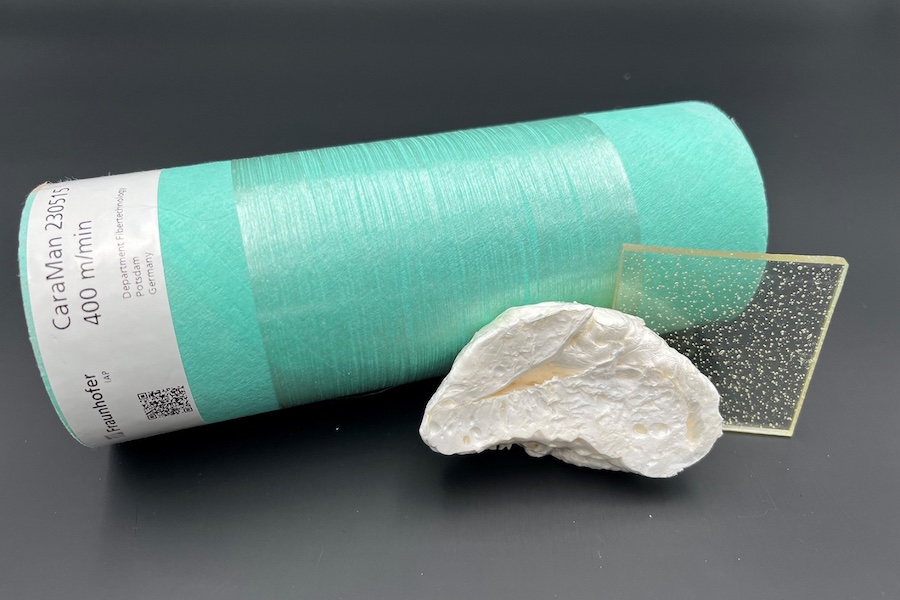
How can new bio-based and biohybrid materials with improved features be developed faster? Six Fraunhofer institutes are jointly exploring this question in the SUBI²MA flagship project, using an innovative bio-based polyamide developed by Fraunhofer researchers as a model. Its specific properties make it a promising alternative to fossil-based plastics.
Monofilaments, foams and plastic glasses made from Caramide. © Fraunhofer IGB


The plastics industry is in flux, as there is an increasing push to replace petroleum-based materials with sustainable alternatives. But sustainability alone is not enough. Bio-based plastics need to be capable of more. In the SUBI²MA flagship project, several Fraunhofer institutes are working to accelerate development of new materials that are not only ecofriendly but also functionally superior. They are focusing on three main goals: further development of new bio-based materials, developing new biohybrid materials and digital fast-track development.

Biological components with functional advantages

The bio-based materials arm of the project focuses on Caramide, a new and completely bio-based form of polyamide. Polyamides are high-performance thermoplastics, and Caramide takes the entire class to the next level. It is derived from 3-carene, a terpene that is produced in large quantities as a by-product of cellulose production. Terpenes are natural organic compounds that are found in many parts of plants, such as leaves, flowers and roots, and are also the main components of resins and essential oils.

Researchers at the Straubing branch of the Fraunhofer Institute for Interfacial Engineering and Biotechnology IGB used 3-carene to develop the monomers 3S-caranlactam and 3R-caranlactam as well as two sorts of Caramide derived from them some ten years back. “In the SUBI2MA project, the shared expertise of six institutes in particular has now allowed us to adopt a new mindset, scale the caranlactams and optimize the Caramides to focus on specific applications,” Paul Stockmann from Fraunhofer IGB explains.

With its special chemical structure, Caramide has unusual thermal properties that make it an excellent candidate for a number of different applications, from gears in mechanical engineering to safety glass, lightweight construction panels, foams, protective textiles and surgical suture materials. Monofilaments, foams and plastic glasses have already been made from the new polyamide, which is not only resistant to high temperatures but also highly adaptable: “During the project, we discovered that the two caranlactams lead to different Caramides with significant differences in properties,” Stockmann says. “The first one, Caramid-S®, has a partly crystalline structure, so it is good for fibers, while the second, Caramid-R®, is what we call amorphous, meaning it has an irregular structure, making it suitable for foams.”

Another characteristic is its chirality, a particular spatial property of molecules in which there are two structural variants that are mirror images of each other but not congruent. This can affect a material’s physical, chemical or biological functions. In the case of Caramide, chirality permits fine-tuning of material properties, for example for specific applications in medical technology or sensors. “Incorporating bio-based components into high-performance polymers produces a functional advantage. It isn’t just that the Caramides are bio-based. They actually offer better performance than fossil-based materials,” Stockmann says.

Biohybrid materials

The project’s second main objective is to develop new biohybrid materials. Incorporation of functional biomolecules is bringing new uses to conventional materials. There are many different areas of application, from bio-based flame retardants for materials to additives or enzymes that accelerate the breakdown of petroleum-based PET. Diagnostic tools such as innovative biosensors and fiber composites that incorporate biomaterials are other fields of use.

“One important feature made possible by integrating specific proteins is water repellency, which is achieved by deliberately changing a material’s surface so that it repels water,” explains Ruben Rosencrantz, a research scientist at the Fraunhofer Institute for Applied Polymer Research IAP. These kinds of materials are used in workplace safety gear and outdoor textiles and in medical applications, for example, where they could replace environmentally harmful substances such as PFAS in the long term.

Digital transformation supercharges material development

The researchers know from experience that material development and substitution take a lot of time, and in many cases it is completely uncertain which specific applications will be best suited to a given material. They aim to change that by pursuing their third objective, fast-track development. To that end, they are harnessing digital solutions for material development: “We are using simulations to create a comprehensive, structured and digital data basis in the lab,” says Frank Huberth from the Fraunhofer Institute for Mechanics of Materials IWM. “Going forward, this digital value chain will bring data-based methods and simulations together to assess property profiles and sustainability at an earlier stage, significantly accelerating development times for both materials and products.” Konrad Steiner from the Fraunhofer Institute for Industrial Mathematics ITWM adds: “Using digital demonstrators for items like protective textiles and tires allows us to skip development steps and evaluate the influences and performance of the new Caramide fibers early on without having to go through the whole long and involved process of producing and testing a textile or an entire tire.”

Outlook: from the lab to application

One important driver in the conceptual design process was the excellent interdisciplinary collaboration on the project among six Fraunhofer institutes — Fraunhofer IGB, IAP, IWM, ITWM, LBF and ICT — along with an external subcontractor. For example, this allowed the partners to overcome a major obstacle, the scaling of synthesis processes. The two monomers can now be produced at the kilogram scale. An increase in funding for the flagship project has also made it possible to test additional demonstrators suitable for industrial use, in some cases in direct collaboration with industry. Plans call for providing the monomers to an associated industry partner in the near future so the partner can use its equipment and facilities to process the starting material for a specific application. “This is a crucial step in advancing the further development of the Caramides to the point of market readiness,” Stockmann says, summing up. “The project is a fresh take on advanced material development that harnesses bio-based substances derived from byproducts along with digital technologies in an interdisciplinary approach.”

More News from Fraunhofer Institute for Applied Polymer Research (IAP)

#Research & Development

Feasibility study shows potential to convert textile waste into PHB bioplastic

Textile waste could serve as a valuable source of raw materials for sustainable plastics in the future, according to the joint TexPHB feasibility study conducted by the Fraunhofer Institute for Applied Polymer Research IAP, Beneficial Design Institute GmbH and matterr GmbH. The study will be presented to the public for the first time at a network meeting on 25 November 2025 at the State Chancellery in Potsdam.

#Recycling / Circular Economy

Closing the Loop in the Textile Industry: Value Creation in the State of Brandenburg

How can the state of Brandenburg benefit from a circular textile industry? This question is addressed in the new policy paper "Closing the loop in the textile industry: Value creation in the state of Brandenburg." Based on the „TexPHB“ feasibility study funded by the Brandenburg Ministry of Climate Protection, it shows how textile waste can be integrated into new value chains.

#Research & Development

Next-generation sustainable carbon fibers: versatile, high-performance and economical

Whether in hydrogen tanks, batteries, fuel cells or for shielding sensitive electronics – carbon fibers are used in a wide range of advanced applications. At the Potsdam Science Park, the Fraunhofer Institute for Applied Polymer Research IAP, in collaboration with Brandenburg University of Technology Cottbus-Senftenberg, is developing novel carbon fibers based on cellulose.

#Research & Development

Fungal mycelium as the basis for sustainable products

Fungi have more to offer than meets the eye. Their thread-like cells, which grow extensively and out of sight underground like a network of roots, offer huge potential for producing sustainable, biodegradable materials. Researchers at the Fraunhofer Institute for Applied Polymer Research IAP in Potsdam Science Park are using this mycelium to develop a wide range of recyclable products, from wallets and insulation to packaging.

More News on Research & Development

#Associations

Young researchers recognised for cutting-edge work in recycling, fibre technology and textile mechanics

At the Aachen-Dresden-Denkendorf International Textile Conference held in Aachen at the end of November, Peter D. Dornier, Chairman of the Walter Reiners Foundation of the VDMA, honoured five successful young engineers. Promotion and sustainability prizes were awarded in the categories bachelor/project theses and diploma/master theses. Academic theses that develop solutions for resource-saving products and technologies, for example, are eligible for the sustainability awards.

#Research & Development

The region of renewable raw materials: Central German Alliance for Bioplastics

The development of sustainable plastic solutions is rapidly gaining importance in light of global environ- mental pollution, dwindling fossil resources and ambitious climate protection targets. As part of the re- gional alliance RUBIO, which brings together 18 partners from central Germany and the Berlin-Branden- burg area, the bio-based and biodegradable plastic polybutylene succinate (PBS) was comprehensively investigated, starting with the raw material, through the manufacturing process, to industrial application.

#Nonwoven machines

Cooperation in the field of meltblown laboratory technology

The Nonwoven Institute (NWI) at North Carolina State University and Oerlikon Nonwoven will be collaborating in the field of meltblown laboratory technology in the future. This was announced by Professor Raoul Farer, Executive Deputy Director of the NWI and Professor at the Wilson College of Textiles at North Carolina State University, and Dr. Ingo Mählmann, Sales Director Nonwoven at Oerlikon Neumag, during this year's ITMA Asia and CITME in Singapore.

#Recycling / Circular Economy

European research project addresses textile waste through integrated recycling technologies

A major European research initiative coordinated by Fraunhofer UMSICHT has been launched to develop integrated solutions for textile waste recycling. The AUTOLOOP project aims to create a comprehensive system that could process 1.24 million tonnes of textile waste annually by 2050, whilst potentially creating over 130,000 green jobs across the EU. This project aims to develop, test and integrate automated sorting, tracing, and closed-loop recycling technologies for polyester-based textiles (NRT), addressing the pressing challenge of textile waste management.

Latest News

#Man-Made Fibers

Teijin Carbon Europe receives EcoVadis Silver status – ranked among the top 15% of evaluated companies

Teijin Carbon Europe (TCE) has been recognized for its sustainability performance and has been awarded the EcoVadis Silver Medal in the latest assessment. In its first-ever EcoVadis evaluation, the company achieved a notable 72 out of 100 points, ranking among the top 15% of all companies evaluated worldwide, within the “Manufacture of Man-Made Fibres” category.

#Weaving

Vandewiele Group: Innovation across the textile value chain at ICFE Istanbul 2026

At the 2026 Istanbul Carpet & Flooring Expo (ICFE), Vandewiele Group presents its latest advancements spanning the entire textile value chain. From spinning and weaving to tufting, carpet manufacturing and digital finishing, the Group demonstrates how integrated innovation can boost performance, efficiency and sustainability across all stages of production. As a global technology leader, Vandewiele continues to develop solutions that strengthen processes, enhance product quality and enable smarter, greener manufacturing.

#Recycling / Circular Economy

Advanced Recycling Conference 2025 fuels innovation across key waste streams

The Advanced Recycling Conference (ARC) 2025 brought together nearly 220 experts from 28 countries to spotlight pioneering advancements and foster industry collaboration in recycling across diverse waste streams including plastics, textiles, automotive and other materials.

#Dyeing, Drying, Finishing

Navis TubeTex announces U.S. partnership with Icomatex

Navis TubeTex, a global leader in advanced dyeing and finishing machinery solutions, is pleased to announce a new partnership with Icomatex (www.icomatex.com), a respected European manufacturer of high-quality stenters and textile finishing equipment. Under this agreement, Navis TubeTex will exclusively represent the Icomatex stenter line in the United States.

TOP