[pageLogInLogOut]

#Research & Development

New approaches to carbon fibre recycling, energy-efficient texturing and the use of microwaves in false-twist texturing

Walter Reiners Foundation Prize awarded to three ITA graduates
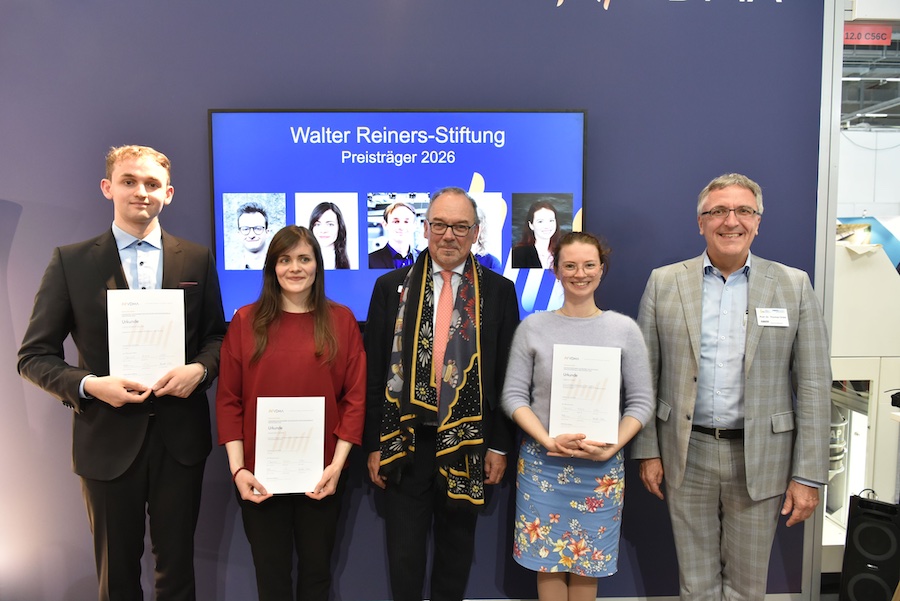
The proud award winners, from left to right: Lukas Balon, Annegret Storm, Peter D. Dornier, Sabina Dann, Professor Dr Thomas Gries. © 2026 Patrick Schibat, German Institutes for Textile and Fibre Research (DITF)
Sabina Dann, Lukas Balon and Annegret Storm from the Institut für Textiltechnik (ITA) of RWTH Aachen University were awarded the Walter Reiners Foundation Prize by the German Engineering Federation (VDMA) for their master’s and bachelor’s theses. Peter Dornier, Chairman of the Walter Reiners Foundation, presented the awards during Techtextil at the VDMA stand in Frankfurt am Main, Germany.

New Approaches in Carbon Fibre Recycling: VDMA Sustainability Award for Innovative Surface Treatment

ITA PhD-student Sabina Dann has been awarded the Master Sustainability Prize of the VDMA Walter Reiners Foundation 2026. The prize, endowed with EUR 3,500, recognises outstanding master’s theses that contribute to sustainable technologies in mechanical engineering.

At the centre of the award-winning thesis titled “Towards Sustainable Waste Management: Electrochemical Surface Treatment of Carbon Fibres for Improved Reclamation and Solvolysis Resistance” is a novel approach for the sustainable recovery of carbon fibres from composite materials. Carbon fibres are a key material in modern lightweight applications, particularly in aerospace, automotive engineering, and mechanical engineering. At the same time, their recycling poses a significant technological challenge due to the sensitive fibre surfaces and complex composite structures.

In the awarded master’s thesis an electrochemical surface treatment of carbon fibres is investigated that is specifically aimed at increasing their resistance to solvolytic recovery processes. Through the formation of stable covalent bonds on the fibre surface, it is ensured that the functional and mechanical properties of the fibres are not lost during the recycling process.

This creates a crucial basis for the reusability of high-performance carbon fibres: instead of a degradation of material properties, the method enables the preservation of performance throughout the entire recovery process.

The benefit of the work lies particularly in its contribution to a genuine circular economy for high-performance composite materials. The results show that carbon fibres can in future not only be recycled, but also specifically stabilised in quality and made available again for industrial applications. This opens up new possibilities for resource-efficient production chains in lightweight construction and mechanical engineering.

Energy-efficient texturing

Lukas Balon was awarded the ‘Master’s Scholarship’ for his Master’s thesis, ‘Development of a CFD model for simulating flow in die-texturing’, along with prize money of EUR 3,500. During texturing, smooth, melt-spun man-made fibre yarns are given a crimped structure to achieve a softer feel, greater elasticity and high heat retention. Textured yarns are therefore used in clothing, upholstery fabrics and carpets. In the compression chamber texturing process, yarns are crimped aerodynamically by a hot air stream. Although the compression chamber is highly productive compared to other processes, it has so far only been suitable for the production of coarse carpet yarns. An expansion into other markets, such as home textiles, has not yet taken place. The reason for this is the complex flow within the compression chamber, which has only been addressed in a rudimentary manner in previous developments. As part of this work, the flow field was therefore first investigated using simulation and subsequently the influence of key process parameters was systematically analysed.

The results provide the first detailed insight into which flow phenomena influence the texturing of the draw chamber and how these can be controlled by adjusting the process parameters. The findings open up a wide range of possibilities for the development of new draw chambers, for example in terms of energy efficiency or novel yarn structures.

Microwaves in false-twist texturing

False-twist texturing is a key component in the production chain for man-made fibres. However, production speed is limited by a phenomenon known as ‘surging’. This causes significant fluctuations in yarn tension, leading to the yarn breaking more readily. The shorter the heater length, the higher the production speeds that can be achieved. Innovative concepts for shorter heaters are therefore necessary for more efficient production.

To this end, in her bachelor’s thesis ‘Analytical Design and Evaluation of a Microwave Heating Technology in the False Twist Texturing Process’, Annegret Storm presented a creative concept for a novel heater that heats the yarn using microwaves rather than convection. To this end, she analytically designed a resonator in which the yarn is to be heated. Using the finite element method, the temperature profiles within the heater were determined numerically. Annegret Storm then compared the microwave heater with a high-temperature heater, which, at approximately 800 mm, is the shortest heater to date. It emerged that the microwave heater enabled a reduction in heater length of approximately 60%.

These results are promising and, if further implemented, could lead to increased production in false-twist texturing. For her bachelor’s thesis, Annegret Storm was awarded the Walter Reiners Foundation’s sponsorship prize and prize money of EUR 3,000.

More News from Institut für Textiltechnik of RWTH Aachen University (ITA)

#Research & Development

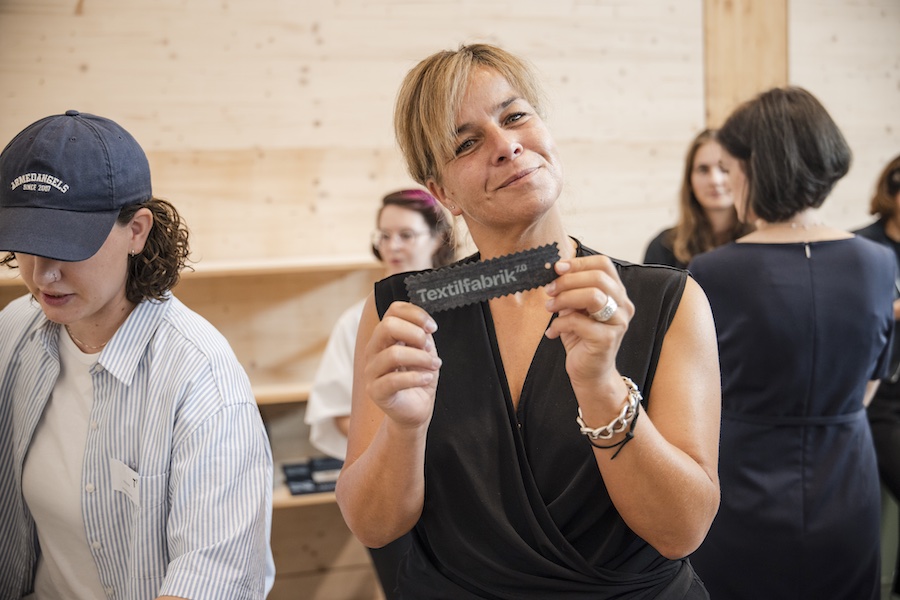
From smart jackets to laser technology: Mona Neubaur explores Textile Factory 7.0

As part of her summer tour, North Rhine-Westphalia’s Minister for Economic Affairs and Climate Action, Mona Neubaur, visited Textilfabrik 7.0 in Mönchengladbach to experience the project’s innovations first-hand. Under the motto “smart and clean”, the visit focused on innovative technologies and sustainable alternatives for textile production - from smart jackets to the decolourisation of textiles using fungal cultures.

#Research & Development

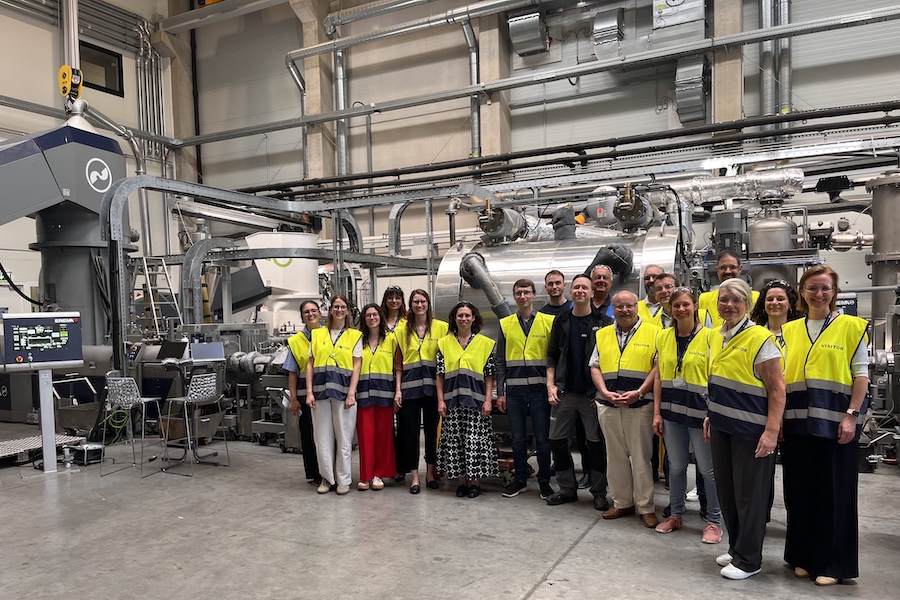
Networking Day 2026: Industry stakeholders unite around textile recycling

In 2026, the Industry Research Group (IRG) Polymer Recycling once again brought together some of the key stakeholders in textile recycling for its annual Networking Day. This year, the event took place at EREMA’s premises in Ansfelden, Austria. It brought together key players from across the textile recycling value chain for a day of structured exchange and in-depth discussions.

#Research & Development

2026 general meeting of the Friends and Supporters of RWTH Aachen at ITA

The Friends and Supporters of RWTH Aachen e. V. (proRWTH) looked back on a successful year of support at their 2026 general meeting. The meeting took place at Institut für Textiltechnik (ITA) of RWTH Aachen and was combined with a joint session of the Executive Board and the Administrative Board. Before the general meeting began, participants were given a guided tour of ITA, providing them with fascinating insights into current research and development topics in textile engineering.

#Research & Development

TERNAfil wins first place at PitchMiUp Night 2026 in Minden

The RWTH spin-off TERNAfil has developed MAXCarbon, a new high-performance hybrid fibre that combines the mechanical performance of carbon with the temperature and corrosion resistance of ceramic materials. For this development, TERNAfil was awarded first prize at the PitchMiUp Night in Minden on 21 May 2026.

More News on Research & Development

#Research & Development

Novel flame-retardant and recyclable fiber-reinforced composite

Airplanes and passenger trains must meet strict safety requirements, including fire safety standards. This calls for materials that are flame-retardant, lightweight, robust, and scalable. Empa researchers, in collaboration with their industry partner Elantas, have now succeeded for the first time in making such a material – a composite – fully recyclable.

#Research & Development

MELANGE starts with a co-creative design workshop at Aalto University to shape the visual identity of this new project transforming colouration in textiles

Over the next three years, MELANGE will lower the environmental impact of interior textile production by moving colour design to the beginning of the manufacturing process. This Horizon Europe project officially started on 1 August 2026, and will be publicly launched on 27 August 2026.

#Research & Development

Outdoor Industry Association completes Clean Heat CoLab initiative

The Outdoor Industry Association (OIA) has completed its multi-year Clean Heat CoLab initiative, bringing together outdoor brands and technology experts to accelerate the adoption of electrified process heating in textile manufacturing. The collaboration focused on reducing emissions from thermal processes such as dyeing, washing and finishing, which remain among the most carbon-intensive stages of textile production.

#Research & Development

Europe is committed to recycling end-of-life wind turbine blades

Starting in 2026, Europe’s wind energy industry has committed itself to ensuring that wind turbine blades do not end up in landfills once they reach the end of their service life. The EU-funded research project REWIND is exploring ways to reuse this composite waste. The German Institutes of Textile and Fiber Research Denkendorf (DITF) are one of 13 project partners from seven countries.

Latest News

#Spinning

Heberlein reinforces its commitment to the Chinese market

Heberlein, globally recognised as a leading provider of air interlacing and air texturing jets for synthetic filament yarns, is consolidating its success in the Chinese market with its APh- and APe-series for DTY applications. Particularly in the field of Air Covering, Heberlein technologies combine excellent quality with significant savings in compressed-air consumption. A new service hub in Shengze City underlines the company’s long-term commitment in the Chinese market.

#Raw Materials

Redesigned World Cotton Day website offers tools, ideas and inspiration

With World Cotton Day just one month away, the International Cotton Advisory Committee (ICAC) has launched a completely redesigned www.WorldCottonDay.com, creating a new global home for everyone who wants to learn about, celebrate, and support cotton.

#Recycled Fibers

RE&UP’s Next-Gen Cotton fibers power Zalando private label t-shirt collection crafted from innovative recycled textiles

RE&UP Recycling Technologies’ Next-Gen Cotton powers a new collection from Zalando’s private labels, marking a step forward in bringing textile-to-textile recycled fibers into commercial fashion production. Launching on Zalando in August, the collection comprises five t-shirts across YOURTURN by Zalando and Even&Odd by Zalando, made from a circular-knit fabric blending 80% organic cotton with 20% RE&UP Next-Gen Cotton — textile-to-textile recycled fiber produced from textile waste. This is the first time RE&UP's recycled fibers feature in Zalando's private label assortment.

#Heimtextil 2027

Heimtextil Trends 27/28: ‘Home-Maxxing’ between performance and respite

Sleep better, recover faster, live more efficiently: the desire for optimisation has long since reached our homes. Under the title ‘Home-Maxxing – The Performance of Everyday Living’, Heimtextil Trends 27/28 show how our relationship with efficiency-driven thinking and technology is influencing the design of spaces and textiles. The more sleep, wellness, routines, materials and spaces are optimised, the stronger the desire for a home that does not demand even more of us.

TOP