[pageLogInLogOut]

#Research & Development

Evonik and LIKAT discover new type of hydroformylation
© 2022 Evonik
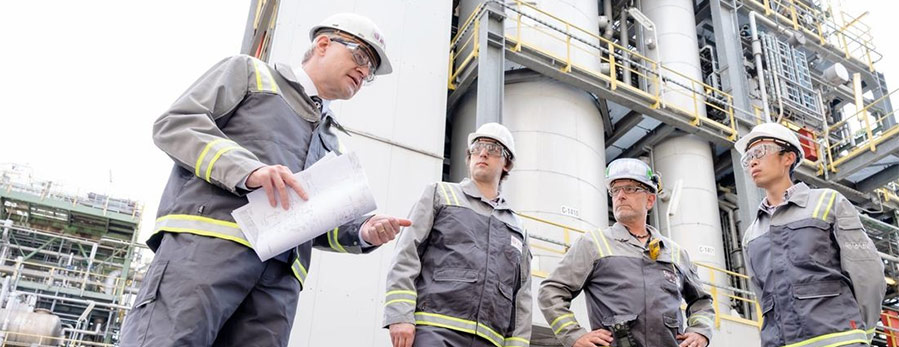
A research team involving Evonik and the Leibniz Institute for Catalysis (LIKAT) has made another breakthrough in the field of hydroformylation. Hydroformylation is one of the most important reactions in industrial organic chemistry. Unsaturated compounds are converted into aldehydes and alcohols using synthesis gas.
  • A research team involving Evonik and the Leibniz Institute for Catalysis has made another breakthrough in the field of hydroformylation.
  • Contrary to accepted doctrine, the reaction also works at low pressures with a stable catalyst
  • Discovery opens way to cost-effective and environmentally friendly production of aldehydes and alcohols

Special recognition through publication in renowned journal Science

Until recently, the scientific consensus was that this reaction, if catalyzed with cobalt, could only be carried out under high pressure conditions without the catalyst decomposing. This was disproved by Professor Dr. Robert Franke, head of hydroformylation research at Evonik, together with research partners from LIKAT, Dr. Baoxin Zhang and Dr. Christoph Kubis. "With this discovery, we have identified new process options for hydroformylation," says Franke, who is also a professor of chemistry at Ruhr University in Bochum. "In the future, it may be possible to make this large-scale reaction much more economical and environmentally friendly. Developing these processes will be our task for the next few years."

The researchers succeeded in demonstrating, for the first time, that cobalt carbonyls - very inexpensive compounds for the catalysis of hydroformylation - are active and stable even at low pressures. The key to this discovery was the development of special spectroscopic measurement methods and associated mathematical tools for data evaluation.

High-pressure processes that use cobalt carbonyls as catalysts could be replaced in the future by new processes with lower pressures. These new processes would then be more cost-effective, energy-efficient and thus more sustainable. At Evonik, this would have an impact on the production of long-chain alcohols such as the oxo alcohol isononanol (INA), which is used, among other things, to manufacture plasticizers.


Due to the particular importance of this discovery, the renowned journal Science published the results of the project. This is Professor Dr. Robert Franke's second appearance in Science on carbonylation reactions. In 2020, Franke succeeded in a so-called 'dream reaction': the direct carbonylation of 1,3-butadiene. This discovery was also worthy of publication in the journal.


Link to the article:

https://www.science.org/stoken/author-tokens/ST-725/full

More News from TEXDATA International

#Texprocess 2026

Texprocess 2026: Automation, digitalisation and AI redefine textile processing

Making investment decisions in textile processing has become significantly more demanding. Increasing energy costs, a shortage of skilled labour and ongoing geopolitical uncertainties are compelling companies to focus on technologies that deliver clear gains in efficiency and process reliability. This applies equally to apparel manufacturing and to the processing of technical textiles and high-performance materials. As a result, modernisation initiatives are assessed more carefully – even as the need to upgrade production systems continues to intensify.

#Techtextil 2026

Techtextil 2026: Between innovation pressure & market reality

From 21 to 24 April 2026, Techtextil in Frankfurt am Main will once again become the central meeting point for the international technical textiles and nonwovens industry. Running in parallel, Texprocess will focus on the industrial implementation of textile processing technologies as the leading platform in this field. Together, the two trade fairs form a closely integrated presentation and working platform along the entire textile value chain – from material development to finished applications.

#Techtextil 2026

Between geopolitical pressure and industrial resilience

In this interview, Dr. Janpeter Horn (VDMA) discusses the current challenges facing textile machinery manufacturers, shaped by geopolitical tensions, regulatory developments and subdued investment. He also outlines why innovation strength, integrated solutions and strategic positioning remain key to global competitiveness.

#Texprocess 2026

Between investment restraint and modernization pressure

Texprocess 2026 takes place in a complex market environment shaped by uncertainty and innovation pressure. In this interview, Elgar Straub (VDMA) explains why the trade fair is particularly relevant this year and which technologies are driving efficiency and competitiveness.

More News on Research & Development

#Research & Development

Textile climate control system in workwear – exhibition at the 2026 SME Innovation Day!

Conventional protective workwear often reaches its limits during strenuous physical activity. In particular, the transport of sweat and excess body heat poses a problem. The German Institutes of Textile and Fiber Research (DITF) conducted research on flow-optimized, air-conducting textile structures that enable targeted climate control directly on the body. These structures can be integrated straight into protective work garments. The textile climate control system supports the body’s natural thermoregulation. This contributes to improved workplace safety and comfort.

#Research & Development

Elastic yarns to become more recyclable and environmentally friendly in future

On 29 April 2026, ITA student Tobias Dickmeiß was awarded a sponsorship prize by the Wilhelm Lorch-Stiftung for his innovative approach, to replacing conventional elastane with elastic yarns made from thermoplastic copolyester elastomers (TPC). Thanks to their thermoplastic nature and compatibility with typical polyesters used in the textile industry, elastic TPC yarns offer improved recyclability. Furthermore, the use of the melt-spinning process in yarn production eliminates the need for solvents that are harmful to the environment and human health.

#Research & Development

Walter Reiners Foundation Prize awarded to three ITA graduates

Sabina Dann, Lukas Balon and Annegret Storm from the Institut für Textiltechnik (ITA) of RWTH Aachen University were awarded the Walter Reiners Foundation Prize by the German Engineering Federation (VDMA) for their master’s and bachelor’s theses. Peter Dornier, Chairman of the Walter Reiners Foundation, presented the awards during Techtextil at the VDMA stand in Frankfurt am Main, Germany.

#Techtextil 2026

Young talents honoured – 60 years Walter Reiners Foundation

At the Techtextil trade fair in Frankfurt at the end of April, Peter D. Dornier, chairman of the VDMA’s Walter Reiners Foundation, presented awards to five successful young engineers. Promotion and sustainability awards were presented in the categories of bachelor’s/project theses and diploma/master’s theses. Academic theses are eligible for the sustainability awards if, for example, they develop solutions for resource-efficient products and technologies.

Latest News

#INDEX 2026

“We clearly see that reliability, flexibility, service and total cost of ownership are becoming increasingly important again.”

The nonwovens industry continues to face a challenging market environment. Nevertheless, AUTEFA Solutions reports successful projects, new line sales and growing demand for energy-efficient and flexible solutions. In this interview, André Imhof of AUTEFA Solutions talks about competitiveness against Chinese suppliers, new service and recycling concepts, the growing importance of application development and the opportunities created by countercyclical investments.

#INDEX 2026

“Needle punching technology is more universal and sustainable than ever!”

Needle punching technology was long regarded as a rather traditional and comparatively slow technology within the nonwovens industry. In this interview, Johann Philipp Dilo explains why needle punching is more relevant than ever today – ranging from energy efficiency and resource conservation to hygiene applications, new machine concepts and design-oriented nonwoven solutions.

#Nonwovens

PET spunbond from China – EDANA welcomes imposition of provisional anti-dumping measures

On 13 May 2026, after eight months of investigation, the European Commission imposed provisional anti-dumping duties of 45.6-50.0% on imports of PET spunbond from China. EDANA welcomes this expression of the Commission’s clear determination to protect EU industries from the unfair trade practices of Chinese producers.

#INDEX 2026

ANDRITZ at INDEX ’26: Driving sustainability with next-generation nonwoven technologies

From May 19-22, ANDRITZ Nonwoven & Textile is presenting its innovative solutions for the nonwoven & textile industry in Geneva, Switzerland. ANDRITZ will focus on technologies for sustainable and durable nonwovens, converting, sustainable fiber processes, textile recycling, and life-cycle services on booth 2114 in hall 02.

TOP