[pageLogInLogOut]

#Research & Development

Textile impulses for the future: Aachen-Dresden-Denkendorf International Textile Conference 2021
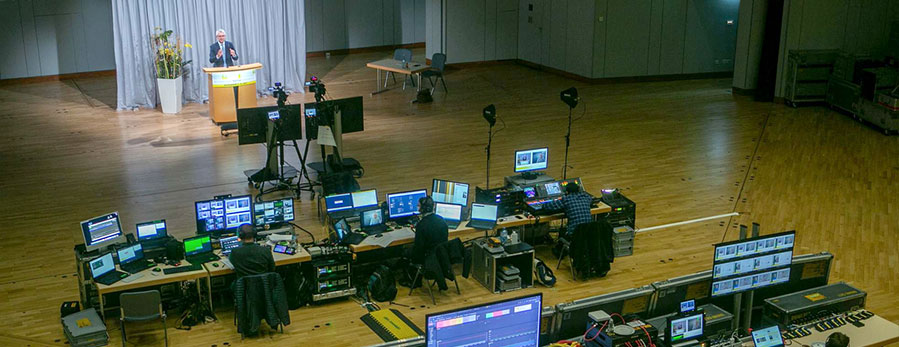
The event took place digitally this year. Photo: DITF Denkendorf
The Aachen-Dresden-Denkendorf International Textile Conference was held in Stuttgart on November 9 and 10. The German Institutes of Textile and Fiber Research Denkendorf (DITF) organized a digital event this year after the conference in 2020 was cancelled due to Covid-19. 360 participants from 25 countries and four continents took the opportunity to be present at one of the most important European technical congresses.

Permanent Secretary Michael Kleiner delivered a message of greeting from Nicole Hoffmeister-Kraut, Minister of Economics, Labor and Tourism Baden-Württemberg, who praised the successful program of the textile industry get-together. The conference is organized annually in alternation by the institutes ITM Dresden, DWI Aachen and DITF Denkendorf.
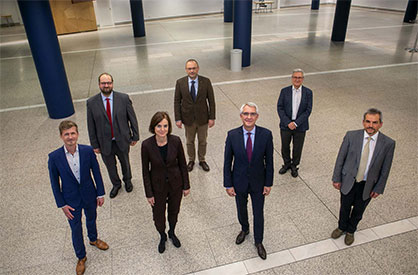
Chairs of the first day of the event (from left: Johannes Diebel, FKT, Jochen Gutmann, DTNW, Maike Rabe, Niederrhein University of Applied Sciences, Michael R. Buchmeiser, Götz T. Gresser, Michael Doser, Thomas Stegmaier, DITF. Not in the picture: Thomas Gries, ITA). Photo: DITF Denkendorf


More than 60 lectures in plenary sessions and three parallel sessions were on the program. Experts from industry and research reported on research results and marketable textile innovations in the fields of high-performance fibers, fiber composites, medical textiles, functionalization and textile machine construction. The topics of the conference focused on the upheavals that the textile industry has to cope with due to the digital transformation and the requirements of a sustainable circular economy.
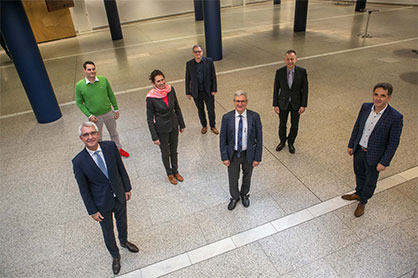
Chairs of the second day of the event (from left: Götz T. Gesser, DITF, Fabian Schreiber, TITV, Heike Illing-Günther, STFI, Christoph Riethmüller, DITF, Michael Doser, DITF, Ansgar Paschen, TFI, Andrij Pich, DWI. Not in the picture: Thomas Fischer, DITF). Photo: DITF


The possibilities for textile applications are vast. Whether mobility with fiber composites, architecture with modern building materials or smart textiles for everyday work, health or for new extraordinary sports - there is hardly any area of life where high-tech textiles do not contribute to solving future challenges. The session "quo vadis textile machine concepts" showed that there is also still a lot of innovation potential in terms of methods and processes, which is being exploited.


Under the motto "From idea to practice", the Forschungskuratorium Textil e. V. presented successful cooperation projects from the IGF-ZIM program in a separate transfer session, in which representatives from science and industry jointly developed and successfully implemented products and processes.
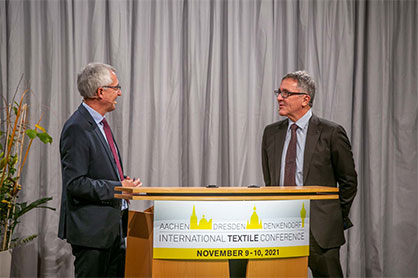
Götz T. Gresser (DITF, left) and Thomas Gries (ITA) lead the virtual discussion room of the first plenary session.


Speakers from this year's partner countries Portugal and Spain gave a comprehensive insight into the textile industry and research of both countries with lectures and discussion contributions.

The conference program was complemented by a virtual exhibition of companies and institutes as well as more than 100 scientific posters. Three of the poster presentations were awarded the Best Poster Award of the Aachen-Dresden-Denkendorf International Textile Conference 2021.

About 20 technicians and six interpreters were on duty to transmit the presentations and discussions around the world. The next ADD International Textile Conference will again be held as a face-to-face event as usual. On December 1 and 2, 2022, the DWI invites you to Aachen.

More News from Deutsche Institute für Textil- und Faserforschung Denkendorf

#Research & Development

Fabolose: Fabricating vegan and circular leather alternatives from bio-tech-derived cellulose

Fabulose is an EU funded project coordinated by the German Institutes of Textile and Fiber Research (DITF). Its consortium consists of leading research institutes, biotech innovators, and industry stakeholders who aim to create high-performance, biobased and recyclable leather-like fabrics, using efficient biotech production routes for bacterial cellulose, cyanophycin and bacterial pigments

#Research & Development

More safety and comfort for protective clothing thanks to auxetic fabrics

When everyday materials are pulled, they stretch or elongate in the direction of the pull and become narrower in cross-section. We can also observe this property in two-dimensional textiles. Auxetic structures behave differently here. They have the striking property of not changing under tensile stress or even increasing their width or thickness. These properties are advantageous, for example, in protective textiles or textile filter media. The DITF are researching auxetic fabrics for various applications.

#Research & Development

Panty liners prevent bacterial vaginosis

Worldwide, almost one third of women of childbearing age suffer from bacterial vaginosis. This is when the sensitive microbiome of the vagina becomes unbalanced. Such a disorder of the vaginal flora can cause urogenital infections, abscesses on the ovaries or fallopian tubes or premature births. This significantly increases the risk of infertility in women and of contracting a sexually transmitted disease or HIV.

#Research & Development

DITF send a signal for climate protection

The German Institutes of Textile and Fiber Research Denkendorf (DITF) have successfully implemented extensive investments in photovoltaic systems at their site in Denkendorf. The systems installed on the roofs of the buildings and covered parking lots have a total installed capacity of 840 kilowatt peak (kWp). The DITF invested 1.6 million euros in this with the support of the state of Baden-Württemberg. The system was ceremonially put into operation on September 17, 2025.

More News on Research & Development

#Composites

More affordable, environmentally friendly hydrogen pressure tanks at ITA-JEC booth

As a highlight of the JEC, the Institut für Textiltechnik (ITA) of RWTH Aachen University will be presenting hydrogen pressure tanks manufactured using multifilament winding processes at the NRW joint booth in Hall 5, Stand G65.

#Research & Development

Pioneer of the first hour: Michael Carus steps down after more than 30 years from nova-Institute’s Management

After more than three decades at the helm, founder and CEO Michael Carus is set to step down as head of the Renewable Carbon division on 1 March 2026. Lars Börger as the new CEO, will take over this key position of the nova-Institute together with COO Linda Engel, while Carus will remain with the research and consulting company as a senior advisor and shareholder. This change takes place after a one-year transition phase, as planned.

#Man-Made Fibers

Toray develops AURLIST™ polyester filament fiber with luxurious luster and ultra-fine structure

Toray Industries has developed AURLIST™, a new polyester filament fiber designed to combine luxurious luster, soft loft and a subtle fibrillated surface texture. The company primarily targets applications in women’s apparel such as tops, bottoms and dresses.

#Sustainability

The nova-Institute establishes new Renewable Feedstock Department to lay the groundwork for industrial defossilisation

The transition from fossil-based to renewable carbon – sourced from biomass, CO₂ utilisation and recycling – is the cornerstone of a climate-neutral chemical industry. The nova-Institute’s new department is dedicated to providing the essential data, analyses and strategic roadmaps required to secure a reliable future feedstock supply and make this transition a commercial and ecological reality.

Latest News

#Spinning

Barmag presents the next generation of POY production – energy-efficient and partial-automated

With POY 2.0, Barmag is introducing a completely redesigned spinning concept that takes the production of partially oriented yarn (POY) to a new level in terms of technology and economy. The solution, which was presented to a selected audience of experts for the first time at ITMA Asia + CITME 2025, was met with great enthusiasm: several yarn producers worldwide immediately expressed their interest in a pilot plant.

#Textile chemistry

DyStar Group Announces Board Transition to Drive Innovation

DyStar, a leading specialty chemical company with a heritage of more than a century in product development and innovation, announced today the appointment of Ruan Cunfan to its Board of Directors, effective 20 February 2026.

#Recycling / Circular Economy

Textile‑to‑textile recycling leader Circulose joins Spinnova’s ecosystem to accelerate technology scale‑up

Textile‑to‑textile recycling leader Circulose joins Spinnova’s ecosystem (consortium) to help advance the scale‑up of Spinnova’s technology. Spinnova has actively sought partners to accelerate commercial scale‑up, and Circulose, as a key player in textile recycling, strengthens the ecosystem by providing a raw material that is in high demand across the industry.

#Yarns

UNIFI® introduces Luxel™: A Linen-inspired, easy-care performance yarn

Unifi, Inc. (NYSE: UFI), the makers of REPREVE® and one of the world’s leading innovators in recycled and synthetic yarns, today announced the launch of Luxel™, a groundbreaking yarn technology that combines the luxurious look and feel of linen with high-performance, easy-care, and textile-to-textile recycled materials.

TOP