[pageLogInLogOut]

#Research & Development

Textile cascade filter for removing microplastics from wastewater
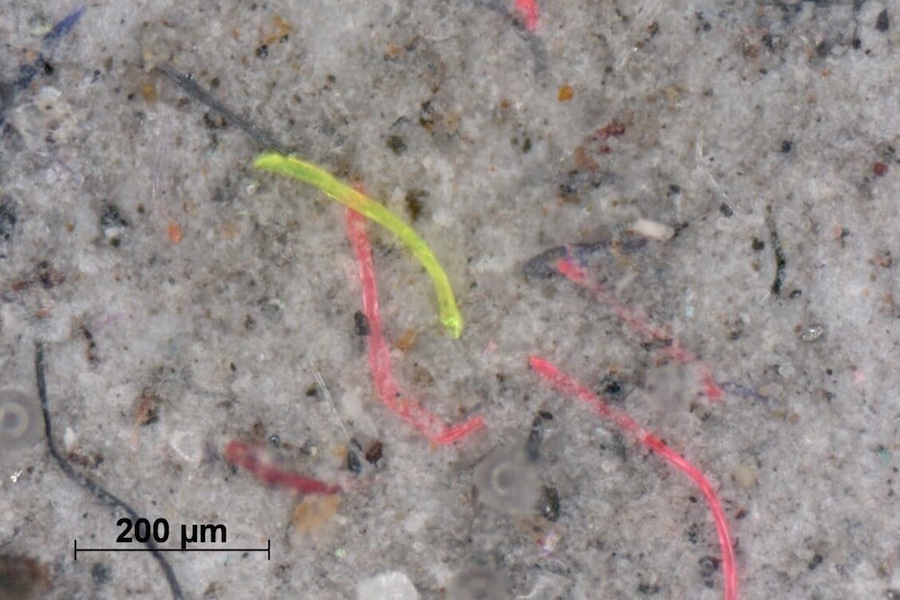
Exemplary picture of a filter cake with deposited microplastic fibers. Photo © 2026 DITF
Microplastics are now found almost everywhere, even in remote regions of Antarctica. They enter the human body through the food chain. Studies indicate that microplastics may have negative effects on the human health.

One important source of microplastic pollution is the washing of textiles made from synthetic fibers. During washing, significant amounts of microplastics are released into wastewater and then enter aquatic ecosystems. To address this problem, the German Institutes of Textile and Fiber Research Denkendorf (DITF) have developed a textile-based cascade filter system.

The amount of microfibers released per wash cycle and per kilogram of textiles is estimated to range from 12 and 1,400 milligrams. Wastewater treatment plants are already able to remove a large portion of microplastic particles from wastewater, with removal rates of up to 99 percent. However, because of the high volume of wastewater discharged every day, these plants can still contribute significantly to microplastic pollution in the environment.

To date, various mechanical and chemical technologies have been used in wastewater treatment. Filter cascades, on the other hand, have mainly been applied for the analysis and characterization of microplastic particles. In their study, the DITF researchers demonstrated that specialized textile-based filter cascades are also capable of effectively removing microplastics from rinse water in industrial laundries. This is possible even at low water pressure. In addition, the system has a simplified design and requires little maintenance.

The cascade microfilter developed by the Denkendorf research team consists of three filtration stages. Each stage uses a three-dimensional textile sandwich composite made of polypropylene fabric and a 3D spacer knit. The stages have progressively smaller pore sizes, allowing the removal of microplastic particles down to 1.5 μm.
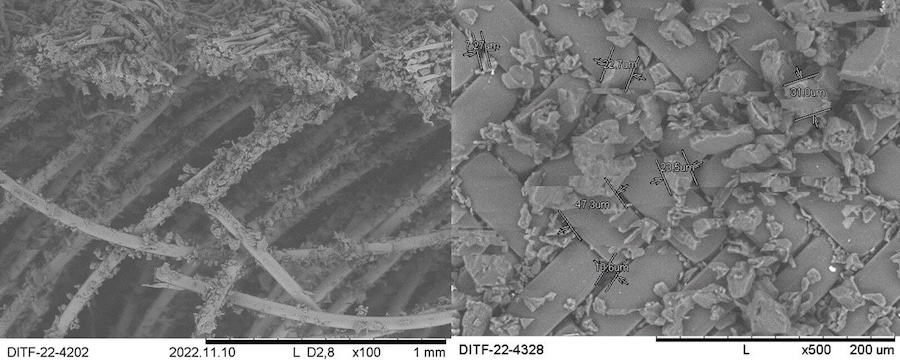
Left: Filter cake structure on 3D warp-knitted fabric cross-section, upstream side. Right: Microplastic particles on filter-woven fabric, upstream side. Images © 2026 DITF


A compressed-air backwashing system is integrated to clean the filter and restore its performance. Because the filter cake moves from the fabric to the spacer layer, backwashing is needed less often, and the operating time can be increased by up to 155 percent.

Field trials at an industrial laundry and a municipal wastewater treatment plant confirmed a separation efficiency of 89.7 percent and 98.5 percent for the microfilter cascade. It can thus make a significant contribution to reducing microplastic pollution.

The high microplastic separation efficiency and the long service life of the filter medium make the system a promising solution for wastewater treatment. It is cost-effective, space-saving, and can be adapted to different applications and scales.

The textile composite medium developed at the DITF can be tailored to meet a variety of filtration requirements beyond its application in microplastic filtration.
More News from Deutsche Institute für Textil- und Faserforschung Denkendorf

#Research & Development

ALADIN paves the way for circular and demand-driven textile production in Europe

Textile production can be organized sustainably by utilizing short supply chains and preventing overproduction. This can already be achieved today by intelligently connecting and efficiently utilizing existing infrastructure. At the same time, production becomes circular when innovative technologies and materials are used that enable high-quality recycling. The ALADIN research project, launched in May 2026 and co-funded with five million euros under the EU Horizon Europe program, is creating the conditions for this.

#Research & Development

Textile climate control system in workwear – exhibition at the 2026 SME Innovation Day!

Conventional protective workwear often reaches its limits during strenuous physical activity. In particular, the transport of sweat and excess body heat poses a problem. The German Institutes of Textile and Fiber Research (DITF) conducted research on flow-optimized, air-conducting textile structures that enable targeted climate control directly on the body. These structures can be integrated straight into protective work garments. The textile climate control system supports the body’s natural thermoregulation. This contributes to improved workplace safety and comfort.

#Techtextil 2026

Stylish design made from sustainable materials – two DITF research projects receive Techtextil Innovation Awards

Materials made from domestic, renewable raw materials reduce CO₂ emissions, prevent microplastics from entering the environment, and close the material cycle. The German Institutes for Textile and Fiber Research Denkendorf (DITF) are developing nature-based alternatives to synthetically produced and predominantly petroleum-based materials. Two research projects have received a prestigious Techtextil Innovation Award. NUO Flexholz and the lignin-coated material FormLig demonstrate that sustainable concepts can meet high standards of functionality and design. Both projects were carried out in close collaboration with industry.

#Research & Development

Fabolose: Fabricating vegan and circular leather alternatives from bio-tech-derived cellulose

Fabulose is an EU funded project coordinated by the German Institutes of Textile and Fiber Research (DITF). Its consortium consists of leading research institutes, biotech innovators, and industry stakeholders who aim to create high-performance, biobased and recyclable leather-like fabrics, using efficient biotech production routes for bacterial cellulose, cyanophycin and bacterial pigments

More News on Research & Development

#Associations

Meadow Grove Research joins ITMF as Corporate Member

Meadow Grove Research is a commodity research firm specializing in supply, demand, and trade analysis in cotton and other soft commodities. Providing clarity to the complex nature of the global fiber supply chain is one of its most formidable services. The firm thrives on customer engagement and providing the best framework for critical decisions.

#Research & Development

TERIS reaches milestone: Fraunhofer consortium develops new standards for tire analysis

In the “TERIS” project, the Fraunhofer institutes ICT, IGD, and IWM—led by the Fraunhofer Institute for Structural Durability and System Reliability LBF—have reached a decisive milestone. For the first time, the teams aim to generate, analyse, and predict tire wear in the laboratory in a standardized and practical manner. As part of this milestone, results are now available on reference abrasion, particle analysis, tribological models, AI-based surface analysis, a test bench concept, and methods for accelerated aging and VOC detection. The tire industry, testing services, and environmental agencies will in future benefit from reliable, rapid laboratory procedures for emissions assessment.

#Research & Development

Geotextiles made from recycled materials: GREEN leads the way into the industry

For the industry, recycled materials are creating new opportunities in geotextile production. In the GREEN project, the Fraunhofer Cluster of Excellence Circular Plastics Economy CCPE demonstrates that recycled polypro-pylene (PP), polyethylene terephthalate (PET), and high-density polyeth-ylene (HDPE) can be processed into nonwovens, fibers, and membranes that meet industrial requirements. This creates opportunities for use in existing production lines and new value chains in the geotextile market.

#Research & Development

2026 general meeting of the Friends and Supporters of RWTH Aachen at ITA

The Friends and Supporters of RWTH Aachen e. V. (proRWTH) looked back on a successful year of support at their 2026 general meeting. The meeting took place at Institut für Textiltechnik (ITA) of RWTH Aachen and was combined with a joint session of the Executive Board and the Administrative Board. Before the general meeting began, participants were given a guided tour of ITA, providing them with fascinating insights into current research and development topics in textile engineering.

Latest News

#Spinning

Rieter sees Barmag integration on track as orders and sales rise

The first half of 2026 was shaped by the successful completion of the largest acquisition in Rieter’s history. The Man-Made Fiber Division enables entry into the growth segment of man-made fibers and sustainably strengthens Rieter’s market position in the Asia region. The expanded Group is now the world’s leading system supplier for the processing of natural and man-made fibers. In the first half of the year, initial cost savings in material costs and operating expenses have already been realized. The targeted synergies are expected to amount to at least CHF 20 million by the end of the 2028 financial year. Due to the completion of the acquisition on February 2, 2026, the first half of the year for the Man-Made Fiber Division only amounts to five months.

#Knitting & Hosiery

Groz-Beckert at Igatex 2026

From October 15 to 18, 2026, Groz-Beckert will present its latest innovations and solutions across the product areas of Knitting, Weaving, Sewing and Spinning at Igatex in Pakistan (Hall 1, Booth A-1-08).

#Natural Fibers

Better Cotton Initiative multistakeholder event in US unpacks regenerative agriculture potential

The Better Cotton Initiative (BCI), in collaboration with Texas-based partner, Quarterway Cotton Growers, will expand upon its annual US field event to relay the vast potential of regenerative agriculture through an immersive experience of tours and demonstrations.

#Sustainability

bluesign appoints Hanane Taidi as CEO to lead next phase of global impact

bluesign, which partners with the textile industry to reduce adverse impact across the value chain, appoints Hanane Taidi as Chief Executive Officer, marking a pivotal moment as the company builds on its leadership amid rapid industry change.

TOP