#Nonwovens / Technical Textiles
Virtual quality inspection optimizes production of filter nonwovens
The abbreviation »ProQuIV« stands for »Production and Quality Optimization of Nonwoven Infection Protection Clothing«. This is because bottlenecks in the production of these materials were particularly evident at the beginning of the Covid 19 crisis. For the meltblown nonwovens, this optimization of the product quality is also particularly difficult because the textiles react very sensitively to fluctuations in the manufacturing processes and material impurities.
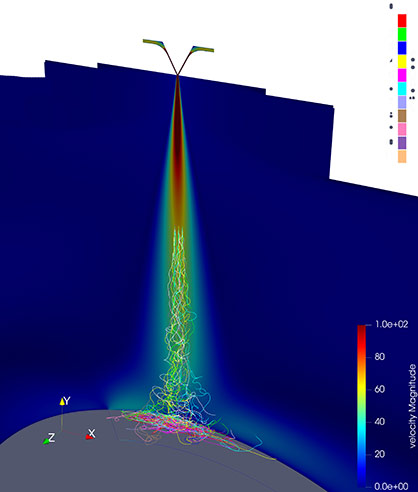
Digital Twin Keeps an Eye on the Big Picture»Meltblown« is the name of the industrial manufacturing process whose ultra-fine fiber nonwovens are responsible for providing the crucial filtering function in face masks. In this process, the molten polymer is forced through nozzles into a forward-flowing, high-speed stream. It is stretched and cooled in a highly turbulent air flow.
»The overall process of filter media production – from the polymer melt to the filter medium – presents a major challenge in simulation,« explains Dr. Konrad Steiner, head of the »Flow and Materials Simulation« department. »In the project, we kept the big picture in mind and developed a completely integrated evaluation chain as a digital twin. In doing so, we take several key components into account at once: We simulate the typical production processes of nonwovens, the formation of the fiber structures and then the material properties – here, in particular, the filter efficiency. This allows us to quantitatively evaluate the influences of the manufacturing process on the product properties.« In each of these individual areas, Fraunhofer ITWM and its experts are among the leading research groups internationally.
Homogeneity of the Material – Fewer Clouds in the Simulation Sky
In the meltblown process, a key factor is the behavior of the filaments in the turbulent, hot and fast air flow. The properties of the filaments are strongly influenced by this air flow. The quality of the filaments – and thus the quality of the nonwovens – is influenced by many factors. Dr. Dietmar Hietel, head of the »Transport Processes« department, knows what this means more precisely in practice. His team has been working at Fraunhofer ITWM for years on the simulation of various processes involving filaments, threads, and fibers. »The focus of the project is the so-called cloudiness, i.e. the non-uniformity of the fiber distributions in the nonwoven,« explains Hietel. »We are investigating the question: How homogeneous is the fabric? Because the quality of the products can be greatly improved if we increase the uniformity. Our simulations help figure out how to do that.«
Objective Evaluation of the Homogeneity of Nonwovens
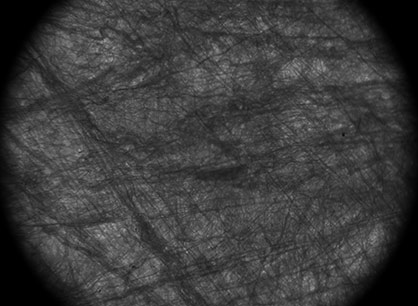
The researchers also use appropriate image analysis techniques to quantify this cloudiness. The power spectrum plays a special role here. »The cloudiness index (CLI) describes homogeneity complementary to local basis weight and its variance,« describes Dr. Katja Schladitz. She brings her expertise in image processing to the project. »Our CLI ensures a robust assessment of the homogeneity and can thus be used for different material classes and imaging techniques to be used as an objective measure.« The frequencies that go into the CLI calculation can be chosen so that the CLI is meaningful for the particular application area.
Filtration: How Efficient Are the Filters?
For the upscaling to industrial processes such as mask production, the ITWM expertise in filters is also included in the project. The »Filtration and Separation« team led by Dr. Ralf Kirsch has been working for years on the mathematical modeling and simulation of various separation processes.
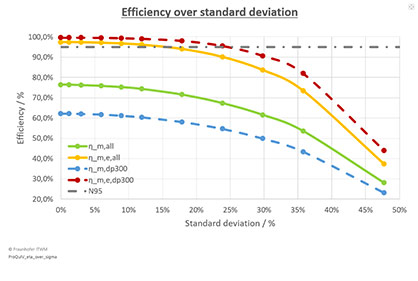
»What's special about this project is that we calculated the efficiency of the filters for fluctuations of varying degrees in the fiber volume fraction,« emphasizes Kirsch. »This allows us to specify up to what level of cloudiness the required filter efficiency can be achieved at all.« As a current example of this, the figure depicts in the graphic the efficiency of a filter material for N95 masks as a function of the inhomogeneity of the nonwoven.
ITMW Methods Support Across the Entire Process Chain
In »ProQuIV«, digital twins and calculations from Fraunhofer ITWM support a holistic view and better understanding of the processes. The production of technical textiles thus not only becomes more efficient, but the nonwovens can be developed virtually without having to realize this in advance in a test facility. In this way, production capacities can be increased while maintaining or even increase the quality. Together with long-term partners from industry, the research can be put into practice quickly and efficiently.
Simulations save textile companies experiments, allow new insights, enable systematic parameter variations and solve upscaling problems that can otherwise lead to bad investments during the transition from laboratory plant to industrial plant. However, virtual implementation of nonwoven production also opens up new opportunities for optimization at other levels. For example, acoustic insulating nonwovens or even hygiene nonwovens can also be optimized in terms of their product quality precisely with regard to the material properties to be achieved – while taking into account the process fluctuations that occur.
The project is part of the Fraunhofer-Gesellschaft's »Fraunhofer versus Corona« program and was completed in April 2021. The results will flow into several follow-up projects with the nonwovens industry.