[pageLogInLogOut]

#Knitting & Hosiery

Mayer & Cie. celebrates anniversary: 120 years of textile machinery from Albstadt

On July 8, 2025, Mayer & Cie will celebrate its 120th anniversary. The company, now in its fourth generation of family ownership, specializes in the production and sales of circular knitting and braiding machines. Almost all its products are exported, and the green MCT logo on the machines is recognized by knitters around the world as a symbol of precision, durability, and reliability.

Time and again, Mayer & Cie.’s inventive developers have delivered key technical milestones. Today, digital solutions are increasingly important: a circular knitting machine is expected not only to deliver production data to the cloud but also to be remotely maintained. In the field of braiding machines, Mayer & Cie. now offers 48-carrier models, enabling the production of even larger hose diameters.

“We are truly proud to be celebrating this anniversary,” says Benjamin Mayer, Managing Partner of Mayer & Cie. “120 years of a family business is far from a given: statistics show that only about 12 percent of family-owned companies make it past three generations – and we are already in our fourth,” he adds with a smile. “This proves that we’ve consistently understood market demands and met them with technological innovation.” Mayer & Cie. has frequently set industry standards, such as the introduction of electronic pattern control or the pioneering Relanit technology.

Challenging times for textile machinery manufacturing

Despite the joy of the anniversary, current global conditions cast a shadow over the festive year. The order situation in Germany’s textile machinery industry remains difficult, and a turnaround is not yet in sight. “We’ve lived through many crises since 1905,” says Mayer. “But the one we’re facing today is by far the most challenging.”

As a result, the company expects significantly lower volumes through 2026 than at full capacity. It has cut running costs significantly, and the workforce has agreed to forego bonuses. Providing a reliable outlook remains difficult: “As a company, we are well positioned, with answers to market needs and modern production processes. This has also been confirmed by third parties. But how the global economy will develop is impossible to predict.”

Latest milestone: connecting circular knitting machines to the internet

A major recent development is a new machine control system that makes Mayer & Cie.’s circular knitting machines “IoT-ready.” This means they are technically equipped to connect with and be integrated into the Internet of Things. The new control system allows Mayer & Cie. customers around the world to access knitlink, a digital platform offering various apps for circular knitting machines.

A new visual monitoring tool has also been introduced – a practical solution, given that errors in fabric can quickly become costly: a circular knitting machine produces around 2.5 meters of fabric per minute.
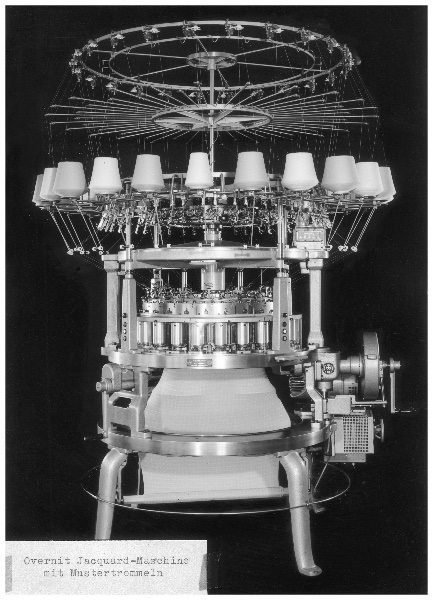
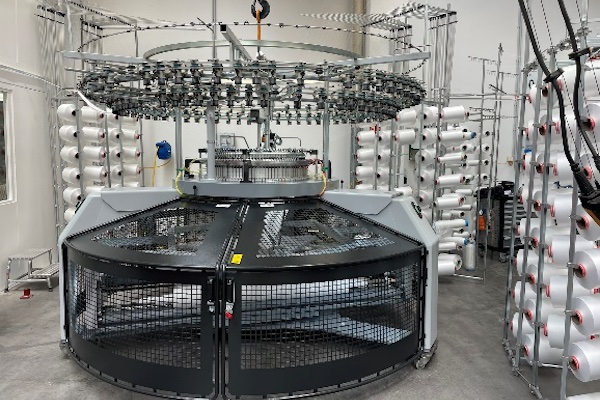
A circular knitting machine: Then …© 2025 Mayer & Cie.


… and today: a new MV4-3.2 QCe waiting to get packed and shipped to the customer. © 2025 Mayer & Cie.


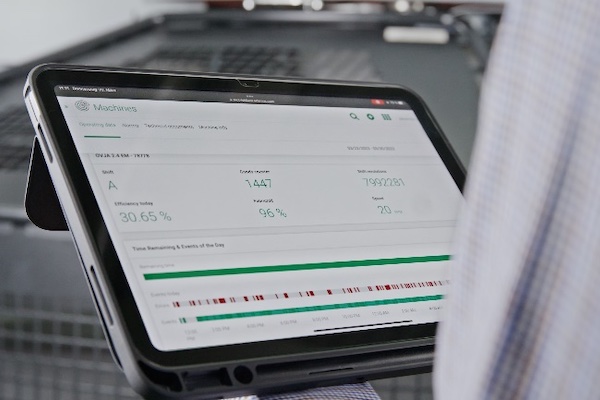
Welcome to the modern world of circular knitting machines: The machines can now be controlled via tablet. © 2025 Mayer & Cie.


Another focus lies on upgrade kits. These allow customers to keep their machine park up to date without having to invest in entirely new machines. “This supports machine longevity and sustainability,” explains Benjamin Mayer. “It also increases investment security for our customers.”

Braiding machine with 48 carriers

Just before Christmas 2024, Mayer & Cie. delivered its first braiding machine equipped with 48 carriers (bobbin holders). The second model with this configuration is currently under development. Customers benefit from a larger inner hose diameter, reduced setup times, and the same high bobbin capacity – whether processing yarn or wire.

Mayer & Cie. braiding machines are used to manufacture reinforcement braids, such as those found in high-pressure hoses used in industries like manufacturing and mining.

Since 2019, braiding machine production has been located at the company’s headquarters in Albstadt. One reason for relocating production – which had been handled by a U.S. subsidiary between 1977 and 2019 – was to improve research and development. “That strategy has paid off,” says Benjamin Mayer. “Our innovations now offer our customers greater productivity.”

Technological milestones

Innovation and technical advancement have long defined Mayer & Cie. Historically, milestones were purely mechanical: in 1938, the company launched its first proprietary circular knitting machine, based on its own patents. Prior to that, it had focused on manufacturing warp knitting machines, known as round frames. But as circular knitting machines proved faster and more efficient, production of warp knitting machines ceased entirely in 1958.

In the mid-1960s, Mayer & Cie. released a machine that became known as “every knitter’s favorite”: the OVJA 36, with innovative pattern control and suitable for especially fine fabrics. Customers were willing to wait up to three years for delivery, and order confirmations became objects of speculation. With around 7,000 units sold, it made the company world-famous in the industry.

In the late 1980s, Mayer & Cie.’s Relanit series continued this success story. With a new knitting technique, these machines delivered excellent fabric quality even when using substandard yarn.

Another technological revolution was the introduction of electronic pattern control, presented by Mayer & Cie. at a leading industry trade show in the 1970s. What used to take a full day of manual work could now be done with the press of a button.

Four generations of Mayer family leadership

The Mayer & Cie. story is also the story of the people who have led the company. Johannes Mayer, co-founder of the United Mechanical Workshops Mayer & Cie., was a hands-on tinkerer with a passion for detail. He played a major role in developing the company’s first circular knitting machines starting in 1935. When he passed away in 1958, he was remembered as the "first servant of his work."

His son, Emil Mayer, joined the company as an apprentice in 1921. As an engineer, he later drove the development of proprietary circular knitting machines and built up the company’s international business after World War II. He was posthumously named an honorary citizen of Tailfingen for founding a textile school.
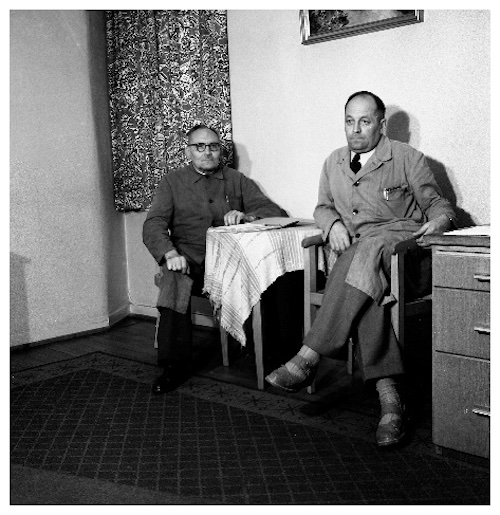
First and second generation at the table together: Johannes Mayer (left) and his son Emil Mayer (right). © 2025 Mayer & Cie.


Emil’s son, Peter Mayer, joined the company in 1961 and took over leadership in 1971 alongside his brother Rainer. He further expanded internationalization, was an early advocate of electronics, and shaped the market with the Relanit machine starting in 1987. He retired in 2003.

Rainer Mayer joined Mayer & Cie. in 1972 and co-managed the company from 1973. He focused on diversification, expanded business with IBM, and successfully led the company through insolvency in 2009.
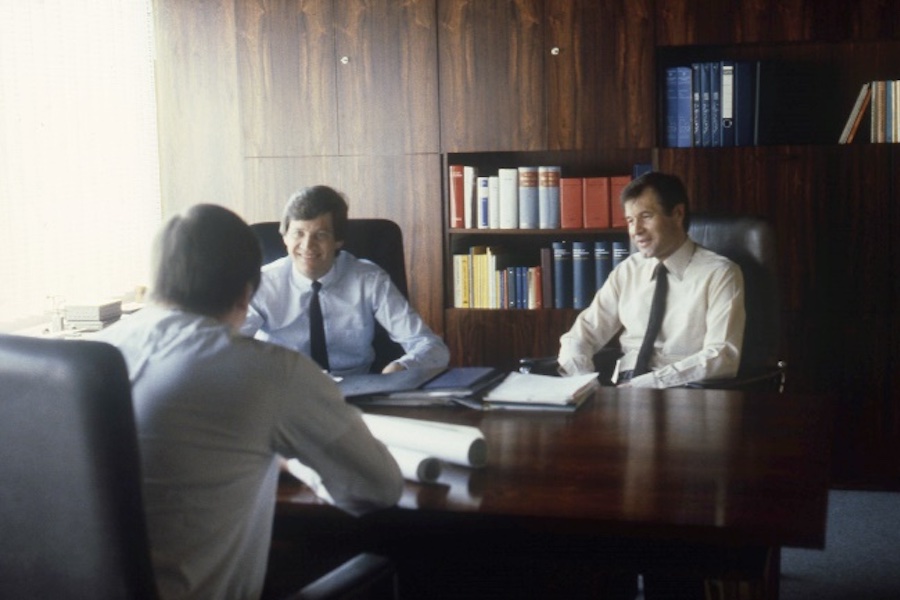
Rainer and Peter Mayer in the 1970s: They represented the third generation of owners; Rainer Mayer joined the company in 1972 at the age of 24. His older brother Peter had been working at the company since 1961. © 2025 Mayer & Cie.


Since Rainer Mayer’s passing in 2015, the fourth generation has taken the helm. Benjamin, Marcus, and Sebastian Mayer now share responsibility for the company’s various business areas.

Fourth generation: Marcus, Sebastian und Benjamin Mayer (from left to right). Sebastian Mayer is spart of the management team jointly led by Benjamin und Marcus Mayer. © 2025 Mayer & Cie.


More News from Mayer & Cie. GmbH & Co.

#Knitting & Hosiery

Mayer & Cie. to shut down after failed search for investor – 270 jobs affected

Mayer & Cie., the long-established German manufacturer of circular knitting and braiding machines, will cease operations after its international search for an investor ended without success. The company, based in Albstadt-Tailfingen, had been undergoing insolvency proceedings in self-administration since its filing on 23 September 2025. As Schwarzwälder Bote reports, the insolvency court has now formally opened the proceedings, triggering the decision to wind down the business in an orderly process.

#Knitting & Hosiery

Mayer & Cie. files for insolvency under self-administration

On 23 September 2025, Mayer & Cie., a manufacturer of circular knitting and braiding machines in Albstadt, filed an application for the opening of insolvency proceedings in self-administration at the Hechingen District Court.

#ITMA Asia + CITME Singapore 2025

Mayer & Cie. at ITMA Asia

Mayer & Cie. will participate in ITMA Asia from October 28 to 31, 2025, which takes place in Singapore. Visitors will find the manufacturer of circular knitting machines and braiding machines in Hall 5, Stand D 301. At its booth, the company will be showing a new circular knitting for jacquard fabrics - the OVJA 2.4 EC II - and will provide an overview of its digital and smart solutions. Another focus is on the machines of Mayer & Cie's "Performance Line": circular knitting machines, which are the most efficient solution in their respective classes.

#Knitting & Hosiery

Mayer & Cie. expands its braiding portfolio again

At the end of July 2025, the Albstadt-based braiding machine manufacturer Mayer & Cie. delivered its first MR-15 braiding machine with 48 carriers. An MR-11 system, also equipped with 48 coil carriers, left the plant before Christmas 2024 and has since reached the customer. The business unit has been part of the headquarters in Albstadt since 2019. Ongoing development has enabled Mayer & Cie. braiding to solidify its market position while evolving from a “little brother” into a key pillar of the company.

More News on Knitting & Hosiery

#Knitting & Hosiery

KARL MAYER and Lenzing partner to advance warp knitting with scalable cellulose fiber solutions

The Lenzing Group, a leading supplier of regenerated cellulosic fibers for the textile and nonwovens industries, together with KARL MAYER, the global market leader in warp knitting machines and warp preparation systems, debut a joint innovation project during Premiere Vision, Paris.

#Knitting & Hosiery

SHIMA SEIKI to exhibit at GMMSA Expo India

Leading Japanese computerized flat knitting technologist SHIMA SEIKI MFG., LTD. of Wakayama, Japan, together with its Indian sales representative Universal MEP Projects & Engineering Services, Ltd., will participate in the upcoming Garments Machinery Manufacturers & Suppliers Association (GMMSA) Expo India 2026 exhibition to be held in Ludhiana, India next month. Through its lineup at GMMSA, SHIMA SEIKI aims to further strengthen its presence within the Indian market with an exhibit that caters to diverse needs, consisting of seam-free WHOLEGARMENT® knitting technology as well as a brand-new shaping machine with high productivity and excellent cost performance.

#Knitting & Hosiery

KARL MAYER opens a new TEXTILE INNOVATION CENTRE – a new era of textile innovation begins

KARL MAYER is opening its new TEXTILE INNOVATION CENTRE (TIC), sending a strong signal that it is driving textile innovation forward and opening up new perspectives for the textile industry. The TIC brings together the latest developments in Warp Knitting, Technical Textiles and Warp Preparation – KARL MAYER’s core areas of expertise.

#Knitting & Hosiery

Proven performance, optimised costs – the new RE 6 EL

Nowadays textile companies increasingly need to produce small production runs and respond to market changes with instantaneous pattern changes in order to operate profitably – meaning they require machines that offer maximum flexibility, reliability and cost efficiency. KARL MAYER understands the challenges of the market and is launching its new RE 6 EL. The Raschel machine offers the core strengths of the classic RSE 6 EL and essentially the same performance parameters, but has been further cost-optimised largely due to local production advantages. This makes the newcomer an efficiency champion in production, especially when it comes to frequent pattern changes.

Latest News

#Dyeing, Drying, Finishing

Orthopac RVMC-20 plus: German Engineering for Smarter Weft Straightening

In times of rising cost pressure and growing quality demands, textile producers worldwide are searching for solutions that combine precision, efficiency, and sustainability. With its latest innovation, the Orthopac RVMC-20 plus, Mahlo once again demonstrates the strength of German engineering: improving proven technology to meet today’s challenges.

#Textile chemistry

RUDOLF gets the exclusive global distribution rights for Sanitized® textile technologies

With effect from today, RUDOLF officially assumes exclusive global distribution rights for Sanitized® textile technologies from SANITIZED AG. This is the next milestone in the strategic collaboration announced in 2025, with the partnership between the two companies now fully implemented and expanded worldwide.

#Europe

ICAC to support European Commission on pending PEF legislation

The International Cotton Advisory Committee (ICAC) is proud to announce that it has been included as a member of the European Commission’s Technical Advisory Board (TAB) on the Product Environmental Footprint methodology. The Commission developed the Product Environmental Footprint (PEF) to assess and communicate the life cycle environmental performance of products and organizations.

#Raw Materials

Cotton production continues to exceed consumption, some growers shift away from cotton

World cotton lint production in the 2025/26 season is currently estimated at 26 million tonnes, continuing to exceed world consumption, which is estimated at 25.2 million tonnes, according to the February 2026 edition of Cotton This Month. Global production is estimated to be 1% higher than the previous season, while consumption is estimated to be 0.4% higher, resulting in a continued supply surplus in the world cotton market.

TOP