[pageLogInLogOut]

#Raw Materials

Better Cotton is mainstream: 10% of world cotton sourced as Better Cotton in 2021
© 2022 Better Cotton
Better Cotton launched its ambitious 2030 Strategy and the first of five impact targets at the end of 2021. Climate change mitigation and adaptation, smallholder livelihoods, soil health, women’s empowerment and pesticide use are critical focal areas where Better Cotton aims to deepen impact over the next decade.

Achieving measurable change at field level will require continued collaboration and commitment from all Better Cotton Members and Programme Partners from across the cotton sector. While all members play their part in contributing to more sustainable practices in cotton farming, Better Cotton Retailer and Brand Members drive progress through increased sourcing of more sustainable cotton.  

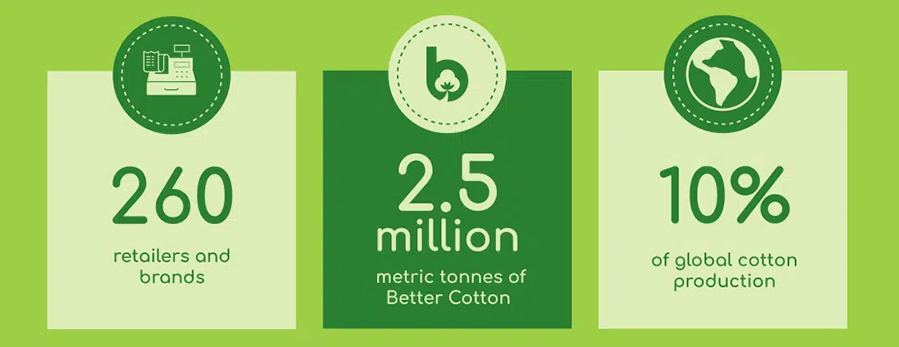
In 2021, 260 of the world’s best-known retailers and brands collectively sourced 2.5 million tonnes of Better Cotton – a record for Better Cotton and the industry. This accounts for 10% of global cotton production1 and represents a 47% increase on 2020 sourcing volumes. This result also marks the end of Better Cotton’s mainstreaming development phase, and transition to its transformation phase. 

Better Cotton’s demand driven funding model means that retailer and brand sourcing of Better Cotton directly translates into increased investment in training on better farming practices for more than 2.7 million cotton producers around the word. By integrating Better Cotton into their raw material sourcing strategies, Better Cotton Members are driving demand for more sustainable farming practices worldwide. 

"IKEA is one of the founding members of Better Cotton and has been investing in the Better Cotton programme since its inception in 2005. We were able to meet our goal of only sourcing cotton from what we classify as ‘more sustainable’ sources in 2015 mainly by sourcing cotton through the Better Cotton programme. We are pleased to continue to support Better Cotton as they aim to achieve deeper impact for cotton farmers and farming communities and seek to make more sustainable cotton the fiber of choice for growers and buyers. Together with other Better Cotton Members, we have been delivering on our sourcing commitments, and today with joint and concerted efforts of everyone, Better Cotton represents 10% of cotton sourced in supply chains, globally. This is a great launch pad for even bigger achievements by 2030, a journey we look forward to being a part of and helping develop even further."

Arvind Rewal, Global Cotton Development Manager, IKEA – Better Cotton Retailer and Brand Member

"Our commitment to better social and environmental practices, as well as demand from our customers, is driving us towards our goal of sourcing more sustainable raw materials for our products. Being a Better Cotton Member is helping us to achieve that goal, as through our membership we are contributing to reducing the environmental impact of cotton farming, as well as improving the safety and well-being of cotton farmers. In 2020, in our first year as a Better Cotton Member, 15% of our cotton came from more sustainable sources, in 2021, that figure was 60%, including Better Cotton."

Valesca Magalhaes, Executive, Sustainability, Riachuelo – Better Cotton Retailer and Brand Member


Whether new to the Better Cotton network, or long-standing members, thousands of organisations across the cotton sector, including retailers and brands, are contributing to transforming cotton: supporting cotton farming communities and driving sustainability in cotton farming. Find all Better Cotton Members.   

"Since 2010, we have been demonstrating the power of public-private partnerships to garner action towards achieving more sustainable development in the cotton sector. The results we see at Better Cotton strengthen our conviction that we, and our members and partners are well placed to continue supporting cotton communities to survive and thrive while protecting and restoring the environment."

Lena Staafgard, COO, Better Cotton

To learn more about the impact of the Better Cotton programme, please see our latest Impact Report. 

1 With global cotton production (ICAC) in 2020-21 cotton season at 24,303,000 MT, Better Cotton Retailer and Brand Member uptake is 10% of global production.
More News from TEXDATA International

#Texprocess 2026

Texprocess 2026: Automation, digitalisation and AI redefine textile processing

Making investment decisions in textile processing has become significantly more demanding. Increasing energy costs, a shortage of skilled labour and ongoing geopolitical uncertainties are compelling companies to focus on technologies that deliver clear gains in efficiency and process reliability. This applies equally to apparel manufacturing and to the processing of technical textiles and high-performance materials. As a result, modernisation initiatives are assessed more carefully – even as the need to upgrade production systems continues to intensify.

#Techtextil 2026

Techtextil 2026: Between innovation pressure & market reality

From 21 to 24 April 2026, Techtextil in Frankfurt am Main will once again become the central meeting point for the international technical textiles and nonwovens industry. Running in parallel, Texprocess will focus on the industrial implementation of textile processing technologies as the leading platform in this field. Together, the two trade fairs form a closely integrated presentation and working platform along the entire textile value chain – from material development to finished applications.

#Techtextil 2026

Between geopolitical pressure and industrial resilience

In this interview, Dr. Janpeter Horn (VDMA) discusses the current challenges facing textile machinery manufacturers, shaped by geopolitical tensions, regulatory developments and subdued investment. He also outlines why innovation strength, integrated solutions and strategic positioning remain key to global competitiveness.

#Texprocess 2026

Between investment restraint and modernization pressure

Texprocess 2026 takes place in a complex market environment shaped by uncertainty and innovation pressure. In this interview, Elgar Straub (VDMA) explains why the trade fair is particularly relevant this year and which technologies are driving efficiency and competitiveness.

More News on Raw Materials

#Raw Materials

China projected to increase cotton production, yields, and imports in 2026/27

World cotton production in the 2026/27 season is projected at 25.9 million tonnes, exceeding global consumption of 25.2 million tonnes, according to the May 2026 issue of Cotton This Month. That means both production and consumption are expected to remain close to current season levels, while global cotton trade is projected to decline by 2.7% to approximately 9.6-9.7 million tonnes.

#Raw Materials

ICAC launches Carbon Credits Initiative to deliver new income streams to cotton farmers

The International Cotton Advisory Committee (ICAC) has announced a new initiative designed to unlock additional income streams for cotton farmers through participation in carbon credit markets, linking sustainable production practices directly to financial returns.

#Raw Materials

ECCO introduces first shoe featuring innovative protein-based fibre

ECCO, in partnership with Spinnova, announces the launch of the limited edition ECCO BIOM® 720, a first-of-its-kind shoe utilising an often overlooked leather by-product, transformed into a protein-based fibre. The fibres are produced using patented technology that advances material innovation while reducing waste and supporting full resource use across the leather and textile industry.

#Raw Materials

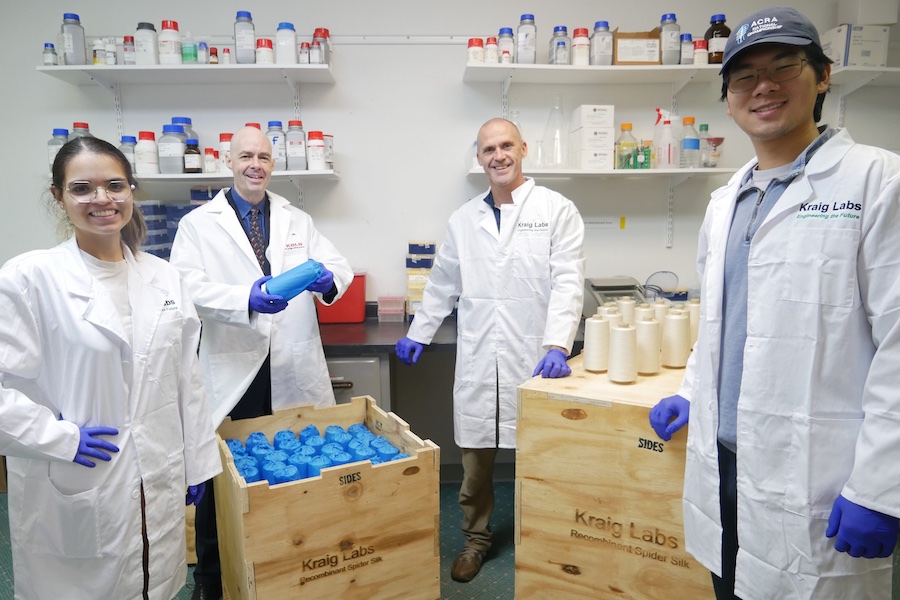
Kraig Biocraft Laboratories reports major progress converting record-setting spider silk cocoon production into reeled silk

Kraig Biocraft Laboratories, Inc. (OTCQB: KBLB) (“the Company”, “Kraig Labs”, or “Kraig’s”), a world leader in spider silk technology*, today announced significant progress in the processing of its recently produced recombinant spider silk cocoons into reeled silk.

Latest News

#Recycling / Circular Economy

Europe’s textile future at a turning point: New 2030 Circularity Blueprint aims to scale recycling and unlock investment opportunities

The EU textile system is at a critical crossroads. Today, less than 1% of discarded garments are recycled into new garments, despite EU-wide obligations for separate collection. In response, Global Fashion Agenda (GFA) is launching the 2030 Circularity Blueprint, in partnership with ReHubs. This ambitious initiative is designed to support the transformation of the EU textile ecosystem to advance textile-to-textile recycling and drive the transition to a circular economy.

#Research & Development

Regional hemp bast for lightweight construction profiles

The cultivation of fibre hemp for the production of ropes and clothing has a long tradition in Saxony. Due to its excellent fibre properties, it is also suitable as a renewable raw material for reinforcement in fibre composites. At the STFI and IWU in Chemnitz, the CannaPul project is cur- rently investigating how a regional value chain for hemp-based lightweight construction profiles can be established. To this end, the technical processing of hemp fibres into continuous fibre strands and their embedding in a suitable bio-based matrix are being investigated.

#Digital Printing

Kornit Digital launches Konnections 365

Kornit Digital (NASDAQ: KRNT) (“Kornit” or the “Company”), a global pioneer in sustainable, on-demand digital fashion and textile production today announced the launch of Konnections 365 - a year-round movement designed for the people moving the apparel, print, and retail industries forward. The strategy is built on the overwhelming success of Konnections 2026 held in Hollywood, Florida, featuring more than 500 customers, partners, and collaborators who together are driving the future of apparel and textiles.

#Techtextil 2026

Techtextil 2026: KARL MAYER impresses as an innovative sector partner

KARL MAYER looks back with satisfaction on its participation in Techtextil 2026. From April 21 to 24, the international industry leader used the trade show in Frankfurt to meet with numerous key customers at its booth and, at the same time, establish many new contacts. Most visitors came from Germany, followed by major markets such as Poland, the United Kingdom, Turkey, France, and Portugal.

TOP