[pageLogInLogOut]

#Europe

Commission calls for environmental sustainability to be at the core of EU education and training systems

The Commission published today a proposal for a Council Recommendation on learning for environmental sustainability. The aim of the proposal is to support Member States, schools, higher education institutions, non-governmental organisations and all education providers in equipping learners with understanding and skills on sustainability, climate change and the environment.

A new European competence framework on sustainability published by the Joint Research Centre, also available today, maps out the competences needed for the green transition, including critical thinking, initiative-taking, respecting nature and understanding the impact everyday actions and decisions have on the environment and the global climate.

Vice-President for the Promoting European Way of Life, Margaritis Schinas, said: "Youth participation has been revolutionising the way we look at climate and the environment. Through our youth programmes, European Solidarity Corps and DiscoverEU, we promote the sustainability drive involving our youth. This is a step further in the work towards a better integration of sustainability in education.”

Commissioner for Innovation, Research, Culture, Education and Youth, Mariya Gabriel said: “There is tremendous work being done right across Europe to help children, young people and adults learn about and engage with climate change, biodiversity loss and sustainability. Our goal is to build on these efforts and to work closely with Member States to place sustainability at the heart of education and training systems. All learners, from an early age need opportunities to understand and take action for environmental sustainability, to protect our planet and our future.”

The Commission's proposal calls on Member States to:

• Provide learners of all ages access to high-quality and inclusive education and training on climate change, biodiversity and sustainability;

• Establish learning for environmental sustainability as a priority area in education and training policies and programmes in order to support and enable the sector to contribute to the green transition;

• Encourage and support whole-institution approaches to sustainability which encompass teaching and learning; developing visions, planning and governance; active involvement of students and staff; management of buildings and resources and partnerships with local and wider communities;

• Mobilise national and EU funds for investment in sustainable and green infrastructure, training, tools and resources to increase resilience and preparedness of education and training for the green transition.

When asked in a Eurobarometer survey, what should be the top priorities for the EU in the years to come young people's first reply was  the protection of the environment and the fight against climate change (67%) followed by the improvement of education and training (56%).This shows how important it is to act.

The 2021-2027 Erasmus+ programme also places a strong focus on the green transition in education and training. For the 2022 annual work programme, priority will be given to projects developing green competences and skills, future-oriented curricula and planned approaches to sustainability by education providers. A specific call for large-scale projects will provide funding to identify, develop and test innovative approaches to education for environmental sustainability. The Commission will also provide training opportunities and communities of practice for educators through School Education Gateway and eTwinning. The new European Education Area Portal of the Commission allows for easy access to information on education and training in the EU, including specific information on green education.


Next Steps

The Commission's proposal will be discussed by Member States and then adopted by EU education Ministers. The Commission will support the implementation of the Recommendation through learning and exchanges between Member States, stakeholders and partner countries.

Background

To prepare the proposal, the Commission consulted widely on the current state of play regarding learning opportunities for environmental sustainability in the EU. A public survey, which ran from June to September 2021, received over 1,300 responses as well as 95 position papers. Input was also gathered during a series of online consultation workshops with policy makers, teachers, youth organisations, social partners, researchers and other interested bodies and organisations. The consultations underlined the crucial role of education and training in helping people understand and take action on environmental sustainability.

In the public survey, 71% of respondents, ranked education and training as the most important sector in this regard, ahead of public bodies and governments (56%), and media (34%). Providing teachers, trainers, youth leaders and academic staff with quality professional development opportunities on the environment and sustainability was considered a main priority for action, along with making sustainability a cross-cutting issue in curricula and study programmes.




More News from TEXDATA International

#Recycling / Circular Economy

textile.4U publishes special edition “Top 100 Textile Recycling Companies 2025”

With a comprehensive 176-page special edition, textile.4U is dedicating its latest issue entirely to one of the most dynamic and influential topics in today’s textile industry: textile recycling. The new issue, published exclusively in high-quality print, presents the Top 100 textile recycling companies researched and selected by TexData – organizations that already play a key role in the transition to circular textiles or are expected to have a significant impact in the near future.

#Recycling / Circular Economy

Responsible Textile Recovery Act of 2024 signed by Governor

Senator Josh Newman (D-Fullerton) is proud to announce that Senate Bill 707 (SB 707), the Responsible Textile Recovery Act of 2024, has been signed into law by the Governor of California, Gavin Newsom. This groundbreaking legislation establishes the country’s first Extended Producer Responsibility (EPR) textile recycling program, marking a significant step forward in the state’s efforts to combat waste and promote sustainability.

#Textiles & Apparel / Garment

Modtissimo promotes sustainability with 28 coordinates in the Green Circle

Modtissimo is proving more and more to be a textile and clothing show that delivers the latest innovations in the area of sustainability, with the iTechStyle Green Circle being the main showcase for companies' creations. In this 60+4 edition, taking place on 12 and 13 September, 28 coordinates will be exhibited in a section organised by CITEVE and curated by Paulo Gomes.

#Europe

The EU and Egypt team up to mobilise private sector investments at Investment Conference and sign a Memorandum of Understanding underpinning €1 billion in macro-financial assistance for Egypt

At the EU-Egypt Investment Conference, co-organised by the EU and the Government of Egypt on 29-30 June, the EU and Egypt are teaming up to intensify private sector investments in Egypt. They are also signing a Memorandum of Understanding (MoU) for the disbursement to Egypt of up to €1 billion in Macro-Financial Assistance.

More News on Europe

#Europe

Antwerp Declaration community urges EU leaders to deliver emergency measures as Europe’s competitiveness crisis deepens

EURATEX, representing the European textile and fashion industry, joins the Antwerp Declaration Community’s call on EU Heads of State and Government to adopt emergency measures that restore industrial competitiveness and deliver tangible results for Europe’s manufacturing base in 2026.

#Europe

New EU rules to stop the destruction of unsold clothes and shoes

The European Commission today (Feb 9) adopted new measures under the Ecodesign for Sustainable Products Regulation (ESPR) to prevent the destruction of unsold apparel, clothing, accessories and footwear.

#Europe

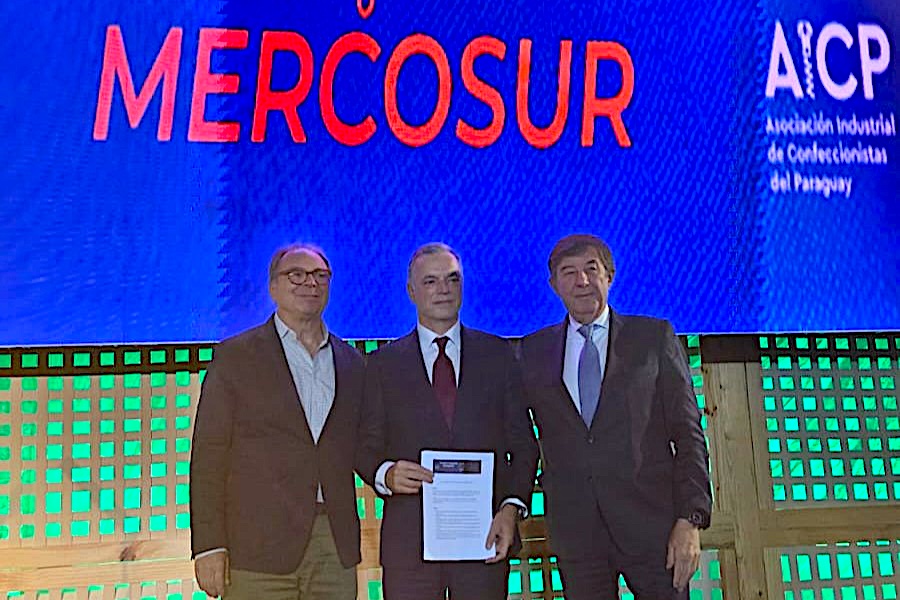
FITA, ABIT and EURATEX underline strategic importance of Mercosur – EU Partnership Agreement for the textile and apparel industry

The Argentine Textile Industry Federation (FITA), the Brazilian Textile and Apparel Industry Association (ABIT), and the European Apparel and Textile Confederation (EURATEX) continue to monitor the process of internalizing the Mercosur-European Union Partnership Agreement. This agreement is essential for the competitiveness of our industries, on both sides of the Atlantic.

#Europe

Commission adopts a first-ever EU Visa Strategy

Today, the European Commission is adopting its first-ever EU Visa Strategy. It sets out a framework for a visa policy that is more strategic and that advances the EU's long-term interests, allowing it to be better equipped for growing mobility as well as the consequences of regional instability and geopolitical competition.

Latest News

#Research & Development

Fabolose: Fabricating vegan and circular leather alternatives from bio-tech-derived cellulose

Fabulose is an EU funded project coordinated by the German Institutes of Textile and Fiber Research (DITF). Its consortium consists of leading research institutes, biotech innovators, and industry stakeholders who aim to create high-performance, biobased and recyclable leather-like fabrics, using efficient biotech production routes for bacterial cellulose, cyanophycin and bacterial pigments

#Textiles & Apparel / Garment

Connecting the ASEAN textile sector: sustainability, trends, and technology take centre stage at this week’s VIATT 2026

Opening this week Thursday, the Vietnam International Trade Fair for Apparel, Textiles, and Textile Technologies (VIATT) is set to welcome visitors from ASEAN’s dynamic textile market and beyond. From 26 to 28 February, VIATT 2026 – the fair’s third editions – will reinforce its strategic proposition with an integrated showcase of the three core sectors of the entire textile value chain. Beyond new sourcing opportunities in Apparel Fabrics & Fashion, Home & Contract Textiles, and Technical Textiles & Technologies, the fair will present an expanded fringe programme.

#Spinning

Measure and control the fiber – optimize yarn quality

Producing consistent yarn quality is an everyday challenge – and a very difficult one. Detailed knowledge and understanding of the fiber raw material is absolutely critical to achieving the best possible quality in the yarn. To help spinners, Uster experts have put together guidelines for avoiding yarn irregularity claims, in a special edition of the Uster News Bulletin.

#Software

Coats Digital appoints Himanshu Mehrotra as Managing Director to lead next phase of cloud and AI-driven innovation

Coats Digital is delighted to announce the appointment of Himanshu Mehrotra as Managing Director to lead the company’s strategic direction, innovation agenda, and global growth as it accelerates the development of its cloud-native, AI-powered software solutions for the global apparel and footwear supply chain.

TOP