[pageLogInLogOut]

#EU Textile Strategy

2024 is a turning point for the European textiles and clothing industry

From 6 to 9 June 2024, European citizens will vote for a new European Parliament and, based on the results, a new European Commission will be formed. In view of this important election, EURATEX publishes a Manifesto, presenting 15 requests which will help to ensure a competitive European textiles and clothing industry.

The textile and apparel industry is making a substantial contribution to European wealth, jobs and growth. Europe counts 192,000 companies employing 1.3 million workers with a turnover of €167 billion and over €67 billion of exports. Entrepreneurship should be recognised as the foundation for a competitive textile industry, offering high quality and sustainable products, based on innovation, creativity and design. European policy makers should recognise such role to textiles and apparel companies and have an open dialogue to create better framework conditions to operate in the internal and global markets.

To realise that vision, the industry and policy makers need to work together on a mix of policy measures and initiatives, which are coherent and offer a transparent and predictable framework for our companies, and make them more resilient and competitive.

These policies should focus around four points:

Develop and implement a “smart” EU industrial policy

Europe should create policies which enhance competitiveness, instead of creating administrative burdens. To EURATEX, each new piece of legislation should undergo a “competitiveness test” to critically look at the impact of the new rules. Europe should also create a favourable environment to promote education and jobs in the industry. The EU textile industry currently employees 1,3 million people, 30% of which is above 50 years old. A critical bottleneck for the textile industry is to attract (young) people and make sure these people have the right set of skills, to operate in a changing textile ecosystem. EURATEX also asks the EU to invest in innovation and digitalisation as they are key to the European competitive advantage. Not only, as the last years have proved, Europe should provide companies with access to sustainable energy at lower prices.


No sustainability without competitiveness

The EU Strategy for Sustainable Textiles is pushing our sector towards new business models with a lower environmental footprint. To realise that ambition, no less than 16 regulatory proposals are on the table, each of them with a different timetable, managed by different departments of the European Commission. EURATEX is committed to sustainability, but asks for economic realism. This set of new regulations needs to be coherent, enforceable, feasible and applicable for SMEs, and not push textile companies out of the market. Moreover, some member states are moving forward faster and some legislations will be decided at national level, creating fragmentation of the market. Such scenarios will hamper Europe and its possibilities to grow.

Ensure free and fair trade

With $224 billion in sold merchandise, Europe is the second major world exporters of textiles and clothes after China ($321 billion). It is therefore important that the global market should be open, free and fair for our industry to continue to thrive. Besides the support to FTAs in general, EURATEX wants to emphasise that all trade agreements should offer effective market access for EU companies and a level playing field in these markets. A free and open market should go hand in hand also with protection against free riders. The EU must always consider enforcement and enforceability when making new laws; it should also take action together with the member states for a better coordination with harmonised criteria for action among Customs Authorities.

Incentivise the Demand for sustainable textiles

Sustainable textile products typically come at a premium price, making it difficult for many consumers and buyers to purchase such products. Many surveys across Europe confirm that around 50% of interviewees do not purchase sustainable fashion products and the main reason is price. EURATEX believes that, to create a demand and help consumers to buy a (genuine) sustainable textile product, there should be standard requirements and fiscal incentives. Public authorities should also implement green public procurements, by increasing the importance of sustainability criteria in their evaluation grids.

According to Alberto Paccanelli, EURATEX President, “these elections are a turning point for the future of Europe and its industrial base. While some regions of the world are already taking measures to support their industry, Europe has been lagging behind. We need now a clear vision which bring us towards a greener and wealthy future. We need to reconcile these two objectives and bring with us major global partners, because this transformation cannot be done by one Region only”.

Read our full Manifesto:

https://euratex.eu/wp-content/uploads/EURATEX-Manifesto-2024-Final.pdf


More News from European Apparel and Textile Confederation (EURATEX)

#Europe

Level playing field at stake: Europe’s textile industry demands decisive action

Yesterday, the European Parliament took a welcomed and necessary step by voting a resolution calling for stronger market surveillance, reinforced customs controls and faster enforcement of the Digital Services Act in case of infringements. For Europe’s textile and clothing manufacturers, this is the first political acknowledgement that the system is broken — and that enforcement must finally match the scale of the problem.

#Recycling / Circular Economy

EURATEX calls for a competitive and harmonised Circular Economy Act For Textiles

EURATEX, representing Europe’s textile and clothing industry with over 200,000 companies and 1.3 million workers, has submitted its official position paper to the European Commission’s consultation on the upcoming Circular Economy Act (CEA). The association welcomes the Commission’s initiative to shape a framework that strengthens Europe’s circular economy while maintaining industrial competitiveness.

#Associations

European textile and clothing federations mobilize against ultra-fast fashion

On the occasion of the Première Vision trade fair in Villepinte, the leading European textile and clothing federations issued a solemn call for urgent action against the rapid rise of ultra fast fashion. This model, driven by major non-European e-commerce platforms, already accounted for 4.5 billion imported parcels in the European Union in 2024—representing 5% of clothing sales (20% online)—and continues to grow at a staggering pace.

#Associations

Joint statement by EURATEX and Danish Fashion and Textiles

EURATEX and its Danish member Dansk Mode & Textil are calling upon the Danish Presidency of the EU to bring back stability and transparency to the European agenda. These last few months we have seen major upheavals and turbulence in global markets, as well as uncertainty surrounding a number of regulatory initiatives. All this creates a climate of uncertainty for European industry and anxiety with the consumers. As a result, demand for textile and garments is low, and entrepreneurs are hesitant to make any further investment decisions.

More News on EU Textile Strategy

#Sustainability

Textile Exchange Conference 2025 kicks off next week in Lisbon

From October 13 to 17, 2025, the Textile Exchange Conference will take place at the Lisbon Congress Centre, bringing together brands, supply-chain partners, innovators, farmers, NGOs, academics, and more for a week of collaborative learning and exchange. Under the theme “Shifting Landscapes”, this year’s agenda highlights the urgent need for the textile industry to adapt rapidly to changing environmental, political, and economic conditions, while linking adaptation to broader systems transformation.

#EU Textile Strategy

CEMATEX strengthens EU representation and advocacy for the European textile machinery industry

CEMATEX, the European Committee of Textile Machinery Manufacturers, has reinforced its role as the voice of the EU textile machinery industry by enhancing its presence and engagement with EU institutions and stakeholders.

#EU Textile Strategy

Germany pushes ahead with Producer Responsibility for Textiles

Germany is taking a leading role in shaping extended producer responsibility (EPR) for textiles – a regulatory concept that is gaining traction across the European Union. EPR requires companies that manufacture or sell products such as clothing, home textiles, and shoes to take financial and operational responsibility for the end-of-life management of these goods.

#EU Textile Strategy

Textile ETP at the European Commission's event on the Textiles Ecosystem Transition Pathway

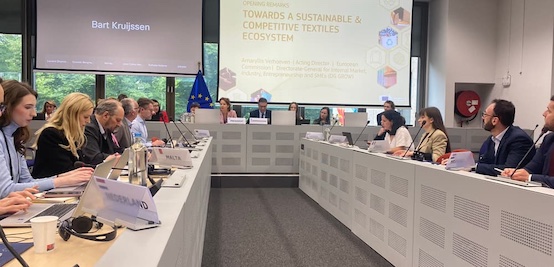
On 4 June 2024, the Textile ETP Secretary General Lutz Walter participated in the European Commission’s Directorate-General for Internal Market, Industry, Entrepreneurship & SMEs (DG GROW) stakeholder event for the Textiles Ecosystem Transition Pathway.

Latest News

#Recycling / Circular Economy

Advanced Recycling Conference 2025 fuels innovation across key waste streams

The Advanced Recycling Conference (ARC) 2025 brought together nearly 220 experts from 28 countries to spotlight pioneering advancements and foster industry collaboration in recycling across diverse waste streams including plastics, textiles, automotive and other materials.

#Dyeing, Drying, Finishing

Navis TubeTex announces U.S. partnership with Icomatex

Navis TubeTex, a global leader in advanced dyeing and finishing machinery solutions, is pleased to announce a new partnership with Icomatex (www.icomatex.com), a respected European manufacturer of high-quality stenters and textile finishing equipment. Under this agreement, Navis TubeTex will exclusively represent the Icomatex stenter line in the United States.

#Recycling / Circular Economy

ADVANSA launches ADVA®tex: A new step toward textile-to-textile recycling

ADVANSA has introduced ADVA®tex, a new filling fibre made entirely from recycled pre-consumer textile waste, positioning the material as a significant step forward in textile-to-textile (T2T) recycling. The fibre is designed for use in duvets, pillows, mattresses, and furniture applications and is available in three versions.

#Knitting & Hosiery

KARL MAYER celebrates 35 years of EL pattern drive

KARL MAYER is celebrating an anniversary this year: on 30 November 1990, the first warp knitting machine with electronic guide bar control, the KS 4 EL, was delivered – another milestone for patterning. As early as 1980, the SU gearbox with the MRS42SU had initiated the transition from mechanical chains to digital data.

TOP