[pageLogInLogOut]

#Yarn & Fiber

SORONA® introduces global preferred mill network

© 2021 Sorona®
One year after the debut of its Common Thread Fabric Certification Program, Sorona® introduces the Preferred Mill Network, a global catalogue of mills offering the full collection of sustainable Sorona® subbranded fabrics—Agile, Aura, Luxe, Profile, and Revive. The network of certified mills is available to any apparel brand in need of samples and sourcing of fabrics scientifically tested to meet the performance and sustainability standards set by the Sorona® team. Sign up for access to the portal by visiting Sorona.com/customer-portal.

“The impacts of sustainability efforts are best at scale,” says DuPont Global Brand & Communications Leader Alexa Raab. “Through the recent COP26 Climate Change Summit we’ve seen how much work there is to do in all corners of industry. We’re taking this step with the Preferred Mill Network and Common Thread Fabric Certification Program to further our commitment to transparency and ease of access to sustainable fabrics throughout the value chain.”

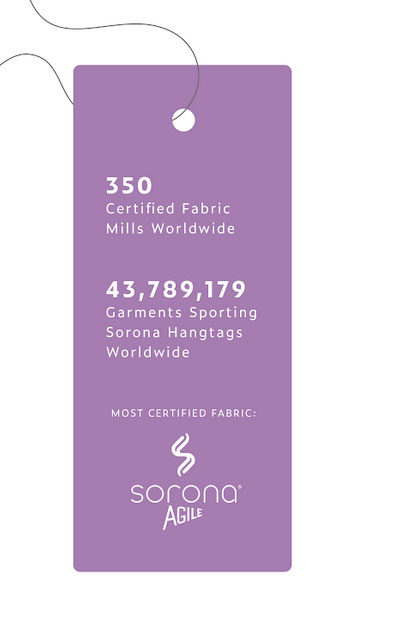
Since the debut of the Common Thread Fabric Certification Program, Sorona® has certified 350 fabric mills worldwide and shipped hangtags for more than 43.7 million garments. Among the certified fabrics, the most certified option is Sorona® Agile, the comfort stretch fabric used for spandex replacement in activewear and athleisure garments.

To qualify for certification, fabric mills must submit fabric swatches to the DuPont (or DuPont approved) lab for testing. Each sample is rigorously analyzed for a minimum content level of Sorona®, as well as for quality and performance characteristics.
© 2021 Sorona®
© 2021 Sorona®


Certified fabric types include:

Sorona® Agile—an alternative for any garment where spandex-free stretch is needed

Sorona® Aura—lightweight insulation fill with unparalleled softness, outstanding fill power, and a higher level of thermal insulation

Sorona® Luxe—natural fiber blends are enhanced with softness, dimensional stability, and reduced pilling

Sorona® Profile—a replacement for 100 percent nylon or PET fabrics that offers improved crease recovery and a rich, soft handfeel

Sorona® Revive—shape retention and dimensional stability without sagging and bagging


Made from 37 percent plant-based materials, Sorona® is a high-performance fiber that offers unparalleled softness, stretch recovery, crease recovery, and resistance to UV and chlorine damage. From harvesting to production, the process for making Sorona uses 30-40% less energy and releases 56-63% fewer greenhouse gas emissions than the production of nylon. Fabrics made from Sorona® polymer can also be dyed and heat-set at much lower temperatures compared to polyester furthering the energy efficiency down the value chain.

“Fundamentally, making Bio-PDO is the same as the fermentation process for making beer,” says DuPont Biomaterials Product & Global Application Development Principle Investigator Samit Chevli. “The use of Bio-PDO to make Sorona® PTT polymer gives the polymer some unique properties. At a molecular level the polymer has a zig zag orientation which gives fibers produced from Sorona® polymer a spring-like property. This provides much better resiliency (bounce) and stretch than other types of polyesters.”

Sorona® is a key ingredient in clothing from some of the world’s most popular and most sustainable brands. To learn more about the Preferred Mill Network and Common Thread Fabric Certification Program, visit Sorona.com/certification. 


More News from TEXDATA International

#Texprocess 2026

Texprocess 2026: Automation, digitalisation and AI reshape textile processing

Investment decisions in textile processing have become increasingly complex. Rising energy prices, labour shortages and geopolitical uncertainties are forcing companies to prioritise technologies that deliver measurable improvements in efficiency and process stability. This applies not only to apparel production, but also to the processing of technical textiles and high-performance materials. Modernisation projects are therefore being evaluated more selectively – but the pressure to upgrade production systems continues to grow. Texprocess 2026 reflects this tension between cautious investment behaviour and increasing technological demand.

#Techtextil 2026

Textile Chemicals & Dyes: Innovation in Textile Chemistry moves into focus at Techtextil 2026

From PFAS-free finishes and water-saving dyeing technologies to advanced coatings and recycling-compatible formulations, innovation in textile chemistry is accelerating across the industry. Reflecting this development, Techtextil 2026 introduces Textile Chemicals & Dyes as a dedicated product segment, highlighting the growing role of chemical solutions in shaping the next generation of technical textiles.

#Recycling / Circular Economy

textile.4U publishes special edition “Top 100 Textile Recycling Companies 2025”

With a comprehensive 176-page special edition, textile.4U is dedicating its latest issue entirely to one of the most dynamic and influential topics in today’s textile industry: textile recycling. The new issue, published exclusively in high-quality print, presents the Top 100 textile recycling companies researched and selected by TexData – organizations that already play a key role in the transition to circular textiles or are expected to have a significant impact in the near future.

#Recycling / Circular Economy

Responsible Textile Recovery Act of 2024 signed by Governor

Senator Josh Newman (D-Fullerton) is proud to announce that Senate Bill 707 (SB 707), the Responsible Textile Recovery Act of 2024, has been signed into law by the Governor of California, Gavin Newsom. This groundbreaking legislation establishes the country’s first Extended Producer Responsibility (EPR) textile recycling program, marking a significant step forward in the state’s efforts to combat waste and promote sustainability.

More News on Yarn & Fiber

#Man-Made Fibers

Lenzing advances its transformation: Higher EBITDA, stronger free cash flow and more than EUR 200 million in cost savings

The business performance of the Lenzing Group in 2025 was affected particularly in the second half of the year by external factors such as international tariff measures, subdued demand and declining market prices. As a result, revenue decreased slightly by 2.3 percent to EUR 2.6 billion, primarily due to lower fiber sales volumes and lower prices for fibers and pulp, which were further negatively impacted by currency developments. Nevertheless, thanks to the comprehensive Performance Program, Lenzing was able to improve its operating performance and key financial indicators compared with the previous year.

#Man-Made Fibers

“Lead Transformation – Generate Impact”: Lenzing presents its 2025 Annual and Sustainability Report

The Lenzing Group has published its 2025 Annual and Sustainability Report, entitled LEAD TRANSFORMATION – GENERATE IMPACT. The report shows how Lenzing is actively shaping change in the industry and making a lasting impact: economically, ecologically, and socially. Lenzing is consistently focused on the future: with targeted investments in premiumization, excellence, innovation, and sustainability, the company is strengthening its position as a leading provider of sustainable, cellulose-based premium fibers. The combined report is available in digital format.

#Raw Materials

Lenzing Group positions bio‑based materials as a strategic asset for Europe’s economic security

The Lenzing Group, a leading supplier of regenerated cellulose fibers for the textile and nonwovens industries, hosted a high‑level roundtable in Brussels to discuss how bio‑based materials can strengthen Europe’s economic security and support the shift toward a fossil‑free future. Organized in cooperation with Euractiv, the event brought together representatives of the European Commission, the UK Mission to the EU, academia, civil society, and industry.

#Yarn & Fiber

Teijin Carbon strengthens high‑end sports offering with advanced prepreg and resin technologies for next‑generation bicycle performance

High‑end bicycle manufacturers are entering a new era in which modern frames and components must be lighter, stiffer, tougher and more sustainable – all while enabling fast, repeatable and cost‑efficient production. To support this shift, Teijin Carbon is expanding its portfolio of advanced prepreg systems developed specifically for premium road, gravel and mountain bike applications.

Latest News

#Techtextil 2026

Gebr. Otto highlights versatility at Techtextil with regional supply chains, yarn innovations and new hygiene segment

At this year’s Techtextil, Gebr. Otto places its versatility at the center of its presentation. In addition to spinning, twisting and dyeing – traditionally focused on fine cotton – textile processors will also find a competent development partner for technical specialty solutions. The Dietenheim-based spinning mill has now built up a decade of experience in the production of technical yarns, particularly from aramids. A new hygiene segment has also been established, where yarns for medical and hygiene products are currently being produced. In the future, this department could also develop textile products for the food sector. Gebr. Otto will once again be present at the BW-i joint stand, booth D81, hall 12.1. What is wound onto the spool is determined by the customer: Gebr. Otto develops according to specific customer requirements and transforms its own ideas into yarn innovations.

#Europe

Commission presents proposal for EU Inc. - unlocking the full potential of the Single Market for Europe's entrepreneurs

Today, the European Commission presented its proposal for EU Inc., a new single set of corporate rules, building the cornerstone and starting point for the EU's 28th regime. EU Inc. is an optional, digital-by-default European corporate framework. It will make it easier for businesses to start, operate and grow across the EU – incentivising them to stay in Europe, and encourage those who once looked elsewhere to return.

#Man-Made Fibers

OnceMore® from Södra brings end-to-end traceability for circular Man-made Cellulosic Fibers (MMCF) using TextileGenesis

OnceMore® from Södra, the world’s first large-scale process for recycling blended fabrics into high‐quality dissolving pulp, will begin using TextileGenesis, a Lectra company, to strengthen traceability from raw material to retail across the value chain. OnceMore® produces dissolving pulp made from blended textile waste and wood sourced from responsibly managed Swedish forests. By integrating TextileGenesis, OnceMore® supports the growing need for verified data and secure, transparent tracking throughout increasingly complex supply chain.

#Sustainability

Experts publish APAC policy priorities

Cascale today announced the publication of its APAC Policy Priorities Paper, developed by the Asia-Pacific (APAC) Policy Member Expert Team (MET) to identify key regional sustainability challenges and provide practical, aligned recommendations for policymakers and industry stakeholders across Asia-Pacific.

TOP