[pageLogInLogOut]

#Yarn & Fiber

Borealis supports Austrian face mask initiatives through production of meltblown fabrics on its unique pilot line in Linz
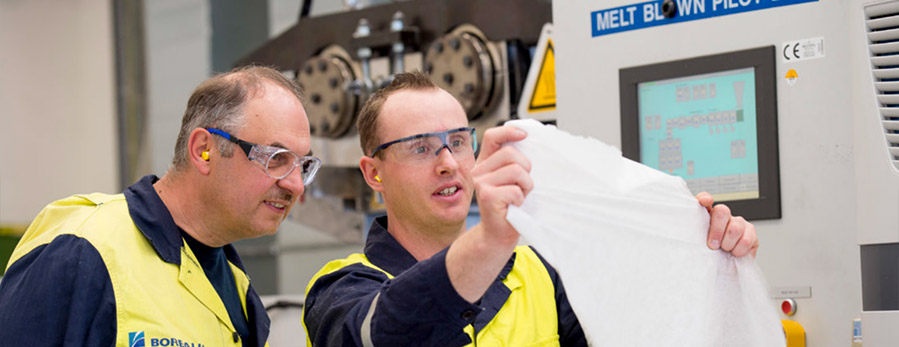
Meltblown pilot line in the Borealis Innovation Headquarters in Linz, Austria. (c) 2020 Borealis
Borealis announces that it has started production of meltblown fabrics for face mask applications on its unique pilot line in Linz, Austria. Borealis has managed quickly to convert the way of working from pure development to smaller scale pilot production to regularly produce rolls of fine fibre fabrics for face masks.

Recently developed by Borealis, a new proprietary polypropylene (PP) meltblown resin has boosted filtration properties due to its capability for finer fibres. By exploiting a robust network of co-operation partners in the country, Borealis is helping bolster the supply of filtration media to increase face masks production.

  • Transformation of meltblown pilot line in record time to increase supply of polypropylene (PP) filtration fabrics for high-quality face masks to support the regional population
  • Recently developed proprietary PP meltblown resin Borealis HL912BF to enable production of superfine fibres with superior barrier and filtration properties

Responding to the Covid-19 crisis with flexibility, collaboration and innovation

A broad variety of PP based meltblown fabrics might not be visible to us, but belong to our daily lives. Such advanced PP solutions for meltblown fabrics are used not only in household appliances (e.g. vacuum cleaners), but also air cooling and heating devices. Their crucial importance for the hygiene and healthcare industries – in particular for face masks and protective wear – has been made painfully apparent as the global coronavirus pandemic has led to dramatic global shortages of essential personal protective equipment (PPE) for healthcare workers and others.
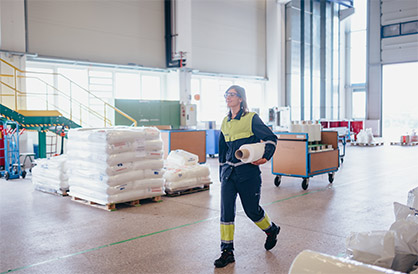
Roll of filtration fibres produced on the meltblown pilot line in the Borealis Innovation Headquarters in Linz, Austria. Photo: © Borealis


Borealis holds a 35-year track record in , and the unique pilot line in Linz has played an important role in the development. The pilot line is now being re-purposed to help meet the need for face masks. By teaming up with value chain partners, local and regional governmental organisations and non-governmental organisations (NGOs), Borealis shows its dedication to enhance health and safety of communities in which it does business. This is done by supplying filtration fabrics for face masks in order to quickly respond to an urgent need in the region. The temporarily converted small-scale pilot testing facilities are located in the Application Hall at Borealis Innovation Headquarters in Linz. The newly developed Borealis HL912FB is being used to produce meltblown fabric to be applied for customised inlays in cotton-based mouth-nose masks, for conventional mouth-nose masks, and also for high-end face masks worn by medical professionals (FFP1 to FFP3).


Unique PP meltblown resins for filtration excellence

A typical mask is made out of spunbonded outer layers and a meltblown middle layer. The spunbonded layers provide the structure while the meltblown layer is providing the barrier properties. For high-end FFP1 to FFP3 masks, more advanced meltblown structures with extremely fine fibres are essential. Borealis offers both the unique meltblown materials and a variety of spunbond PP grades.

The well-known Borealis meltblown resins HL708FB and HL712FB are reference grades for filtration. Recently, a new resin Borealis HL912FB was introduced to the market, which can be processed at higher processing temperatures allowing the production of even finer fibres. According to in-house testing, the use of Borealis HL912FB results in a significant improvement in filtration efficiency. All three grades are manufactured at Borealis facilities in Europe and made available to customers worldwide.
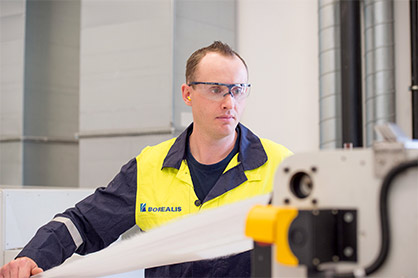
Borealis meltblown and spunbond PP grades are in fact listed as reference grades at leading machine suppliers. Photo: © Borealis


“The Covid-19 pandemic has led to a sudden steep increase in the need for PPE, while supply chains are being disrupted around the globe. We would like to assure our partners that we remain the reliable supplier of advanced polymers for the manufacture of high-quality face masks and other PPE,” says Lucrèce Foufopoulos, Borealis Executive Vice President Polyolefins, Innovation and Circular Economy Solutions. “True to our company purpose, ‘Life demands progress – we are re-inventing for more sustainable living’, we are offering innovative solutions like Borealis HL912FB and are re-purposing our own pilot facilities to a small-scale production line for meltblown fabrics. We have capitalised on our close collaboration with governments, NGOs and value chain partners to optimally deploy our innovation and manufacturing capabilities at the service of society.”

Watch the to learn more:

https://www.youtube.com/watch?v=HWn32njZ4gc&feature=youtu.be

More News from TEXDATA International

#Texprocess 2026

Texprocess 2026: Automation, digitalisation and AI redefine textile processing

Making investment decisions in textile processing has become significantly more demanding. Increasing energy costs, a shortage of skilled labour and ongoing geopolitical uncertainties are compelling companies to focus on technologies that deliver clear gains in efficiency and process reliability. This applies equally to apparel manufacturing and to the processing of technical textiles and high-performance materials. As a result, modernisation initiatives are assessed more carefully – even as the need to upgrade production systems continues to intensify.

#Techtextil 2026

Techtextil 2026: Between innovation pressure & market reality

From 21 to 24 April 2026, Techtextil in Frankfurt am Main will once again become the central meeting point for the international technical textiles and nonwovens industry. Running in parallel, Texprocess will focus on the industrial implementation of textile processing technologies as the leading platform in this field. Together, the two trade fairs form a closely integrated presentation and working platform along the entire textile value chain – from material development to finished applications.

#Techtextil 2026

Between geopolitical pressure and industrial resilience

In this interview, Dr. Janpeter Horn (VDMA) discusses the current challenges facing textile machinery manufacturers, shaped by geopolitical tensions, regulatory developments and subdued investment. He also outlines why innovation strength, integrated solutions and strategic positioning remain key to global competitiveness.

#Texprocess 2026

Between investment restraint and modernization pressure

Texprocess 2026 takes place in a complex market environment shaped by uncertainty and innovation pressure. In this interview, Elgar Straub (VDMA) explains why the trade fair is particularly relevant this year and which technologies are driving efficiency and competitiveness.

More News on Yarn & Fiber

#Man-Made Fibers

Indorama Ventures supports Southeast Asia’s textile customers with reliable regional supply and global innovative portfolio

Indorama Ventures, one of the leading global polyester fiber and filament yarn suppliers globally, will participate in Indo Intertex 2026 in Jakarta this April, making its diverse global portfolio available to apparel, home textile, and hygiene customers across Southeast Asia.

#Yarns

Yarn Expo Spring 2026 concludes, connecting buyers with innovative selection of sustainable yarns and fibres

Yarn Expo Spring 2026 wrapped up successfully on 13 March, as a record-high of over 600 exhibitors from 12 countries and regions welcomed more than 25,000 visitors from 113 countries and regions. Held across 27,000 sqm in Hall 8.2 of the National Exhibition and Convention Center (Shanghai), the fair highlighted the textile industry’s accelerating shift toward a lower-impact, more functional future. Exhibitors presented eco-friendly organic, regenerated and recycled yarns and fibres, alongside innovative options such as sweat-resistant and high-performance materials. A comprehensive fringe programme further enriched the event, offering practical market insights and new networking opportunities.

#Man-Made Fibers

Lenzing advances its transformation: Higher EBITDA, stronger free cash flow and more than EUR 200 million in cost savings

The business performance of the Lenzing Group in 2025 was affected particularly in the second half of the year by external factors such as international tariff measures, subdued demand and declining market prices. As a result, revenue decreased slightly by 2.3 percent to EUR 2.6 billion, primarily due to lower fiber sales volumes and lower prices for fibers and pulp, which were further negatively impacted by currency developments. Nevertheless, thanks to the comprehensive Performance Program, Lenzing was able to improve its operating performance and key financial indicators compared with the previous year.

#Man-Made Fibers

“Lead Transformation – Generate Impact”: Lenzing presents its 2025 Annual and Sustainability Report

The Lenzing Group has published its 2025 Annual and Sustainability Report, entitled LEAD TRANSFORMATION – GENERATE IMPACT. The report shows how Lenzing is actively shaping change in the industry and making a lasting impact: economically, ecologically, and socially. Lenzing is consistently focused on the future: with targeted investments in premiumization, excellence, innovation, and sustainability, the company is strengthening its position as a leading provider of sustainable, cellulose-based premium fibers. The combined report is available in digital format.

Latest News

#Recycling / Circular Economy

Europe’s textile future at a turning point: New 2030 Circularity Blueprint aims to scale recycling and unlock investment opportunities

The EU textile system is at a critical crossroads. Today, less than 1% of discarded garments are recycled into new garments, despite EU-wide obligations for separate collection. In response, Global Fashion Agenda (GFA) is launching the 2030 Circularity Blueprint, in partnership with ReHubs. This ambitious initiative is designed to support the transformation of the EU textile ecosystem to advance textile-to-textile recycling and drive the transition to a circular economy.

#Research & Development

Regional hemp bast for lightweight construction profiles

The cultivation of fibre hemp for the production of ropes and clothing has a long tradition in Saxony. Due to its excellent fibre properties, it is also suitable as a renewable raw material for reinforcement in fibre composites. At the STFI and IWU in Chemnitz, the CannaPul project is cur- rently investigating how a regional value chain for hemp-based lightweight construction profiles can be established. To this end, the technical processing of hemp fibres into continuous fibre strands and their embedding in a suitable bio-based matrix are being investigated.

#Digital Printing

Kornit Digital launches Konnections 365

Kornit Digital (NASDAQ: KRNT) (“Kornit” or the “Company”), a global pioneer in sustainable, on-demand digital fashion and textile production today announced the launch of Konnections 365 - a year-round movement designed for the people moving the apparel, print, and retail industries forward. The strategy is built on the overwhelming success of Konnections 2026 held in Hollywood, Florida, featuring more than 500 customers, partners, and collaborators who together are driving the future of apparel and textiles.

#Techtextil 2026

Techtextil 2026: KARL MAYER impresses as an innovative sector partner

KARL MAYER looks back with satisfaction on its participation in Techtextil 2026. From April 21 to 24, the international industry leader used the trade show in Frankfurt to meet with numerous key customers at its booth and, at the same time, establish many new contacts. Most visitors came from Germany, followed by major markets such as Poland, the United Kingdom, Turkey, France, and Portugal.

TOP