[pageLogInLogOut]

#Yarn & Fiber

Solid performance in first quarter of 2020 despite looming impact of COVID-19 and falling oil prices

Borealis CEO Alfred Stern / Photo: © Borealis
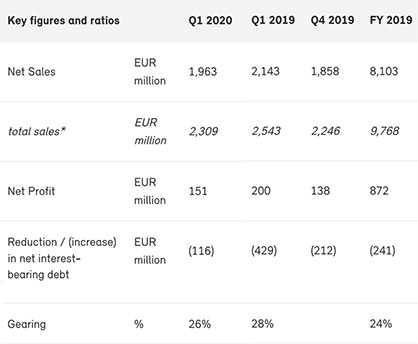
Borealis announces a net profit of EUR 151 million for the first quarter of 2020, compared to EUR 200 million in the same quarter of 2019. The contribution from Borouge in the first quarter of 2020 deteriorated versus the same period in 2019, as an already low polyolefin price environment in Asia was further impacted by the coronavirus pandemic and falling oil prices.
  • Lower Q1 profit versus 2019 mainly attributable to lower result from Borouge due to weak market conditions in Asia
  • Demand for innovative Borealis polyolefins remains robust in many product segments
  • Resilience programme launched to maintain solid financial position in face of uncertain global market outlook
  • Negative impact of coronavirus pandemic and falling oil prices on financial results likely to be greater in subsequent quarters
 

* Net sales of Borealis plus pro-rata sales of at equity consolidated companies (c) 2020 Borealis


The drop in profit compared to the first quarter of 2019 was also due to lower European integrated polyolefin results. At the same time, the contribution from the Fertilizer business improved compared to the first quarter of 2019 thanks to increased sales volumes and lower gas prices. In the first quarter of 2020, net debt increased by EUR 116 million, due largely to the payment of a EUR 300 million final dividend over 2019 to Borealis shareholders. The cash inflow from the business result and dividends from Borouge enabled Borealis to maintain a strong financial position, with a gearing of 26% at the end of the first quarter of 2020.

Review and Outlook

“Towards the end of the first quarter of 2020, the European polyolefins industry environment began to feel the effects of the COVID-19 pandemic and lower oil prices. For the second quarter in particular we expect a challenging market environment due to the continued negative impact of both COVID-19 and record low oil prices,” comments Alfred Stern, Borealis CEO.

“At the same time, demand remains solid in many product segments. The current crisis demonstrates just how critical our products are – not only for numerous industry sectors, but for human health and safety, too. At this point in time, all our production locations and warehouses are maintaining operations to secure supply of these products.”

“To ensure that we maintain our strong financial position despite the uncertain outlook for the global economy in the mid-term, Borealis has launched a resilience programme with focus on reduction of cost and investments and builds on previously existing initiatives. Borealis is well positioned to remain a strong partner for our customers and all other stakeholders during these exceptionally challenging times.”



More News from TEXDATA International

#ITM 2026

ITM 2026: The new geography of textile production

New production hubs are emerging across North Africa and Central Asia, while Türkiye is accelerating its transformation toward higher-value, technology-driven and more sustainable textile manufacturing.

#Research & Development

“Production is a product”

From technical textiles and AI-driven robotics to the limitations of textile circularity: Professor Dr Thomas Gries looks back on more than two decades of development at ITA Aachen. In the interview, he explains why production technology remains a decisive success factor, discusses international collaborations and innovation ecosystems, and shares his views on the transformation of production landscapes and the challenges facing an increasingly regulated industry.

#Knitting & Hosiery

“We need to move away from the price trap and return to a value-driven mindset.”

With its new Textile Innovation Center, KARL MAYER is sending a strong signal for innovation, collaboration, and the future of textile applications. In this interview, Karl Josef Mayer discusses new opportunities in warp knitting, the processing of staple fibres, recycling, the changing role of machinery manufacturers, and why the textile industry must once again focus more strongly on the value of textiles. by Oliver Schmidt

#Associations

“Innovation, resilience and international experience remain the great strengths of the Swiss textile machinery industry”

Geopolitical uncertainty, growing competitive pressure from China, new free trade agreements and the shift towards a circular economy are currently reshaping the global textile industry. In this interview, Cornelia Buchwalder discusses the current mood within the Swiss textile machinery sector, the industry’s distinctive innovative strength, new market opportunities in India and Asia, and the technological trends that could shape the upcoming trade fair cycle leading up to ITMA 2027.

More News on Yarn & Fiber

#Recycling / Circular Economy

The textile industry in transition

Recycling, traceability, eco-design and digitalisation are among the key future challenges facing the European textile industry. The Erasmus+ project Skills4Circularity, involving 21 partners from twelve countries, is investigating the skills required to address these challenges. As the German industry partner, the Industry Association for Finishing – Yarns – Fabrics – Technical Textiles (IVGT) is bringing the industry’s perspective to the project.

#Research & Development

GenuTrace client advisory: Is your cotton supply chain UFLPA ready?

U.S. Customs and Border Protection has released updated operational guidance (CBP Publication No. 5560-0526) expanding its forced labor enforcement framework. The guidance supersedes the original 2022 UFLPA Operational Guidance and now covers all forced labor enforcement authorities — UFLPA, CAATSA, and WROs/Findings — in a single unified document. For cotton importers, the enforcement posture has not softened. It has become more structured, more documented, and more demanding. Learn more about UFLPA.

#Spinning

"We will become a recycling powerhouse"

The textile industry is now in its fourth consecutive year of crisis, while automation, artificial intelligence and recycling are reshaping the rules of the game. In this interview, Rieter CEO Thomas Oetterli discusses the first signs of a market recovery, reflects on his first three years at the helm of the company, explains the integration of Barmag, outlines Rieter’s vision of the fully automated spinning mill and highlights the strategic importance of recycling. In doing so, he explains why the new Rieter Group aims to play a leading role in transforming the textile value chain into a circular economy.

#Man-Made Fibers

ROICA™ launches new global brand identity and digital experience

ROICA™, the premium stretch fiber developed by Asahi Kasei, today announced the launch of its new global brand identity, including a new key visual and a fully redesigned website. This milestone initiative marks the beginning of a new phase in ROICA™’s evolution as a global brand.

Latest News

#Natural Fibers

Bremen Cotton Exchange: Fritz A. Grobien re-elected as President

The members of the Bremen Cotton Exchange have re-elected Fritz A. Grobien as President during the association’s 152nd General Assembly on June 18, 2026. The election confirms the organization’s commitment to maintaining its role as a leading international platform for the cotton and fiber industry amid a period of geopolitical and economic uncertainty.

#Natural Fibers

Organic cotton at the crossroads: Ideology, evidence, and the road ahead

Organic cotton occupies one of the most contentious spaces in global agriculture. While praised by brands and consumers for its environmental ideals, it also faces persistent questions about yield stability, certification integrity, and scalability. The current edition of The ICAC Recorder cuts through the ideology to deliver a rigorous, evidence-based assessment of both sides of the debate.

#Spinning

New spinning package with two-step filtration for recycled yarns and more

At the ITM in Istanbul, BB Engineering unveiled its new, patented ValuePack spinning package for the first time, which features a two-stage filtration system. This is particularly beneficial for re-cycling processes. Until now, spinning packs have used either metal powder (“sand”) or filter candles as filter media. Both options are suitable for differ-ent applications, and each has its own specific advantages and dis-advantages.

#ITMA 2027

ITMA 2027 gains strong momentum

In line with the theme "Co-creating the future of textiles", ITMA continues to strengthen its support for start-ups, recognising their role in driving innovation and shaping the future of textile and garment manufacturing. Through the Start-Up Valley, emerging companies gain access to a global marketplace where they can connect with industry leaders, potential partners, investors and customers.

TOP