#Textiles & Apparel / Garment
adidas presents growth strategy ‘Own the Game’ until 2025
- Strategic focus on brand credibility, consumer experience and sustainability
- adidas brand architecture to be sharpened
- Shift to a DTC-led business model
- E-commerce sales to double to between € 8 billion and € 9 billion
- 9 out of 10 adidas articles will be sustainable
- Digital transformation supported by investments of more than € 1 billion
- Mindset of innovation as an enabler across the entire company
- Revenues to increase at a rate of between 8% and 10% p.a. on average 2021-2025
- Operating margin to reach a level of between 12% and 14%
- Net income to increase at a rate of between 16% and 18% p.a. on average 2021-2025
- Total cash return to shareholders to be between € 8 billion and € 9 billion
As building direct relationships with its target audience plays an increasingly important role, adidas will evolve its operating model to address consumers more directly. As a result, the company’s direct-to-consumer (DTC) business is projected to account for around half of the company's total net sales by 2025 and to generate more than 80% of the targeted top-line growth. The company's e-commerce business is forecast to double to between € 8 billion and € 9 billion. From a market perspective, the company will focus on Greater China, EMEA (Europe, Middle East, and Africa) and North America. Overall, these three strategic markets are expected to account for around 90% of sales growth until 2025. In addition, nine out of ten adidas articles will be made from sustainable materials by 2025. The company draws confidence from the success of its previous strategy ‘Creating the New’, its strong market position as well as attractive growth prospects for the sporting goods industry as a whole.
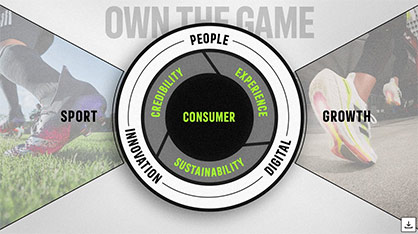
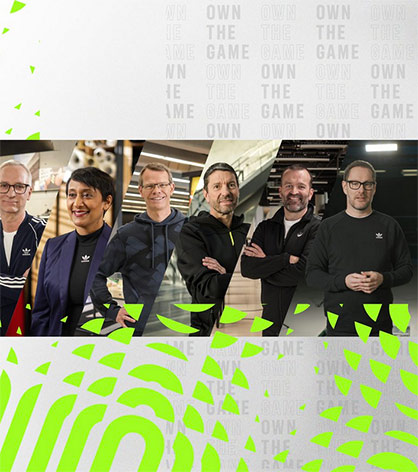
“‘Own the Game’ is a growth and investment strategy, which will lead adidas into a successful future. Our strategy is deeply rooted in sport, puts the consumer at the heart of everything we do and is brought to life by our people. Our strategic focus is on increasing credibility of the adidas brand, elevating the experience for our consumers and pushing the boundaries in sustainability,” said adidas CEO Kasper Rorsted. “To successfully execute our strategy, we will continue to significantly invest into our people, our brand and the digital transformation of the company.”
Strong growth of sales, profitability, and cash flow
With its new strategy, the company aims to increase sales by an average of between 8% and 10% per annum on a currency-neutral basis over the four-year period between 2021 and 2025. Gross margin is forecast to expand to a level of between 53% and 55%, and the operating margin to a level of between 12% and 14% by 2025. Net income from continuing operations is also projected to increase substantially by an average of between 16% and 18% per year over the four-year period between 2021 and 2025. Driven by the significant top-line growth and strong bottom-line expansion, adidas will generate substantial cumulative free cash flow until 2025. The majority of this – between € 8 billion and € 9 billion – will be distributed to shareholders through regular dividend pay-outs in a range of between 30% and 50% of net income from continuing operations, complemented with share buybacks.
Given the impact of the coronavirus pandemic, the company’s financial ambition has the 2021 financial year – rather than 2020 – as a baseline. For 2021, the company expects currency-neutral net sales to increase at a mid- to high-teens rate. Gross margin is forecast to increase to a level of around 52% in 2021 and the operating margin is projected to rebound to a level of between 9% and 10%. Net income from continuing operations is anticipated to increase to a level of between € 1.25 billion and € 1.45 billion this year.
Investing into people, the brand, and digitalization
To successfully deliver on its strategy, adidas intends to invest consistently into its people and its unique workplace. Furthermore, adidas will continue its efforts to ensure there is a level playing field for all, as the company continues its Diversity & Inclusion journey. Investments into product development, marketing, sponsoring and the company's digitalization are also set to increase significantly over the next five years. adidas plans to invest around € 1 billion more into the brand in 2025 compared to 2021. By 2025, the digital transformation of the company will have been driven forward with investments amounting to over € 1 billion as well.
‘Own the Game’ – Overview
Credibility
adidas will sharpen its market position in Sport and Lifestyle through a clear brand architecture. In Sport, the company will focus on the four most important categories: Football, which is the biggest sport in terms of viewership, as well as Running, Training, and Outdoor, the three biggest participation sports. In the company's lifestyle segment, adidas introduces Sportswear as a new consumer proposition to address the growing relevance of the ‘athleisure’ trend toward sport-inspired leisurewear. At the same time, Originals will be extended into the premium segment to ensure a stronger distinction of the respective product offerings going forward. Until 2025, the five categories Football, Running, Training, Outdoor, and Lifestyle are expected to account for more than 95% of revenue growth.
adidas is committed to attracting more female consumers. In order to achieve this, the company will execute on a cross-category plan to achieve product excellence and to elevate the women’s experience with the goal to grow currency-neutral net sales for its Women’s business at a mid-teens rate on average per year between 2021 and 2025.
Experience
Consumers expect to receive a brand and shopping experience tailored to their preferences, with personalized offerings in both digital and physical spaces. The transformation into a direct-to-consumer-led business built around membership, enabled by a network of own-retail stores and e-commerce, will therefore play an even more important role for adidas in the future. Sales through DTC channels are projected to account for around half of the company's total net sales by 2025 and to generate more than 80% of the company’s increase in sales until 2025. The company's own e-commerce net sales are expected to double from currently more than € 4 billion to between € 8 billion and € 9 billion. To achieve this, adidas will continue to invest into e-commerce and into expanding its membership program. In 2025, adidas aims to have tripled the number of members in its membership program from the current level of more than 150 million to around 500 million. In addition, adidas’ own-retail stores will be digitized with fully-fledged omnichannel capabilities. The focus on increasing digitalization will be expanded to the company’s wholesale partners to ensure a seamless experience for the consumer across all touchpoints.
adidas also seeks to drive membership through its engagement in megacities, doubling the number of Key Cities from six to twelve: The company will build on its existing Key Cities portfolio of Tokyo, Shanghai, Paris, London, New York, and Los Angeles, by adding Mexico City, Berlin, Moscow, Dubai, Beijing, and Seoul. In addition to these twelve Key Cities, the strategic markets Greater China, EMEA (Europe, Middle East, and Africa) and North America continue to increase in importance. The company plans to invest overproportionately in these markets to gain market share, as they are expected to jointly account for around 90% of net sales growth until 2025.
Sustainability
For over two decades, sustainability has been an integral part of adidas’ philosophy. A philosophy rooted in the company’s purpose that through sport adidas has the power to change lives. In the years to come, adidas will once again significantly expand its commitment to sustainability and move to a comprehensive consumer-facing program with a sustainable offering at scale. Already today, six out of ten adidas articles are made from sustainable materials. By 2025, nine out of ten will be sustainable as the company expands and further innovates its 3-loop system: recycled loop (made from recycled materials), circular loop (made to be remade), or regenerative loop (made with natural and renewable materials). adidas has been researching fully recyclable or biodegradable materials for some time already and aims to only use recycled polyester in every product from 2024 onward. In addition, the communication and marketing for products made from sustainable materials will be intensified, while product takeback programs will be rolled out at a large scale. adidas is committed to reducing its CO2 footprint per product by 15% by 2025. To this effect, the company is working closely with its partners in the global supply chain to reduce energy and material consumption and make greater use of green energy sources. adidas aims to achieve climate neutrality in its own operations by 2025 and overall climate neutrality by 2050.
The execution of ‘Own the Game’ is supported by the further digitalization of the company as well as innovation across all dimensions of adidas’ business.
Digital
The company's digital transformation is driven by investments of more than € 1 billion until 2025. Core processes across the entire value chain will be digitalized: from the creation process with 3D design capabilities, via the sourcing of its products to selling it to customers and consumers. In 2025, the vast majority of adidas’ sales will be generated with products that were created and sold digitally. To achieve this, the company will expand its data and technology expertise internally and increase the size of its tech team. In 2021 alone, adidas will hire more than 1,000 tech and digital talents. The company is also investing into the new ERP system S/4HANA.
Innovation
adidas will strengthen its innovation mindset across all areas of the company over the coming years in order to continue to enable ground-breaking innovations, as already demonstrated in the past with the Boost technology or the partnership with Parley for the Oceans. Recent examples of such innovations are Futurecraft.Strung, a running shoe with an upper based on athlete data – to be launched in 2022 – or new vegan and recyclable versions of the popular lifestyle silhouette Stan Smith. adidas aims to make one of its most important and most successful franchises the most sustainable in its entire product portfolio. Further innovations include several new tech platforms in Running, a swipe mechanism for product feedback incorporated into the adidas app as well as dedicated and sustainable Outdoor stores in the Alps called Terrex Mountain Lofts.
At the Olympics and major marathons, adidas athletes will compete in the adizero Adios Pro 2. The running shoe is the second generation of the adizero Adios Pro that was successfully launched in the second half of last year and in which both Peres Jepchirchir and Kibiwott Kandie set new world records in the women’s and men’s half marathon. Further innovations to create sustainable products and processes are already in the making. In the coming months, adidas will launch the Ultraboost DNA Loop in larger quantities for the first time. Once this version of the successful running shoe reaches the end of its life cycle, it can be shredded to pieces and reused.
‘Creating the New’ as strong foundation
The company's new strategy ‘Own the Game’ builds on ‘Creating the New’, the strategy adidas has successfully executed over the past five years from 2016 to 2020. ‘Creating the New’ was introduced in March 2015 and centered around three strategic priorities: Open Source partnerships, Key Cities and driving Speed in product manufacturing. Digitalization, strengthening adidas’ positioning in North America, the standardization of processes under ONE adidas, and sharpening the brand portfolio were then added in 2017.
Despite the negative impact resulting from the global coronavirus pandemic in 2020, ‘Creating the New’ enabled the company to grow significantly in its strategic growth areas and to gain market share: During the five years between 2015 and 2020, sales doubled in both North America and Greater China, whereas e-commerce sales increased sevenfold. For the period 2015 to 2019, prior to the coronavirus pandemic, adidas successfully increased sales by a total of around € 7 billion, operating margin improved around 5 percentage points, net income from continuing operations grew by around € 1.2 billion, while at the same time marketing investments increased by more than € 700 million. The strong operational performance also translated into attractive shareholder returns. During the five-year period of ‘Creating the New’, the adidas share price more than tripled.
Kasper Rorsted said: “Together with our more than 60,000 adidas employees, I look forward to executing our new strategy. ‘Own the Game’ will enable us to continue growing in an attractive industry, gaining market share, and creating sustainable value for all our stakeholders. By 2025, adidas will be stronger, more sustainable and more digital than ever before.”