[pageLogInLogOut]

#Sustainability

Practical toolkit to drive coordinated climate action launched
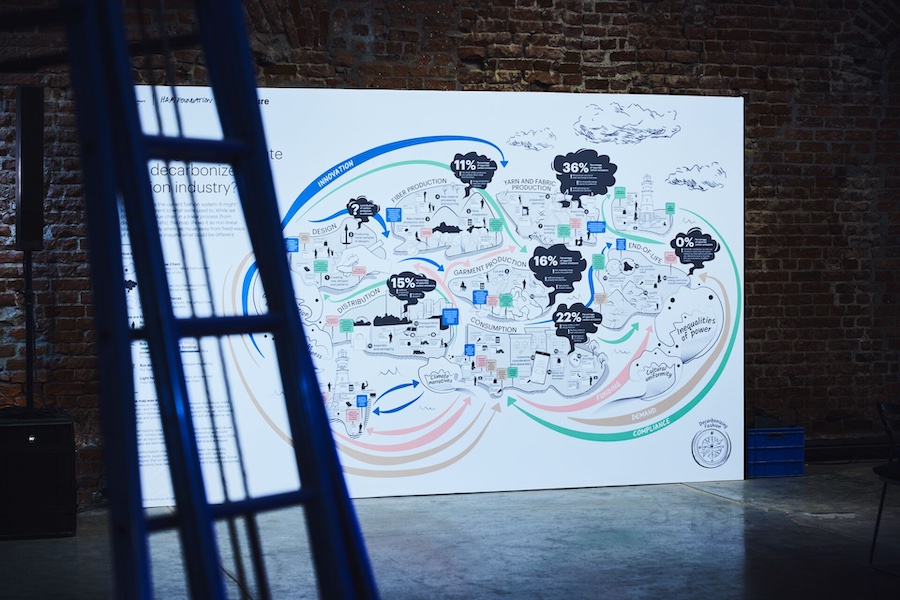
The System Map: a practical tool to help you understand, navigate and transform the textile system. © 2026 H&M Foundation
An open-access workshop toolkit enables brands, suppliers, policymakers and investors across the textile industry to apply the System Map in their own work, identifying leverage points to halve emissions and enable a just transition.

The textile industry must halve its greenhouse gas emissions every decade until 2050. The challenge is not lack of ambitions; it’s lack of alignment. In 2024, H&M Foundation introduced the System Map, a visual framework that reimagines the textile industry as an interconnected ecosystem shaped by flows of capital, incentives, innovation, regulation and demand.

Now, H&M Foundation is launching a practical, open-source toolkit to help organisations turn that systemic insight into action. While the System Map provides a shared understanding of how emissions, power and value flows across the industry, the new toolkit enables actors to apply it within their own organisations and partnerships.

"Change won’t come from islands of perfection – in a system as interconnected as fashion, every part influences the other. The System Map helped make that visible and now this toolkit makes it usable. If we want to halve emissions every decade, we have to stop optimising in silos and start pulling the right levers together", says Anna Gedda, CEO H&M Foundation.

The System Map challenges the traditional linear view of fashion. It visualises:

  • The full textile value chain, from fibre to end-of-life
  • Indicative carbon emissions across stages
  • Systemic forces such as profit-centredness, power imbalances and cultural norms

By mapping actors, flows and leverage points, it reveals where decisions can unlock system-wide impact and where well-intended action may simply shift burdens elsewhere.

To translate this into practice, H&M Foundation engaged Accenture to develop a facilitation toolkit that can be delivered digitally or in person. The toolkit includes:

  • A keynote introduction to the System Map
  • Workshop 1: Identifying your role and sphere of influence
  • Workshop 2: Pinpointing systemic leverage points
  • Workshop 3: Reimagining a decarbonised and just future textile system

The sessions are designed for brands, manufacturers, innovators, policymakers, investors, researchers and civil society organisations.

Decarbonisation must go hand in hand with a just transition. Climate action cannot shift costs onto the most vulnerable parts of the value chain. By providing a structured way to examine power dynamics and structural barriers, the toolkit supports more coordinated and equitable climate strategies.

The System Map remains publicly available as an open industry resource. With the launch of the toolkit, the H&M Foundation aims to move the conversation from understanding the system to actively reshaping it. Structural transformation will not come from isolated efforts. It will come when more actors work from a shared view of the system and choose to redesign it together.

The System Map and toolkit are available for download here:

https://hmfoundation.com/system-map-toolkit-and-guiding-material/


More News from H&M Group

#Sustainability

Pioneering open-source framework shows how early innovation drives a just and net-zero fashion future

The non-profit H&M Foundation, in collaboration with Accenture, has unveiled From Signals to Systems Change, an insight report calling on the fashion industry to rethink its role in transformation. At its core is the Reimagined System Map, a pioneering open-source framework that visualises how early-stage innovation could drive a just and net-zero textile future.

#Sustainability

H&M Foundation funds pioneering initiative to build the factories of the future

The H&M Foundation is committing SEK 53 million (approx. EUR 5 million) towards Future Forward Factories, a five-year initiative led by Fashion for Good, to address fashion’s most polluting stage: tier 2 textile processing.

#Textiles & Apparel / Garment

Global Change Award 2026: Nominations now open

On 1 September, the H&M Foundation launched the nomination round for the Global Change Award 2026. The international innovation challenge is looking for early-stage ideas that can drive the textile and fashion industry towards circularity and climate neutrality.

#Sustainability

Ten bold ideas to decarbonise fashion: Meet the winners of Global Change Award 2025

The H&M Foundation has revealed the ten winners of the Global Change Award 2025 – spotlighting groundbreaking ideas aimed at decarbonising the fashion industry in a just way. Each winner will receive a €200,000 grant and take part in the yearlong GCA Changemaker Programme – one of the few programmes of its kind focused on early-stage fashion innovation. Designed to accelerate the industry’s journey toward net-zero, the programme offers a mix of innovation support, systems thinking and personal growth.

More News on Sustainability

#Sustainability

A new standard to combat plastic waste in forests

With DIN SPEC 35808 “Tree Shelter for Forestry Applications,” the testing and research service provider Hohenstein, in collaboration with Rottenburg University of Forestry, as well as forestry authorities and industry partners, has established a clear framework for bio-based and fully biodegradable tree shelters. The pre-standard defines requirements and practical testing methods designed to reduce plastic waste in forests and strengthen the long-term protection of soil and the environment.

#Denim

Denim moves towards sustainability

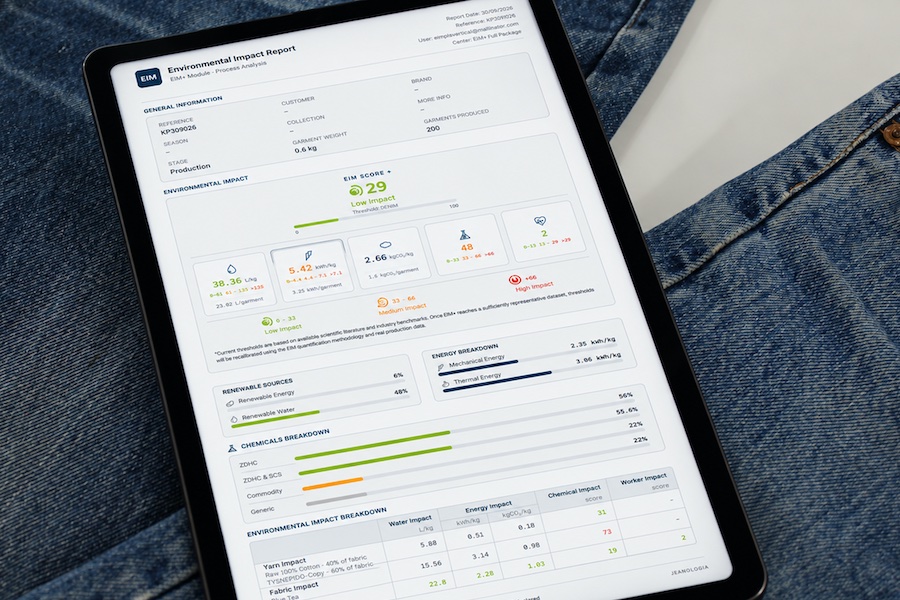
EIM (Environmental Impact Measurement), the global reference platform for measuring the environmental impact of garment finishing, presents the second edition of its annual report Denim Industry Progress & Insights 2025. The study analyses over 100,000 real denim finishing processes, providing an accurate and up-to-date view of the industry’s evolution towards more sustainable models.

#Recycling / Circular Economy

Europe’s textile future at a turning point: New 2030 Circularity Blueprint aims to scale recycling and unlock investment opportunities

The EU textile system is at a critical crossroads. Today, less than 1% of discarded garments are recycled into new garments, despite EU-wide obligations for separate collection. In response, Global Fashion Agenda (GFA) is launching the 2030 Circularity Blueprint, in partnership with ReHubs. This ambitious initiative is designed to support the transformation of the EU textile ecosystem to advance textile-to-textile recycling and drive the transition to a circular economy.

#Sustainability

Number of GOTS-certified facilities grow 15% globally as demand for credible sustainability standards continues to strengthen

Global Organic Textile Standard (GOTS) certification continued to grow in 2025, with nearly 18,000 certified facilities worldwide, despite ongoing geopolitical uncertainty and rapidly evolving regulatory requirements across global textile supply chains.

Latest News

#Digital Printing

Mimaki ‘Powers Possibilities’ with a market-diverse application and printer line-up at FESPA 2026

Mimaki Europe, a leading manufacturer of industrial inkjet printers and cutting plotters, is bringing its “Print Different - Powering Possibilities” theme to life at FESPA Global Print Expo 2026 (Fira de Barcelona, 19-22 May 2026), demonstrating how digital printing technology can turn ideas into high-value applications and new business opportunities.

#INDEX 2026

INDEX™26 Awards winners announced: Setting new benchmarks in nonwovens

The nonwovens industry has officially crowned its new winners. Today at the opening of INDEX™ 2026, five companies were honoured with the INDEX™ Awards, the industry’s highest accolade for technical excellence and forward-thinking design.

#Yarns

From advanced fibres to eco‑focused yarns: Yarn Expo Autumn 2026 set to welcome global industry to Shanghai

From 25 – 27 August, Yarn Expo Autumn 2026 will return to the National Exhibition and Convention Center (Shanghai) to reinforce its role as a key meeting point for the global yarn and fibre industry. With over 22,000 visitors, the previous edition gathered nearly 580 leading exhibitors from 16 countries and regions, showcasing advanced developments and creative applications that support innovative, sustainable textile design. The upcoming edition will not only present an extensive range of fibre and yarn products, but will also feature a comprehensive fringe programme, including industry forums and trend display areas, providing innovative upstream enterprises with a stage to introduce next‑generation materials and sustainable concepts.

#ITM 2026

Monforts sees growing potential for technical textiles in Türkiye

For many years now, Türkiye has been one of the most important markets for textile finishing, coating and continuous dyeing equipment, making ITM 2026 from June 9-13 a key event for Germany’s Monforts. At the Istanbul exhibition at stand 1117D in Hall 11, the company will put the emphasis on its machines which continue to lead the field in conventional dyeing and finishing, and also highlight the strong opportunities for Turkish textile manufacturers in the growing field of technical textiles.

TOP