[pageLogInLogOut]

#Textile chemistry

How to defossilise the chemical industry: RCI’s new policy proposals for a renewable carbon future

A new report presents policy proposals to facilitate the transition from fossil carbon to renewable carbon from biomass, CO2 and recycling in Europe.

The European chemical industry, a cornerstone of manufacturing with significant economic impact and a key enabler for many other industries, is at a crossroads. The sector is facing an acute crisis due to global competition, rising energy costs and regulatory burdens. Once a leader in patents and production, Europe now trails behind China and the US, reflecting signs of declining competitiveness. The sector’s heavy reliance on fossil fuels for raw materials (over 90%) exacerbates its challenges, creating dependencies and limiting control over its carbon footprint at a time when Europe is grappling with the need for a green transition to ensure long-term prosperity and competitiveness. As a result, there are clear signs of ongoing deindustrialisation in the EU chemical industry. 

Amidst these challenges lies an opportunity: Defossilising Europe’s chemical sector by transitioning to renewable carbon sources such as biomass, carbon capture and utilisation (CCU) and recycling. This shift is not merely an environmental necessity, but a strategic move to enhance Europe’s industrial competitiveness and resilience in the global marketplace. However, progress is hampered by regulatory barriers, the slow expansion of renewable energy, insufficient demand for sustainable products and limited uptake of new technologies.

To address these barriers, the Renewable Carbon Initiative (RCI) has released a comprehensive report outlining ten policy proposals designed to accelerate the transition to renewable carbon in feedstocks and materials. Developed in collaboration with experts from nova-Institute and RCI members, these proposals aim to bridge the gap between innovation and large-scale implementation. 

A vision for defossilisation: Driving change through targeted policies

The defossilisation of Europe’s chemical industry requires not only a clear commitment to defossilisation but also an actionable policy framework that supports, guides and incentivises the transition to renewable carbon. At the heart of this vision is an overarching commitment to defossilisation – a high-level agreement that establishes the foundation on which all future European policies can build upon. To create concrete market demand for sustainable products from renewable carbon, mandatory targets for the use of renewable carbon in chemicals and materials should be implemented. This can either be achieved by novel regulation or adaptation of existing regulations such as the Packaging and Packaging Waste Regulation (PPWR), the End-of-Life of Vehicles Regulation (ELVR) or the Ecodesign for Sustainable Products Regulation (ESPR) – and an adaptation of the EU Emission Trading System (ETS) or an alternative European Carbon Utilisation Trading System (CUTS).

To make the transition to renewable carbon a reality, EU policy further needs to enable sustainable access to renewable carbon feedstocks while ensuring competitiveness at both global and sectoral levels. To achieve this, RCI’s policy proposals include concrete suggestions to facilitate access to more waste as a feedstock, secure local access to biomass from agriculture, forestry and carbon capture, lead the way on international trade of renewable carbon feedstocks, balance regulation between energy and material uses to maximise synergies and ramp up availability of affordable renewable energy e.g. by favourable conditions for alignment with defossilisation targets. 
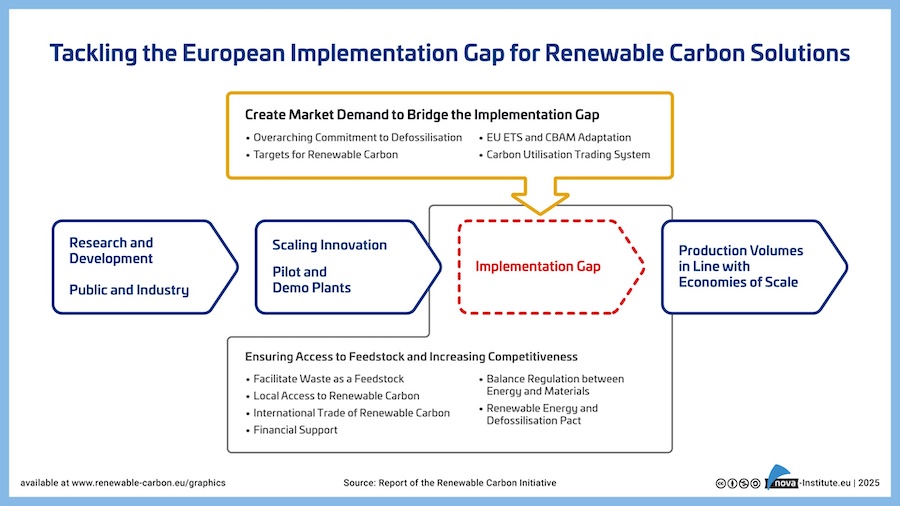
A new report by the Renewable Carbon Initiative outlines 10 concrete policy proposals to facilitate the transition of Europe’s chemical industry to renewable carbon. These proposals are aimed to support the target of a clean, but competitive chemical industry in Europe with increased resilience and lower fossil dependence. © nova-Institute


A new report by the Renewable Carbon Initiative outlines 10 concrete policy proposals to facilitate the transition of Europe’s chemical industry to renewable carbon. These proposals are aimed to support the target of a clean, but competitive chemical industry in Europe with increased resilience and lower fossil dependence. © nova-Institute

Addressing the implementation gap to unleash innovation

The transition to renewable carbon is not just about environmental sustainability; it is about securing Europe’s industrial future and maintaining its global competitiveness in a rapidly changing world. By pioneering renewable carbon technologies, the EU can unlock economic benefits and unleash its innovation potential while advancing climate neutrality ambitions. 

Addressing defossilisation and supporting the transition to renewable carbon will provide a comprehensive and reliable framework for the transformation of the chemicals and materials sector – in particular addressing the implementation gap from innovation to scaled product.

As highlighted by the EU Competitiveness Compass: “To shift the economy towards clean production and circularity, the EU needs to develop lead markets and policies to reward early movers.” The RCI’s policy proposals are in line with this vision by addressing key challenges and providing actionable solutions.

More News from nova-Institut für politische und ökologische Innovation GmbH

#Recycling / Circular Economy

Advanced Recycling Conference 2025 fuels innovation across key waste streams

The Advanced Recycling Conference (ARC) 2025 brought together nearly 220 experts from 28 countries to spotlight pioneering advancements and foster industry collaboration in recycling across diverse waste streams including plastics, textiles, automotive and other materials.

#Recycling / Circular Economy

Advanced Recycling Conference 2025: From industry crossroads to circularity

Alongside core-topics like plastics and polymer recycling, this year’s program explores new developments in biochemical, textile and automotive recycling, plus digital tools supporting scalable solutions for circular systems.

#Recycling / Circular Economy

Advanced Recycling Conference 2025 – Shaping the future of the circular economy

Closing the loop by setting the stage for recycling innovation at Europe’s largest event on advanced recycling technologies. Call for abstracts is now open.

#Research & Development

Joint forces for renewable carbon: Lars Börger appointed as new CEO of nova-Institute

In these challenging times for the sustainable transformation of the chemicals and materials sector, collaboration is more necessary than ever. That is why nova-Institute is proud to welcome Dr. Lars Börger as the new Co-CEO alongside with Michael Carus, the current CEO of nova-Institute. As a team, they will join forces to drive progress towards a greener and fossil-free future for these industries.

More News on Textile chemistry

#Textile chemistry

PIGMENTURA by CHT wins the German Sustainability Award in the Products category

On Thursday, December 4, 2025, the German Sustainability Award was granted in Düsseldorf for the CHT Group's state-of-the-art pigment dyeing process PIGMENTURA.

#Textile chemistry

Archroma and Lilienweiss join forces to deliver faster and localized color management services in Europe

Archroma, a global leader in specialty chemicals focused on sustainable solutions, today announced its partnership with Lilienweiss, who will begin offering Archroma Color Management solutions across Europe starting January 2026.

#Man-Made Fibers

Ascend Performance Materials secures court approval for restructuring and appoints new CEO

Ascend Performance Materials has reached a major milestone in its Chapter 11 process: the U.S. Bankruptcy Court for the Southern District of Texas has confirmed the company’s Plan of Reorganization. Ascend expects to emerge from Chapter 11 by year’s end with a significantly improved capital structure. In parallel with the restructuring progress, Ascend announced a leadership change.

#Textile chemistry

Indorama Ventures ranks first globally in ChemScore 2025 for excellence in chemicals management and environmental performance

Indorama Ventures Public Company Limited (IVL), a global sustainable chemicals company, has been ranked first globally with a green card in ChemScore 2025, the internationally recognized benchmark developed by ChemSec, assessing the environmental performance and chemical management of the world’s 40 largest chemical companies. The company has consistently found itself in the top three ChemScore companies and scored twice as high on average as the Asia-based companies taken together.

Latest News

#People

Happy Holidays!

Dear reader, the year 2025 is drawing to a close. We are entering what we hope will be a peaceful holiday season, spending time with our families and taking a moment to pause and reflect. We hope we have been able to support you once again this year with relevant news and articles, and we look forward to surprising you with many innovations in the coming year. Enjoy the festive season, stay healthy, and we wish you a happy and joyful holiday season.

#Weaving

Lindauer Dornier announces leadership transition in weaving machine business

After more than ten successful years at Lindauer DORNIER GmbH, Mr Wolfgang Schöffl will leave the family-owned company at the end of the year to enter well-deserved retirement.

#Heimtextil 2026

Texpertise Focus AI: Messe Frankfurt puts Artificial Intelligence centre stage at its international textile and apparel trade fairs

Under the banner 'Texpertise Focus AI, Messe Frankfurt will place a strong emphasis on Artificial Intelligence (AI) across its international textile and apparel trade fairs from 2026 onwards, setting a future-shaping signal for the industry. The initiative highlights the responsible use of AI along the entire textile value chain, from fibre production to the point of sale. The programme will launch at Heimtextil in Frankfurt in January 2026.

#Technical Textiles

Autoneum and Polestar set new benchmarks for passenger experience and sustainability

As the global market leader in sustainable acoustic and thermal management, Autoneum is a key supplier of interior and exterior components for the highly anticipated Polestar 5 model. The successful collaboration between Autoneum and Polestar marks a significant milestone in sustainable automotive engineering: the electric grand tourer sports car features several innovations in lightweight, fully recyclable polyester-based components that ensure a superior driving experience. Polestar 5 was revealed at the IAA Mobility 2025 in Munich and is available in 24 markets.

TOP