[pageLogInLogOut]

#Sustainability

The European LIFE ANHIDRA project revolutionizes sustainable water management in the textile industry with a closed-loop, zero-discharge system
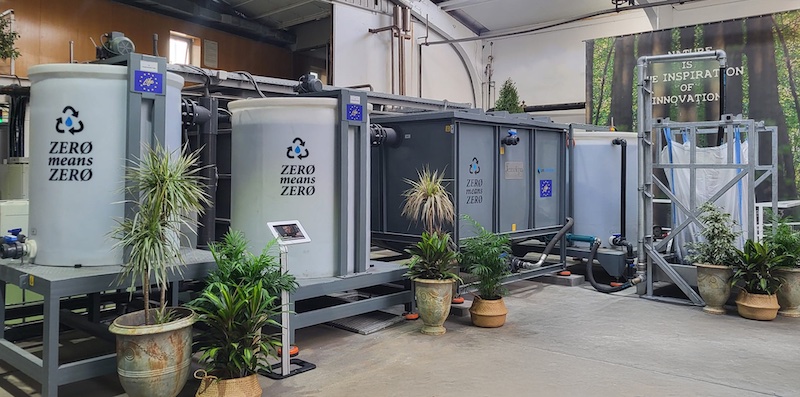
The European LIFE ANHIDRA project marks a milestone in sustainability with the unveiling of its innovative closed-loop system for treating and reusing textile wastewater. During the event held at the Pizarro facility in Guimarães (Portugal), ANHIDRA was introduced as a revolutionary solution transforming water management in the textile industry. The event brought together the project’s key partners: Jeanologia, the Spanish company responsible for designing and building ANHIDRA and a global leader in sustainable technologies for the textile sector; AITEX, the Textile Industry Research Association; and Portuguese textile company Pizarro, accompanied by representatives from the European Commission.
The sustainable, zero-discharge solution aims to significantly reduce the environmental footprint of one of the world’s most water-intensive industries © 2024 ANHIDRA project


A key solution to reduce the textile industry’s water footprint

The textile industry consumes an estimated 93 billion m³ of water annually, accounting for 4% of global water use. ANHIDRA addresses this critical challenge by regenerating up to 95% of the water used in textile washing and finishing processes, returning it in optimal conditions for reuse.

With zero discharges, zero contamination, and no complex treatments, ANHIDRA stands out with exceptional results:

+ 92% reduction in water consumption

+ 98% reduction in wastewater generation

+ Up to 15% reduction in energy consumption

ANHIDRA not only minimizes environmental impact but also reduces the operational costs associated with traditional water management, making it a competitive and eco-friendly solution.

Innovation and circular economy

Beyond water regeneration, ANHIDRA focuses on reusing textile waste. In collaboration with AITEX, the project is exploring how to transform fibrous fragments collected during water treatment into new textile products, reinforcing the project’s commitment to the circular economy.

"ANHIDRA not only transforms water management in the textile industry but also proves that sustainability and competitiveness can go hand in hand. This system sets a new global benchmark," said Vicent Albert, Jeanologia’s Product and Technology Director.

Launch and demonstration of the ANHIDRA system

During the event, attendees observed the various stages of the system in action at the Pizarro pilot plant. Following the demonstration, a coffee-networking session allowed project partners to exchange ideas about the technical, environmental, and economic impact of the technology.

"ANHIDRA represents a radical shift in how we address environmental challenges in a resource-intensive industry like textiles. It is a sustainable, efficient, and essential solution," emphasized Manuel Pizarro, CEO of Pizarro.

Scalability and future of the project

The project plans to implement ANHIDRA in at least 36 industrial facilities over the next three years, aiming to expand to 100 systems internationally within five years. This is expected to save up to 12.34 million m³ of water annually.

Funded by the European Union's LIFE program, LIFE ANHIDRA demonstrates how business cooperation and technological innovation can provide effective solutions to major environmental challenges. "Our goal is to make this technology accessible to the entire textile industry, contributing to a more sustainable future for fashion and the planet," concluded Vicent Albert, project coordinator.



More News from JEANOLOGIA S.L.

#Denim

Jeanologia launches Billy

The new AI extracts precise laser designs from a garment image in minutes, transforming how vintage denim is recreated for production. If Jeanologia’s laser changed the way jeans were made at the end of the last century, its AI now takes the next step: moving from reproducing wear to designing it. / archive photo © 2026 Jeanologia

#Textile chemistry

Jeanologia urges industry to accelerate PP Spray phase-out following ZDHC Watchlist update

Potassium permanganate has officially entered the Chemical Watchlist of the ZDHC Foundation, signaling increased scrutiny and potential phase-out of one of the most hazardous chemicals still used in denim finishing. The inclusion confirms an industry shift that Jeanologia anticipated more than a decade ago.

#Denim

Jeanologia celebrates its 30th anniversary transforming how jeans are produced worldwide

Jeanologia celebrates its 30th anniversary reaffirming the mission it was born with in 1994, to transform the textile industry into a more sustainable, efficient, and human-centered sector. Three decades later, that vision has become a global reality. Today, more than 40 percent of all jeans produced worldwide are made using technologies developed by the Valencia-based company.

#Denim

Jeanologia shapes the denim of the future at Kingpins with ‘Mediterranean Soul’

Jeanologia, the global leader in sustainable technologies for the textile industry, returns to Kingpins Amsterdam with its new collection “Mediterranean Soul”, blending nature, creativity, and technology to prove that authentic denim can be designed and produced with efficiency and minimal environmental impact.

More News on Sustainability

#Sustainability

Experts publish APAC policy priorities

Cascale today announced the publication of its APAC Policy Priorities Paper, developed by the Asia-Pacific (APAC) Policy Member Expert Team (MET) to identify key regional sustainability challenges and provide practical, aligned recommendations for policymakers and industry stakeholders across Asia-Pacific.

#Sustainability

GOTS version 8.0 released: advanced supply chain accountability, from fibre to finished product

Global Standard is pleased to announce the release of GOTS Version 8.0, the latest update to the world's leading processing standard for organic textiles. The updated Standard strengthens requirements for air emissions and waste management, as well as criteria for product safety. It introduces new provisions on circularity, microfibre management and updates in residue testing. Version 8.0 also elevates due diligence obligations and formalises governance requirements, including ESG disclosure, anti-corruption policies and conflict-of-interest safeguards, to support credible, responsible business conduct.

#Sustainability

The nova-Institute establishes new Renewable Feedstock Department to lay the groundwork for industrial defossilisation

The transition from fossil-based to renewable carbon – sourced from biomass, CO₂ utilisation and recycling – is the cornerstone of a climate-neutral chemical industry. The nova-Institute’s new department is dedicated to providing the essential data, analyses and strategic roadmaps required to secure a reliable future feedstock supply and make this transition a commercial and ecological reality.

#Sustainability

Textile Exchange unveils commitment-based pathway for members to accelerate responsible raw material production

Textile Exchange has unveiled further details about its new membership structure, designed to guide the fashion, textile, and apparel industry in a collective course of action toward preferred production systems for raw materials and fibers.

Latest News

#Europe

Commission presents proposal for EU Inc. - unlocking the full potential of the Single Market for Europe's entrepreneurs

Today, the European Commission presented its proposal for EU Inc., a new single set of corporate rules, building the cornerstone and starting point for the EU's 28th regime. EU Inc. is an optional, digital-by-default European corporate framework. It will make it easier for businesses to start, operate and grow across the EU – incentivising them to stay in Europe, and encourage those who once looked elsewhere to return.

#Man-Made Fibers

OnceMore® from Södra brings end-to-end traceability for circular Man-made Cellulosic Fibers (MMCF) using TextileGenesis

OnceMore® from Södra, the world’s first large-scale process for recycling blended fabrics into high‐quality dissolving pulp, will begin using TextileGenesis, a Lectra company, to strengthen traceability from raw material to retail across the value chain. OnceMore® produces dissolving pulp made from blended textile waste and wood sourced from responsibly managed Swedish forests. By integrating TextileGenesis, OnceMore® supports the growing need for verified data and secure, transparent tracking throughout increasingly complex supply chain.

#Spinning

Temco launches a new DTY all-in-one solution

Temco introduces the DTY All-in-One Solution – a fully harmonized set of components engineered to give customers a highly stable, low maintenance and reproducible process environment. The solution reduces interruptions, extends component lifetimes and supports consistent yarn quality across all machine positions. All-in-One Solution – a fully harmonized set of components engineered to provide maintenance and reproducible process environment.

#Knitting & Hosiery

SHIMA SEIKI announces partnership with CLO Virtual Fashion

Leading computerized flat knitting innovator SHIMA SEIKI MFG., LTD. of Wakayama, Japan is partnering with digital garment solutions provider CLO Virtual Fashion of Seoul, South Korea for the integration of technology in garment design and simulation.

TOP