[pageLogInLogOut]

#Sustainability

Epson research reveals more people cite climate change as a critical global issue than any other – as technology seen as an enabler to solve the crisis

This year’s Epson’s Climate Reality Barometer captures the views of over 30,000 people in 39 markets to better understand global responses to climate change. Results reveal that more people now cite climate change as a major global issue than any other – and that technology is seen as a key enabler in solving the crisis. As we approach COP 28 in the UAE, Epson also focuses on the unique perspectives of those born since the first COP in 1995 – exploring their experiences and needs as they act to tackle climate change.

Epson Research reveals more people cite climate change as a critical global Issue than any other - as technology seen as an enabler to

People born since the first COP – the COP Generation - optimistic about a solution but sensitive to cost 

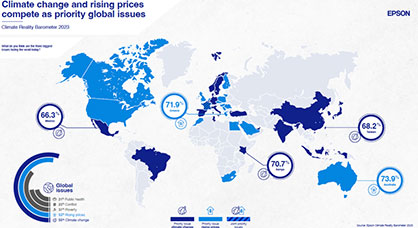
Now in its third year, the Barometer is published as evidence grows of catastrophic climate change: with record high sea temperatures; record low levels of Arctic and Antarctic sea ice; and extreme climate events across the world. Increasingly adverse events are likely to explain more people citing “Climate Change" (55%) than any other global issue, including “Rising Prices” (53%), “Poverty” (37%) and “Conflict” (23%).

Yasunori Ogawa, global president of Epson, said, “As adverse impacts accelerate, now more than ever, we need to understand attitudes towards ongoing climate change. Epson is fully committed to achieve UN Sustainable Development Goal 13 through positive climate action - and to delivering solutions that enrich lives and build a better world.

“The Climate Reality Barometer has enabled us to reach out across geographies, generations and economies, and has given us insights into how climate change transforms the ways we live – and how we can all combat it. We believe that listening to the younger generation will help governments, communities and companies better align positive action to support those for whom climate change has been a lifelong reality.”

The COP Generation – optimism from climate change natives

With the 28 thCOP fewer than 50 days away, Epson shines a spotlight on the attitudes of people born since the first COP in 1995. Currently 29 years old and under, this is the COP Generation (Gen COP). They are climate change natives who have lived their whole lives in the shadow of increasingly adverse weather events – and their experiences and insights need to be central to effective solutions.

While there may be regional differences, the Climate Reality Barometer reveals that globally Gen COP is the joint most optimistic age group (equal with 35-44) – with close to half (49%) believing that we will solve the climate crisis within their lifetime. This contrasts with the 45-54 and 55+ age groups, which register the lowest optimism at 42% and 32% respectively.

Groups invested in the decades ahead – either for themselves or through their children – show the highest levels of optimism about our ability to solve the crisis. While Gen COP is the most optimistic age range, the most optimistic group of all (55%) consists of parents of children under the age of 18 – the world’s ‘Mom & Pop’.

Extending this comparison, however, it’s clear that optimism leads to different outcomes. When asked what positive climate actions they already take, Gen COP records: lower levels of action than the global average in nine of the 14 categories; and lower levels of action than Mom & Pop in 12 of the 14 categories (see the climate actions table in notes to editors below).

There are likely multiple reasons for this. Gen COP have grown up with climate change and the increasing focus on the environment, while older age groups may recognise increasing volatility over time. It’s also interesting to note that Gen COP sees “Rising Prices” as a bigger issue than “Climate Change” (51% v 47%), so affordability of often more expensive sustainable choices is also a likely cause.


Climate action – and inaction

While climate positive action is widespread, there are groups of respondents who state that they will never act across key areas. As an example, globally, 38% report that they have already reduced international business and leisure travel, and a further 30% that they plan to do so. Almost one person in six, however, states that “I will never do this” (17%).

This reluctance to act on international travel is significantly higher in markets such as Singapore, Spain and the UK (21%), Japan and the Netherlands (22%), Canada and Germany (23%), Australia and Serbia (26%) and Israel (31%). As a counterpoint, fewer people from countries such as South Korea (9%), China (10%), Egypt and Turkey (11%) and Morocco and UAE (12%) say they will never reduce international travel.

Globally, the “I will never do this” response is also particularly noticeable in areas such as “Reduce consumption of animal products“ (18%), “Boycott unsustainable brands” (15%), and “Encourage friends and family to learn about the climate crisis” (10%).

Reasons for resistance to action will be complex, including geographic, cultural, and economic factors and faith in humanity’s ability to solve the issue without having to take individual action.

Technology as an enabler

Barometer respondents see technology as the most important weapon in the fight against catastrophic climate change.

When asked what they believed was the most important thing that a business could do to tackle the issue, 48% cited investment in environmental technologies. This was closely followed by improvements in the recycling and reuse of products (45%), with reductions in the use of resources (28%), encouraging employee participation in environmental activities (21%) and offsetting carbon and plastic impact (21%) making up the top five.

Henning Ohlsson, Epson Europe’s director of sustainability, said, “Epson’s Climate Reality Barometer ensures that all voices – including those of the often-overlooked COP Generation – are heard as the world moves to tackle climate change. It has surfaced issues such as familiarity and affordability as possible barriers to action for millions of younger people. It shows us that some people continue to ignore catastrophic climate change and refuse, or feel unable, to act.
© 2023 Epson
© 2023 Epson


“These issues, however, are not problems confined to specific groups: they are challenges for us all. If we are to solve the climate crisis, we must act as one.

“Epson’s Barometer also shows us the way forward as people look to companies to take the lead on the green transition. Epson sees technology as an enabler, with products that are designed to use fewer resources in production and use, last for longer, are more easily repairable, can be re-used and are more easily recycled.  Together, we can create the solutions that people need as they act to mitigate climate impact.”



More News from Epson Europe

#Digital Printing

Epson future proofs textile printing with Epson Textile Academy 2.0

Technology leader Epson today hosted its second Textile Academy Event at the company’s Textile Innovation Centre in Lutterworth, Leicestershire. Building on the success of its inaugural Textile Academy earlier this year, the event welcomed Textile Design BA students from Nottingham Trent University (NTU) and Loughborough University. The event features workshops designed to enhance student’s practical textile printing skills; corporate and entrepreneurial business acumen; marketing and self-branding; and environmental awareness around the textile industry.

#Recycling / Circular Economy

HKRITA and Epson develop silk-like regenerated fiber from cotton

The Hong Kong Research Institute of Textiles and Apparel ("HKRITA") and Seiko Epson Corporation ("Epson"; TSE: 6724) have succeeded in developing new regenerated cellulose fiber with a silk-like sheen from waste cotton fabric through a new production process.

#Digital Printing

Epson unveils Monna Lisa ML-16000JQ for more efficient and sustainable Jacquard fabric printing

Global technology firm Epson announces a new direct-to-fabric digital textile printer designed for jacquard fabrics. The Monna Lisa ML-16000JQ delivers direct-to-fabric double-sided printing on jacquard fabrics, meeting the needs of fashion designers looking to enhance their creativity by seamlessly integrating vibrant colours with intricate woven patterns.

#Digital Printing

Acquisition of Fiery, LLC, a company leading the digitalization of the printing process

Seiko Epson Corporation ("Epson") is pleased to announce that Epson has entered into an agreement with affiliates of Siris Capital Group, LLC ("Siris"), including Electronics for Imaging, Inc., on September 19, 2024 to acquire all interests in Fiery, LLC ("Fiery"), a U.S.-based company which is the leading provider of digital front end* ("DFE") servers and workflow solutions for the print industry. The transaction is subject to customary closing conditions including required regulatory approvals.

More News on Sustainability

#Weaving

Itema announces strategic partnership with Ivy Decarb to accelerate decarbonization in weaving process

Itema is pleased to announce the strategic partnership with Ivy Decarb, the digital platform helping textile companies measure and reduce their carbon footprint.

#Man-Made Fibers

Teijin Carbon Europe receives EcoVadis Silver status – ranked among the top 15% of evaluated companies

Teijin Carbon Europe (TCE) has been recognized for its sustainability performance and has been awarded the EcoVadis Silver Medal in the latest assessment. In its first-ever EcoVadis evaluation, the company achieved a notable 72 out of 100 points, ranking among the top 15% of all companies evaluated worldwide, within the “Manufacture of Man-Made Fibres” category.

#Research & Development

The region of renewable raw materials: Central German Alliance for Bioplastics

The development of sustainable plastic solutions is rapidly gaining importance in light of global environ- mental pollution, dwindling fossil resources and ambitious climate protection targets. As part of the re- gional alliance RUBIO, which brings together 18 partners from central Germany and the Berlin-Branden- burg area, the bio-based and biodegradable plastic polybutylene succinate (PBS) was comprehensively investigated, starting with the raw material, through the manufacturing process, to industrial application.

#Textile chemistry

Archroma funds development of sustainable textile laboratory at Mumbai’s Institute of Chemical Technology

Archroma, a global leader in specialty chemicals focused on sustainable solutions, has supported the Institute of Chemical Technology (ICT), Mumbai, India in the renovation and development of a sustainable laboratory facility as part of its Corporate Social Responsibility (CSR) program.

Latest News

#Exhibitions & Events

Groz-Beckert showcases textile innovation at ShanghaiTex 2025

From December 16 to 19, 2025, the global textile industry will gather at ShanghaiTex at the Shanghai New International Expo Center (SNIEC), where Groz-Beckert will present its latest highlights and innovations across its five product areas – Knitting, Weaving, Nonwovens, Sewing, and Spinning – at Hall N3, Booth A05.

#Weaving

Vandewiele Group: Innovation across the textile value chain at ICFE Istanbul 2026

At the 2026 Istanbul Carpet & Flooring Expo (ICFE), Vandewiele Group presents its latest advancements spanning the entire textile value chain. From spinning and weaving to tufting, carpet manufacturing and digital finishing, the Group demonstrates how integrated innovation can boost performance, efficiency and sustainability across all stages of production. As a global technology leader, Vandewiele continues to develop solutions that strengthen processes, enhance product quality and enable smarter, greener manufacturing.

#Associations

Young researchers recognised for cutting-edge work in recycling, fibre technology and textile mechanics

At the Aachen-Dresden-Denkendorf International Textile Conference held in Aachen at the end of November, Peter D. Dornier, Chairman of the Walter Reiners Foundation of the VDMA, honoured five successful young engineers. Promotion and sustainability prizes were awarded in the categories bachelor/project theses and diploma/master theses. Academic theses that develop solutions for resource-saving products and technologies, for example, are eligible for the sustainability awards.

#Recycling / Circular Economy

Advanced Recycling Conference 2025 fuels innovation across key waste streams

The Advanced Recycling Conference (ARC) 2025 brought together nearly 220 experts from 28 countries to spotlight pioneering advancements and foster industry collaboration in recycling across diverse waste streams including plastics, textiles, automotive and other materials.

TOP