[pageLogInLogOut]

#Digital Printing

Epson unveils Monna Lisa ML-16000JQ for more efficient and sustainable Jacquard fabric printing
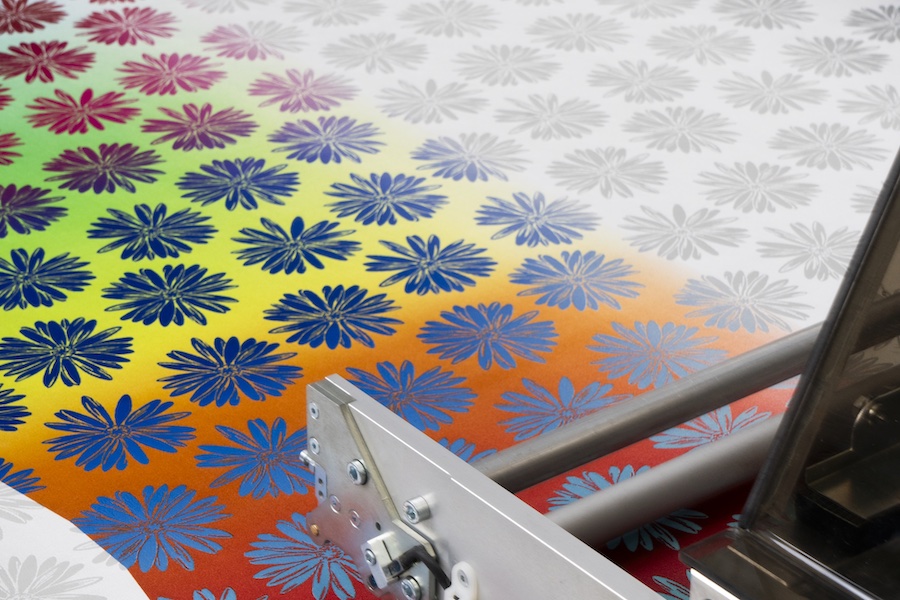
Global technology firm Epson announces a new direct-to-fabric digital textile printer designed for jacquard fabrics. The Monna Lisa ML-16000JQ delivers direct-to-fabric double-sided printing on jacquard fabrics, meeting the needs of fashion designers looking to enhance their creativity by seamlessly integrating vibrant colours with intricate woven patterns.
The Monna Lisa ML-16000JQ simplifies colored Jacquard patterns © 2025  Epson
The Monna Lisa ML-16000JQ simplifies colored Jacquard patterns © 2025 Epson


Traditional jacquard production is laborious and repetitive, yet the Monna Lisa ML-16000JQ simplifies this process. With just a white jacquard base, designers can explore infinite variations without repetitive processes thanks to its remarkable adaptability in colour, areas, and line changes—creating entirely novel and original fabrics.

The Monna Lisa ML-16000JQ stands out with its advanced and far more efficient double-sided printing feature. This allows it to automatically recognise pre-printed fabrics and produce prints on both sides with differing colours. This unique capability enhances customisation, engendering greater creative freedom for designers and allowing for new possibilities in textile design.

The ML-16000JQ deploys a high-precision recognition system that captures the exact position and shape of fabric patterns, optimising colour assignment with greater accuracy. This integrated software adapts to various fabric types, ensuring superior precision and reducing waste typically associated with traditional printing methods.

“At Epson, we understand the urgency of responding to evolving market demands with products that anticipate fashion trends while minimising environmental impacts. The Monna Lisa ML-16000JQ embodies this ethos," remarks XXXXXX. "Through combining high-precision recognition systems with bespoke software, the Monna Lisa ML-16000JQ detects the exact positions and shapes of jacquard fabric patterns, assigns precise colours to each area, adjusting as necessary for different fabric types, ensuring precision in pattern alignment. More than this, the precision pattern detection system ensures flawless double-sided printing with differential colouring.”

Incorporating 16 state-of-the-art Epson PrecisionCore printheads, the ML-16000JQ offers eight colours across four ink families from Epson GENESTA—Acid, Reactive, Dispersed, and Pigment. These versatile inks deliver unparalleled quality across a spectrum of fabric, from natural fibres to cutting-edge plant-based textiles like coconut and banana.
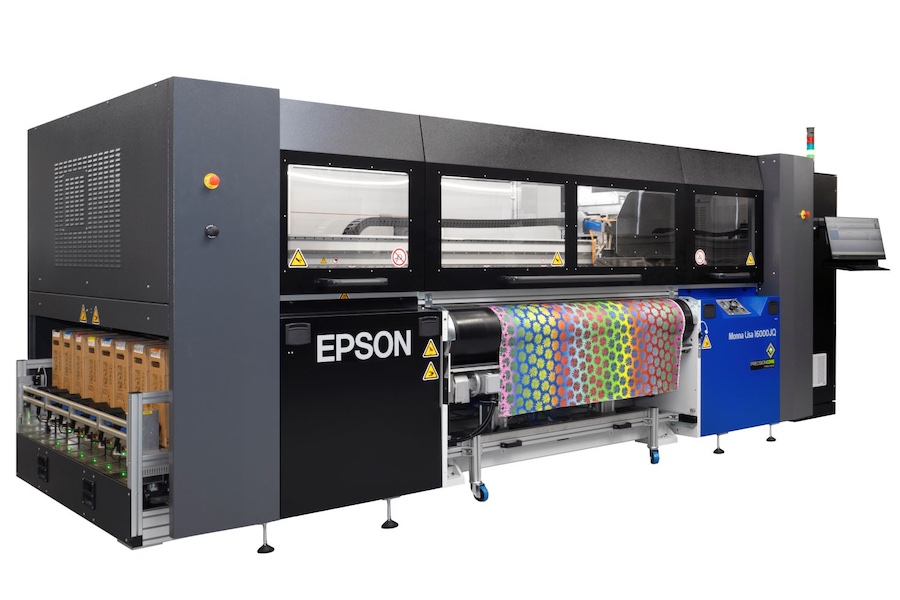
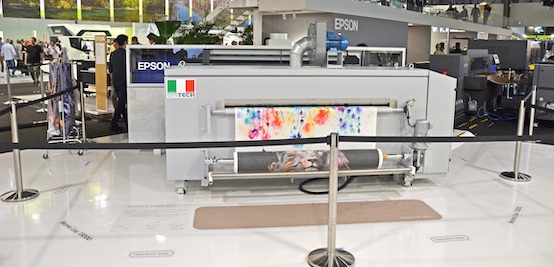
Epson Monna Lisa ML-16000JQ © 2025  Epson
Epson Monna Lisa ML-16000JQ © 2025 Epson


Monna Lisa ML-16000JQ - Key specifications:

- Printheads: 16 advanced Epson PrecisionCore printheads

- Resolution: Up to 1200 dpi for exquisite detail

- Width: Prints up to 180 cm wide

- Ink Colours: GENESTA inks available in Acid, Reactive, Dispersed, and Pigment variants

- Environmental Certification: All inks hold ECO PASSPORT certification, with additional recognitions such as bluesign and GOTS approvals

- Ink Cartridges: High-capacity, swappable 10-liter cartridges for seamless production

Through the Monna Lisa ML-16000JQ, Epson continues to lead the way towards integrating creativity and sustainability in the textile industry, redefining the future of fabric printing.

A more sustainable approach to digital textile printing with Monna Lisa

+ Digital textile printing with the Monna Lisa ML-16000JQ provides a more sustainable approach compared with traditional analogue printing as follows:

+ Reduced resource consumption: Digital printing technologies use less electricity and water compared to traditional printing methods. This reduction in resource usage is crucial for minimising environmental impact, especially in water-scarce regions.

+ On-demand printing: The Monna Lisa ML-16000JQ allows for on-demand printing, which means that fabrics can be produced as needed rather than in large batches. This approach helps to minimise waste, as it reduces the surplus stock that often results from overproduction in traditional printing processes.

+ Less chemical waste: Digital printing uses advanced ink formulations, such as Epson's GENESTA inks, which are designed to meet stringent environmental standards. Many of these inks are ECO PASSPORT certified and compliant with regulations such as GOTS and bluesign, which ensures that they are less harmful to the environment.

+ Quick turnaround and flexibility: With fast setup times and adjustable designs, the Monna Lisa ML-16000JQ promotes efficiency and flexibility in production. Designers can produce only what is necessary, incorporating trend changes without the need for extensive retooling or material waste.

+ Double-sided printing: The printer's capability to recognize pre-printed fabrics and accurately reproduce designs on both sides with different colours not only enhances creativity but also reduces the number of fabrics needed to achieve complex designs, thereby cutting down on material wastage.

+ Product lifecycle management: Digital printing allows for modifications and updates to designs even during production runs. This adaptability means that companies can be more responsive to trends and customer demands without over-production.

By using the Monna Lisa ML-16000JQ, the textile industry can embrace a more sustainable future, emphasising resource efficiency, waste reduction, and a commitment to environmental responsibility while delivering both creativity and innovation.

More News from Epson Europe

#Digital Printing

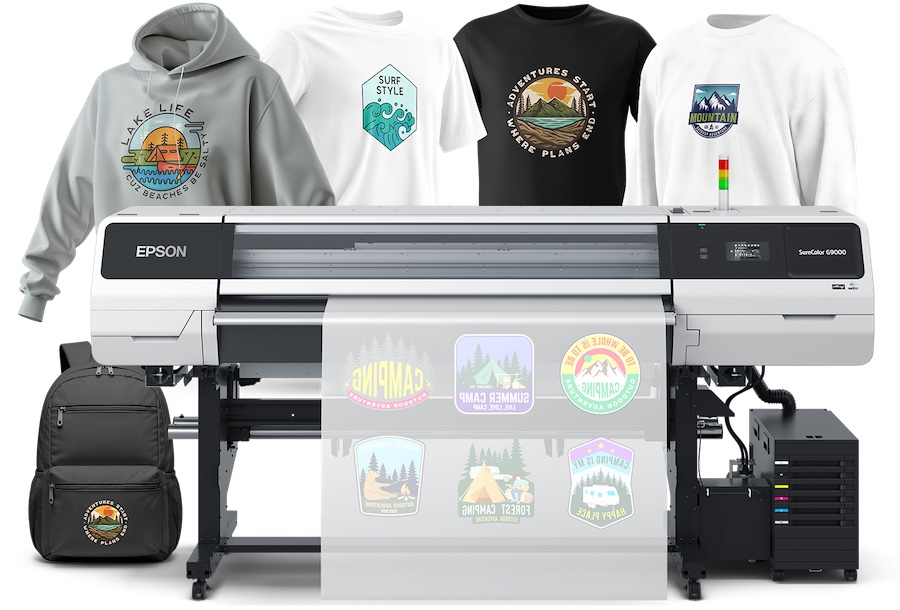
Epson launches SureColor G9000: high-production Direct-To-Film printer delivering greater productivity and reliability

Epson today announces the launch of the SureColor G9000, a new high-production Direct-To-Film (DTFilm) printer designed to meet growing global demand for flexible and efficient textile transfer printing. Expanding Epson’s DTFilm line-up alongside the SC-G6000, the SC-G9000 introduces enhanced speed, reliability and ease of maintenance for commercial garment decorators and textile producers.

#Digital Printing

Epson future proofs textile printing with Epson Textile Academy 2.0

Technology leader Epson today hosted its second Textile Academy Event at the company’s Textile Innovation Centre in Lutterworth, Leicestershire. Building on the success of its inaugural Textile Academy earlier this year, the event welcomed Textile Design BA students from Nottingham Trent University (NTU) and Loughborough University. The event features workshops designed to enhance student’s practical textile printing skills; corporate and entrepreneurial business acumen; marketing and self-branding; and environmental awareness around the textile industry.

#Recycling / Circular Economy

HKRITA and Epson develop silk-like regenerated fiber from cotton

The Hong Kong Research Institute of Textiles and Apparel ("HKRITA") and Seiko Epson Corporation ("Epson"; TSE: 6724) have succeeded in developing new regenerated cellulose fiber with a silk-like sheen from waste cotton fabric through a new production process.

#Digital Printing

Acquisition of Fiery, LLC, a company leading the digitalization of the printing process

Seiko Epson Corporation ("Epson") is pleased to announce that Epson has entered into an agreement with affiliates of Siris Capital Group, LLC ("Siris"), including Electronics for Imaging, Inc., on September 19, 2024 to acquire all interests in Fiery, LLC ("Fiery"), a U.S.-based company which is the leading provider of digital front end* ("DFE") servers and workflow solutions for the print industry. The transaction is subject to customary closing conditions including required regulatory approvals.

More News on Digital Printing

#Digital Printing

Mimaki takes DTF performance to the next level with TxF300-75Plus

Mimaki Europe, a leading manufacturer of industrial inkjet printers and cutting plotters, announces the TxF300-75Plus, an upgraded model within its high-productivity direct-to-film (DTF) printing portfolio. Following on from the success of the original TxF300-75, this enhanced version reflects Mimaki’s commitment to continuously evolving its solutions to meet the changing demands of the market.

#Digital Printing

Former ASOS CEO Nick Beighton joins Kornit Digital to help shape the future of on-demand fashion

Kornit Digital LTD. (NASDAQ: KRNT) ("Kornit" or the "Company"), a global leader in sustainable, on-demand digital fashion and textile production technologies, today announced it has appointed Nick Beighton, former Chief Executive Officer of ASOS, as a strategic advisor to the Company and its Board of Directors. His appointment reflects Kornit’s continued focus on strengthening its connection to global brands, retailers, and digital commerce platforms as the industry transitions toward on-demand production. The Company plans to nominate Mr. Beighton for election to the Board at Kornit’s 2026 Annual Shareholder Meeting.

#Digital Printing

FESPA confirms participation from leading exhibiting suppliers and brands for inaugural textile event

FESPA has confirmed a strong exhibitor line-up for its inaugural Textile show, a dedicated new event that will run as part of FESPA 2026, alongside co-located events: Global Print Expo, Personalisation Experience, European Sign Expo, WrapFest and the brand-new Corrugated.

#Digital Printing

UK Manufacturer Basic Prints commits to digital-first production model with dual investment in Kornit Digital’s Apollo

Kornit Digital, a global leader in sustainable, on-demand digital fashion and textile production technologies, today announced that UK clothing manufacturer Basic Prints has expanded its digital production capacity with a second Kornit Apollo Direct-to-Garment (DTG) system. This marks a strategic shift supporting Basic Prints’ digital-first manufacturing model.

Latest News

#Recycled Fibers

RE&UP partners with Madewell and ISKO on textile-to-textile denim capsule

RE&UP Recycling Technologies is accelerating the shift toward a closed-loop textile economy through a collaboration with American denim brand Madewell and global fabric manufacturer ISKO. By transforming approximately 20,000 pairs of post-consumer jeans into recycled feedstock for a textile-to-textile denim capsule, RE&UP demonstrates the commercial viability of circular systems in the denim sector.

#Techtextil 2026

Sedo Treepoint will exhibit smart technologies for technical textile production

As technical textile production becomes increasingly complex and sustainability requirements intensify, digital integration is evolving from an efficiency tool into a strategic task. At Techtextil 2026 (April 21–24, Frankfurt am Main), Sedo Treepoint will present smart digital systems designed to address the demanding production environments of technical textile manufacturing. The company’s focus will be on practical technologies that enhance process transparency, reproducibility, and efficient resource use. Visitors will meet Sedo Treepoint in Hall 12, Booth D05.

#Techtextil 2026

ITM presents cutting-edge textile research at Techtextil

From April 21 to 24, 2026, the Chair of Textile Machinery and High Performance Material Technology (ITM) at TUD Dresden University of Technology will be presenting its current research at Techtextil, the leading international trade fair for technical textiles and nonwovens. In Hall 12.0, Stand D41, the team will be demonstrating how it combines high-performance fibers, AI-supported digital development tools and innovative machine technologies to develop textile solutions for lightweight construction, construction, medical technology and sustainable production from atom to product.

#Techtextil 2026

CHT Group to showcase intelligent specialty chemical solutions at Techtextil 2026

At this year's Techtextil 2026 in Frankfurt am Main, the CHT Group will be presenting its comprehensive portfolio of tailor-made specialty chemicals and process solutions for technical textiles. As a reliable partner to the global textile industry, the company offers innovative products and in-depth technical expertise across all areas of the textile value chain – from pretreatment, dyeing, and printing to finishing, coating, and fiber auxiliaries.

TOP