[pageLogInLogOut]

#Recycling / Circular Economy

HKRITA and Epson develop silk-like regenerated fiber from cotton

The Hong Kong Research Institute of Textiles and Apparel ("HKRITA") and Seiko Epson Corporation ("Epson"; TSE: 6724) have succeeded in developing new regenerated cellulose fiber with a silk-like sheen from waste cotton fabric through a new production process.

A movement toward using fibers recycled from discarded clothing has been gaining momentum, driven by a growing recognition of waste clothing as a global environmental issue. In Europe in particular, a move is under way to use more regenerated fiber and reduce textile waste.

To address societal issues surrounding textile waste, HKRITA and Epson have been conducting research and development on regenerated fibers since signing a joint development agreement in January 2024. As a result of this collaboration, the partners have successfully developed regenerated cellulose fiber using a new production process that transforms discarded cotton fabric into regenerated fiber.

This new process was made possible by integrating Epson's proprietary Dry Fiber Technology for defibrating textiles with HKRITA's fiber-dissolving technology. The process involves (1) defibrating discarded cotton fabric into a powder-like state, (2) dissolving the cotton in a solvent, and (3) extruding it through a nozzle into a coagulation bath, where it solidifies and is spun into fiber.

The regenerated cellulose fiber produced through this process is expected to have both a smooth, silky sheen and the strength of cotton. This fiber is expected to be used in high-end materials such as scarves, neckties, and suit linings. Moreover, since the short fibers that occur during the regenerated fiber production process can also be used rather than discarded, as was usually the case, this regeneration process can help to increase the total clothing recycling rate.
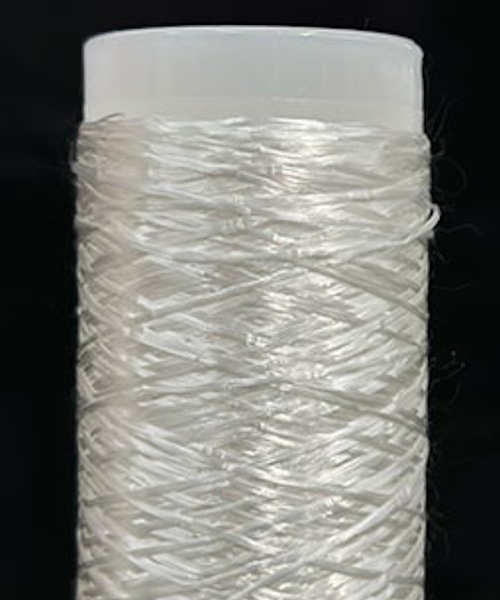
Yarn from the regenerated cellulose fiber © 2025 Epson


Newly developed regenerated cellulose fiber yarn

"As an applied research center, HKRITA is dedicated to solving real-world problems and enhancing current practices and products," said HKRITA CEO Jake Koh. "We are thrilled to collaborate with Epson to recycle fibers and repurpose them into high-quality yarns. This cross-industrial collaboration is not only reimagining materials but also redefining the future of sustainable production."

Epson Executive Officer Satoshi Hosono, who serves as the deputy general administrative manager of the Global Environmental Strategy Promotion Office and as the deputy general administrative manager of the Technology Development Division, said, "We are extremely pleased with the results that this joint development project has yielded. The selective application of this new wet process and our previously developed dry process should enable fiber to be regenerated from all waste cotton fabrics while reducing environmental impact."

Information about the work under this joint development project was exhibited at HKRITA's Booth 2415 at Textiles Recycling Expo 2025, held in Brussels, Belgium, from June 4, 2025.

Looking ahead, HKRITA and Epson will continue to combine their advanced technologies to accelerate the adoption of regenerated fibers, contributing to global efforts to solve the challenge of clothing recycling.


More News from Epson Europe

#Digital Printing

Epson future proofs textile printing with Epson Textile Academy 2.0

Technology leader Epson today hosted its second Textile Academy Event at the company’s Textile Innovation Centre in Lutterworth, Leicestershire. Building on the success of its inaugural Textile Academy earlier this year, the event welcomed Textile Design BA students from Nottingham Trent University (NTU) and Loughborough University. The event features workshops designed to enhance student’s practical textile printing skills; corporate and entrepreneurial business acumen; marketing and self-branding; and environmental awareness around the textile industry.

#Digital Printing

Epson unveils Monna Lisa ML-16000JQ for more efficient and sustainable Jacquard fabric printing

Global technology firm Epson announces a new direct-to-fabric digital textile printer designed for jacquard fabrics. The Monna Lisa ML-16000JQ delivers direct-to-fabric double-sided printing on jacquard fabrics, meeting the needs of fashion designers looking to enhance their creativity by seamlessly integrating vibrant colours with intricate woven patterns.

#Digital Printing

Acquisition of Fiery, LLC, a company leading the digitalization of the printing process

Seiko Epson Corporation ("Epson") is pleased to announce that Epson has entered into an agreement with affiliates of Siris Capital Group, LLC ("Siris"), including Electronics for Imaging, Inc., on September 19, 2024 to acquire all interests in Fiery, LLC ("Fiery"), a U.S.-based company which is the leading provider of digital front end* ("DFE") servers and workflow solutions for the print industry. The transaction is subject to customary closing conditions including required regulatory approvals.

#Sustainability

Epson research reveals more people cite climate change as a critical global issue than any other – as technology seen as an enabler to solve the crisis

This year’s Epson’s Climate Reality Barometer captures the views of over 30,000 people in 39 markets to better understand global responses to climate change. Results reveal that more people now cite climate change as a major global issue than any other – and that technology is seen as a key enabler in solving the crisis. As we approach COP 28 in the UAE, Epson also focuses on the unique perspectives of those born since the first COP in 1995 – exploring their experiences and needs as they act to tackle climate change.

More News on Recycling / Circular Economy

#Recycling / Circular Economy

Reju announces site selection for first U.S. industrial sized facility regeneration hub in Rochester, New York

Reju, the textile-to-textile regeneration company, today announced it has selected the site for its first U.S.-based industrial facility marking a significant milestone in its efforts to scale globally. This future Regeneration Hub will be in Rochester, New York, reinforcing Reju’s commitment to the adoption of circular textile system across key regions worldwide.

#Business

Canopy introduces a first-of-its-kind $2 billion USD investment blueprint to decarbonize global materials supply chains

Today, the global, solutions-driven not-for-profit Canopy joined partners at Davos to introduce a new finance model designed to accelerate the growth of low-carbon materials and transform the paper, packaging, and textile supply chains. The event was anchored by a keynote speech from Sri A Revanth Reddy, Hon’ble Chief Minister of Telangana, with India set to host the first iteration of the new investment blueprint.

#Recycled_Fibers

Borealis invests EUR 49 million in Burghausen, Germany to accelerate design for circularity

Borealis announces a EUR 49 million strategic investment to scale up production of Borstar® Nextension polypropylene (PP) at its manufacturing site in Burghausen, Germany. This will expand commercial production of next-generation single-site polypropylene (ssPP) grades that deliver enhanced purity, processability, and performance - supporting customers in key sectors including packaging, healthcare, mobility, and fibers, to meet evolving market and regulatory demands.

#Recycling / Circular Economy

From local actions to industrial innovations: SOLSTICE shares mid-project results

Since its launch in May 2024, the SOLSTICE project is accelerating the transition from linear models to circular regional ecosystems in the textile industry, focusing on four key territories: Grenoble-Alpes Métropole (France), Berlin (Germany), Prato (Italy), and Catalonia (Spain). By mid-project, SOLSTICE has already revealed both regional disparities and promising solutions to strengthen textile repair, reuse, and recycling infrastructure.

Latest News

#Fabrics

MUNICH FABRIC START: Between Attitude and Sensuality

The future begins where we reimagine it. After seasons of restraint, Spring.Summer 27 marks a conscious counter-trend: optimism, sensuality, and creative freedom are replacing pragmatism and neutrality. Physical presence and individuality are regaining importance – as a response to uncertainty, exhaustion, and algorithmic predictability. The overarching theme of PLEASURE stands for fashion as an emotional space, as an expression of attitude and cultural reflection. Colours, surfaces, and materials become vehicles for self-confidence and joie de vivre.

#Denim

organIQ seek: smart alternative to potassium permanganate

CHT Group announces new technical findings within its organIQ seek platform that significantly advance the transition toward permanganate-free denim bleaching. Through extensive industrial testing and application research, CHT confirms that organIQ seek can now be used with remarkable effectiveness as a substitute for potassium permanganate in spray bleach, while remaining aligned with sustainability expectations and cost realities in the European market. At the COLOMBIATEX in Medellín as well as at the Exintex in Puebla and the Kingpins Show in Amsterdam the CHT Group will present organIQ seek as an alternative to potassium permanganate.

#Functional Fabrics

PERFORMANCE DAYS: Focus topic shifts to the beginning of the value chain

Following the last Focus Topic in October 2025, which placed Textile-to-Textile Recycling at its core, PERFORMANCE DAYS continues to drive the conversation around circularity – this time with an expanded and more upstream perspective. The upcoming Focus Topic, “Textile to Textile: The Role of Collectors and Sorters,” presented during the spring edition on March 18–19, will spotlight one of the most essential yet often overlooked components of a functioning circular textile system: the efficient collection and sorting of post-consumer textiles.

#Knitting & Hosiery

Proven performance, optimised costs – the new RE 6 EL

Nowadays textile companies increasingly need to produce small production runs and respond to market changes with instantaneous pattern changes in order to operate profitably – meaning they require machines that offer maximum flexibility, reliability and cost efficiency. KARL MAYER understands the challenges of the market and is launching its new RE 6 EL. The Raschel machine offers the core strengths of the classic RSE 6 EL and essentially the same performance parameters, but has been further cost-optimised largely due to local production advantages. This makes the newcomer an efficiency champion in production, especially when it comes to frequent pattern changes.

TOP