[pageLogInLogOut]

#Sustainability

“Neonyt on Air”: shaping the future of sustainable fashion together – the Neonyt community shows how it's done

The Grüner Knopf (Green Button) government-run certification label by the Federal Ministry of Economic Cooperation and Development, German fair fashion pioneer Hessnatur and the Oeko-Tex Association, partner for certification systems, are the “Presenting Partners” of digital community format “Neonyt on Air”. From 18-22 January 2021, representatives from these organisations and several other speakers from the sustainability fashion scene will be discussing a transparent textile value chain and everything it entails: from accountability, transparency and green financing to sustainable sourcing and blockchain solutions.

The textile and fashion industry are regularly coming up with new, smart approaches and solutions related to sustainability – throughout the past year, the COVID-19 crisis has raised people’s awareness of this, but also revealed the gaps that still need to be closed: from transparent supply chains to business practices based on solidarity through to green investment and financing strategies. These are all topics that the Neonyt community is constantly developing or rethinking completely. “New concepts and progressive advancements need space for discussion and exchange, the right audience and a fresh, outside perspective,” says Thimo Schwenzfeier, Show Director of Neonyt. “This is something we always wish to provide – albeit digitally again in January. During our planning for “Neonyt on Air”, we realised once more how important knowledge sharing is for the future of the sustainable fashion scene and that we are responsible for working together to make it happen.” In addition to many other speakers, the Grüner Knopf, Hessnatur and Oeko-Tex, the “Presenting Partners” of “Neonyt on Air” in January, will be contributing their valuable insights in interviews, keynotes and panel talks.

“Neonyt is a strong platform and we are delighted that our partnership is still active during these digital times,” said Andrea Sibylle Ebinger, CEO of Hessnatur. Following a welcome from the Neonyt organisers, she will be appealing to the sustainability community in her keynote to kick off the digital week on Monday, 18 January 2021: “When it comes to our future, we don’t have any time to lose. Only together can we ensure that respecting nature and treating people with fairness are no longer the exception but the rule. With “Neonyt on Air”, we are keeping the dialogue going and driving forward our common objective for a better tomorrow.”

The keyword here is “together”: showing solidarity is taking on a huge significance in the sustainable fashion scene and the COVID crisis has shown us once again that deglobalisation is the wrong path to take. Following the first shockwave and a phase of reorientation, for many companies and initiatives the crisis became an opportunity to drive forward change, to re-evaluate previous approaches, business practices and ways of thinking, to invest in local and international partnerships and to intensify global relations.


“The longstanding partnership between Neonyt and Oeko-Tex is built on the foundations of a shared vision: to support the textile industry on its path towards a more sustainable future and to initiate positive discussions,” says Georg Dieners, Secretary General of Oeko-Tex. “In these difficult times especially, we want to put more of a spotlight on sustainability and social responsibility and make them the focus of the discussion. That’s why we are delighted to be a part of “Neonyt on Air” in January 2021 and to be continuing our longstanding collaboration.” In a panel talk presented by Oeko-Tex, Annika Sauerhöfer (Product Manager for “Made in Green” by Oeko-Tex), Mirjam Smend (Greenstyle) and Andreas Bothe (Head of CSR & Sustainable Management at Bay City) will be talking about transparency in textile supply chains and building a bridge to the Sustainable Development Goals of the United Nations.?

Transparency and accountability are also important topics in politics – like in the case of the Grüner Knopf, the textile standard of Germany’s Federal Ministry of Economic Cooperation and Development (BMZ). On the second day of “Neonyt on Air”, Anosha Wahidi, Head of Division at the BMZ, will be talking to Max Gilgenmann, Content Director at Neonyt, about the future and further development of the textile standard, as well as explaining why the ministry decided to develop and launch its own seal of approval for corporate social responsibility in 2019.?

The Neonyt community can also look forward to a keynote by the Kering Group, a live interview with Timberland and a panel talk by the Maleki Corporate Group on the topic of “Sustainable fashion – the long financial thread of sustainability” with Dr. Sabine Schlorke (Global Head Manufacturing at the IFC World Bank Group), Christian Heller (CEO of Value Balancing Alliance e.V.) und Hans-Jürgen Walter (Global Leader Sustainable Finance at Deloitte). Plus: insights on the topic clusters of certification, sourcing and digitalisation with speakers from Fairtrade and the Federal Environment Agency, as well as from Foursource, the biggest B2B sourcing platform and international IT corporation IBM.

“Neonyt on Air” will take place from 18 to 22 January 2021 on the social media channels of Neonyt. No registration is required to participate. The full line-up will be available on the http://www.neonyt.com website and Neonyt’s Instagram channel @neonyt.berlin very soon.



More News from TEXDATA International

#Texprocess 2026

Texprocess 2026: Automation, digitalisation and AI redefine textile processing

Making investment decisions in textile processing has become significantly more demanding. Increasing energy costs, a shortage of skilled labour and ongoing geopolitical uncertainties are compelling companies to focus on technologies that deliver clear gains in efficiency and process reliability. This applies equally to apparel manufacturing and to the processing of technical textiles and high-performance materials. As a result, modernisation initiatives are assessed more carefully – even as the need to upgrade production systems continues to intensify.

#Techtextil 2026

Techtextil 2026: Between innovation pressure & market reality

From 21 to 24 April 2026, Techtextil in Frankfurt am Main will once again become the central meeting point for the international technical textiles and nonwovens industry. Running in parallel, Texprocess will focus on the industrial implementation of textile processing technologies as the leading platform in this field. Together, the two trade fairs form a closely integrated presentation and working platform along the entire textile value chain – from material development to finished applications.

#Techtextil 2026

Between geopolitical pressure and industrial resilience

In this interview, Dr. Janpeter Horn (VDMA) discusses the current challenges facing textile machinery manufacturers, shaped by geopolitical tensions, regulatory developments and subdued investment. He also outlines why innovation strength, integrated solutions and strategic positioning remain key to global competitiveness.

#Texprocess 2026

Between investment restraint and modernization pressure

Texprocess 2026 takes place in a complex market environment shaped by uncertainty and innovation pressure. In this interview, Elgar Straub (VDMA) explains why the trade fair is particularly relevant this year and which technologies are driving efficiency and competitiveness.

More News on Sustainability

#Sustainability

A new standard to combat plastic waste in forests

With DIN SPEC 35808 “Tree Shelter for Forestry Applications,” the testing and research service provider Hohenstein, in collaboration with Rottenburg University of Forestry, as well as forestry authorities and industry partners, has established a clear framework for bio-based and fully biodegradable tree shelters. The pre-standard defines requirements and practical testing methods designed to reduce plastic waste in forests and strengthen the long-term protection of soil and the environment.

#Denim

Denim moves towards sustainability

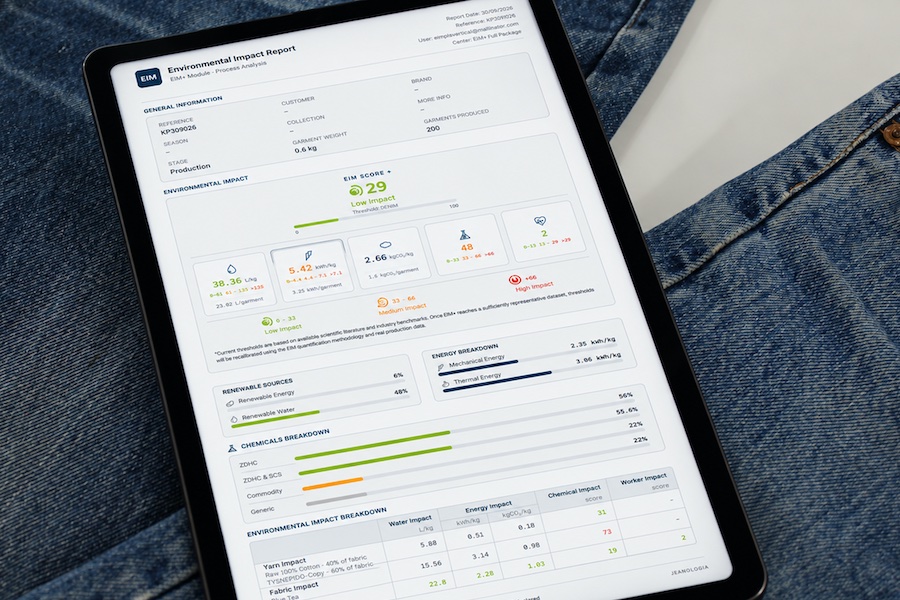
EIM (Environmental Impact Measurement), the global reference platform for measuring the environmental impact of garment finishing, presents the second edition of its annual report Denim Industry Progress & Insights 2025. The study analyses over 100,000 real denim finishing processes, providing an accurate and up-to-date view of the industry’s evolution towards more sustainable models.

#Recycling / Circular Economy

Europe’s textile future at a turning point: New 2030 Circularity Blueprint aims to scale recycling and unlock investment opportunities

The EU textile system is at a critical crossroads. Today, less than 1% of discarded garments are recycled into new garments, despite EU-wide obligations for separate collection. In response, Global Fashion Agenda (GFA) is launching the 2030 Circularity Blueprint, in partnership with ReHubs. This ambitious initiative is designed to support the transformation of the EU textile ecosystem to advance textile-to-textile recycling and drive the transition to a circular economy.

#Sustainability

Number of GOTS-certified facilities grow 15% globally as demand for credible sustainability standards continues to strengthen

Global Organic Textile Standard (GOTS) certification continued to grow in 2025, with nearly 18,000 certified facilities worldwide, despite ongoing geopolitical uncertainty and rapidly evolving regulatory requirements across global textile supply chains.

Latest News

#INDEX 2026

“We clearly see that reliability, flexibility, service and total cost of ownership are becoming increasingly important again.”

The nonwovens industry continues to face a challenging market environment. Nevertheless, AUTEFA Solutions reports successful projects, new line sales and growing demand for energy-efficient and flexible solutions. In this interview, André Imhof of AUTEFA Solutions talks about competitiveness against Chinese suppliers, new service and recycling concepts, the growing importance of application development and the opportunities created by countercyclical investments.

#INDEX 2026

“Needle punching technology is more universal and sustainable than ever!”

Needle punching technology was long regarded as a rather traditional and comparatively slow technology within the nonwovens industry. In this interview, Johann Philipp Dilo explains why needle punching is more relevant than ever today – ranging from energy efficiency and resource conservation to hygiene applications, new machine concepts and design-oriented nonwoven solutions.

#Research & Development

Textile climate control system in workwear – exhibition at the 2026 SME Innovation Day!

Conventional protective workwear often reaches its limits during strenuous physical activity. In particular, the transport of sweat and excess body heat poses a problem. The German Institutes of Textile and Fiber Research (DITF) conducted research on flow-optimized, air-conducting textile structures that enable targeted climate control directly on the body. These structures can be integrated straight into protective work garments. The textile climate control system supports the body’s natural thermoregulation. This contributes to improved workplace safety and comfort.

#Nonwovens

PET spunbond from China – EDANA welcomes imposition of provisional anti-dumping measures

On 13 May 2026, after eight months of investigation, the European Commission imposed provisional anti-dumping duties of 45.6-50.0% on imports of PET spunbond from China. EDANA welcomes this expression of the Commission’s clear determination to protect EU industries from the unfair trade practices of Chinese producers.

TOP