#Spinning
Technology transfer that is creating waves
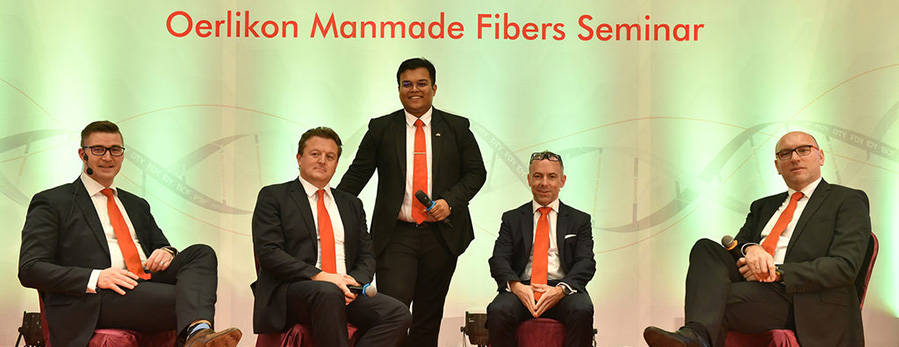
Fed from Oerlikon polycondensation and extrusion systems, these companies manufacture polyester, nylon and polypropylene on large-scale installations with Oerlikon Barmag WINGS POY, WINGS FDY, IDY and DTY product lines and using Oerlikon Neumag’s staple fiber and BCF technologies. Reason enough for the Manmade Fibers segment’s experts to regularly provide their clientèle with detailed specialist presentations in India on the latest developments of the product and service portfolio.
And this was once again the case at the event held at the beginning of 2020, where around 450 managers and employees from local businesses took the opportunity to exchange ideas and information. For the third time in succession, Oerlikon also entered into dialog with the next generation of managers at major Indian polyester and nylon manufacturers in a separate event hosted in Mumbai beforehand. The technology symposium was again held – for the very first time – just a few days later and in a slightly modified form at a second venue: in Kolkata in West Bengal, a potential second future key location for manufacturing manmade fibers in India according to plans revealed by the Indian government. Here, the discussions held by the Oerlikon experts focused above all on the transfer of technologies for manufacturing polyester, nylon and polypropylene. Oerlikon is able to offer the entire process chain – from the melt to the textured yarn or the fibers and including the necessary semi- and fully-automated logistics process – from a single source. This is of interest above all for potential new customers and investors in West Bengal and neighboring Bangladesh, as some do not have decades of expertise in manufacturing manmade fibers, as is the case for most companies in the region around Silvassa/Daman.
Clean Technology. Smart Factory.
The focus of all events was on the latest product and service developments from the Oerlikon Barmag, Oerlikon Neumag and Oerlikon Nonwoven brands. With their ‘Clean Technology. Smart Factory.’ motto, the engineers from Germany presented selected machines and systems specifically designed for the Indian market, along with the associated services. Needless to say, the innovations unveiled at the last ITMA were of particular interest to all attendees.
eAFK Evo and WINGS FDY PA6 promise greater productivity
Philip Jungbecker, Senior Technology Manager for texturing machines at Oerlikon Barmag, presented the new Oerlikon Barmag eAFK Evo generation of machines. “The eAFK Evo promises superior speeds, greater productivity and consistently high product quality, along with lower energy consumption and simpler operation vis-à-vis comparable market solutions”, comments Jungbecker. In particular, the machine concept’s numerous new value-added features include two that are excelling with fantastic technology: the optimized, innovative EvoHeater and the EvoCooler, a completely newly-developed active cooling unit. These proved to be of huge interest to the attendees of the technology symposium.
WINGS FDY is now also available for the polyamide 6 process. To this end, the new 24-end winding concept makes the efficient production of FDY PA6 yarns a reality”, explained Guido Dresen, Regional Sales Manager at Oerlikon Barmag. Extending the polyamide yarn production from 12 to 24 ends with DIO and WINGS FDY pays yarn producers dividends, particularly in terms of investment expenditure (CAPEX) and operating expenditure (OPEX): significant savings with regards to energy, footprint and – due to the more ergonomic design – string-up time are among the concept’s most convincing arguments. The enclosed draw unit ensures low spin finish emissions, offering a safe working environment. Offering swift string-up, the optimized yarn path of the tried-and-tested WINGS FDY PET system is united with the high relaxing performance of conventional polyamide systems to create a completely new concept. The 24-end WINGS FDY PA hence profitably combines the benefits of both processes. The result: outstanding yarn properties, superlative dyeability, optimum process performance and high full package rate. A perfect package build guarantees excellent further processing properties in the downstream processes. With a 116-mm stroke, this winder makes high package weights possible, therefore delivering added-value yarns for further processing. As a consequence, yarn manufacturers can give themselves a competitive advantage in the marketplace.
The BCF S8’s impressive performance data
With the new BCF S8 production platform, Nis Lehmann-Matthaei, Sales Manager at Oerlikon Neumag, promised manufacturers of carpet yarns greater performance within this fiercely-competitive market: “Superlative spinning speeds, up to 700 individual filaments and fine titers of up to 2.5 dpf – our new system’s performance data and technological finesse are truly impressive. Our customers’ feedback on the new system is outstanding”, comments Lehmann-Matthaei.
Zero-waste philosophy successfully implemented
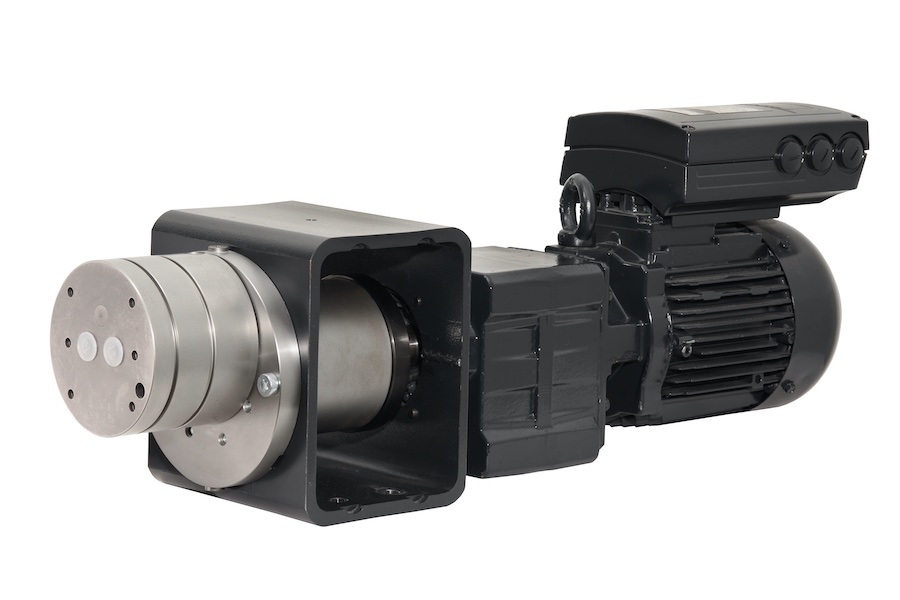
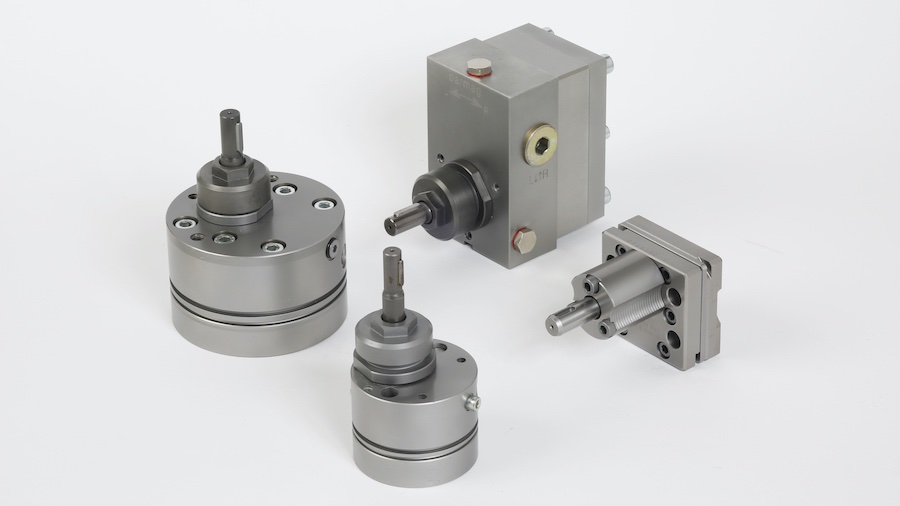
With the new VacuFil® recycling range, Oerlikon Barmag is now offering – in cooperation with its joint venture partner, BBEngineering – a zero-waste philosophy solution. Decades of experience in the areas of extrusion, filtration and spinning systems have been bundled into a new, innovative core component – the vacuum filter. It unites gentle large-scale filtration and controlled intrinsic-viscosity build-up for consistently outstanding melt quality. The vacuum unit – located adjacent to the filter – swiftly and reliably removes volatile contamination (such as spinning oil, for example). The excellent degasification performance additionally relieves energy-intensive predrying”, explained Dr Klaus Schäfer, Managing Director of BBEngineering. The modular structure of the VacuFil® range offers numerous possibilities for the process guiding system. Whether as a standalone solution with downstream granulation or as an inline variant with 3DD additive feed – customer requirements can be optimally catered for with various system configurations.
Exciting podium discussion on digitalization, automation and recycling
In addition to presenting the four 2019 world premières, the program also included talks on further technology innovations. To this end, the latest developments of the relatively nascent Oerlikon Nonwoven brand were unveiled and the upgrade packages for the CW and ACW winder generations were explained. Within the context of a podium discussion, Jochen Adler, Chief Technology Officer of the Manmade Fibers segment, together with further Oerlikon experts, answered questions relating to the future of digitalization, automation and recycling along the textile value chain, among other things.
Here, Jochen Adler stated: “Digitally upgrading our machines and production systems for manufacturing yarns, fibers and nonwovens along the textile value chain is increasingly becoming a focus of our customers’ interest. Here, our promise is: creating digital value-added beyond our excellent hardware. We want to further optimize the efficiency of our systems and the quality of the end products with our digital solutions. True to our e-save philosophy, our mission is to protect the environment and to promote the sustainability of our solutions – in future undoubtedly also with a focus on recycling. For this, we are deploying the know-how of our entire large-scale systems engineering team, including full-automation, transport, packaging and warehouse logistics and end-product automated quality control. We combine these with our process competencies and digital data handling using our Plant Operation Center, or POC for short, and our artificial intelligence-based software solutions – known as ‘AIM’, our abbreviation for ‘Artificial Intelligence Manufacturing’. This has created innovative Industrie 4.0-solutions for our customers – with integrated storage and communication capabilities, wireless sensors, embedded actuators and intelligent software systems. In turn, this allows us to build bridges between data and material flows and between the virtual and real worlds.
Complex large-scale systems from a single source
Michael Roellke, Head of Global Factory Sales, showed the interested audience how the Oerlikon Manmade Fibers segment experts execute complex large-scale systems, simultaneously accompanying its customers with its decades of experience and expertise from day one. In his talk, he also once again emphasized the Oerlikon Group’s performance, including supporting the financing of projects as well. Roellke also explained the benefits of executing a factory project with Oerlikon: “Our customers have a contract partner who assumes the responsibility. There is a project manager as the primary contact partner. This reduces the number of interfaces and means less organization on the customers’ part. We have a huge network of experts. All core components come from Oerlikon’s in-house manufacturing facilities. We offer planning reliability, high efficiency as a result of continual process optimization, an optimized CAPEX/OPEX ratio as well as comprehensive handling of quality data – from the raw material all the way through to the individual package.” This is absolutely unique in this form within the manmade fiber industry.
Economic center of gravity returns to Asia
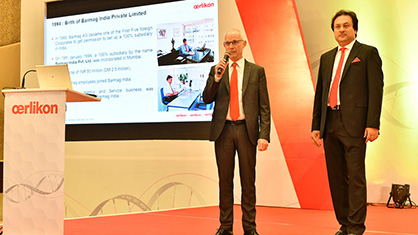
Eagerly anticipated by the audience, André Wissenberg, Vice President, Head of Marketing, Corporate Communications and Public Affairs, spoke about the uncertain times amidst the global trade conflict between the US and China and the emerging countries suffering as a result. He determined that the manufacture of manmade fibers in countries such as India and Bangladesh has tremendous potential for the future. He stated: “Over the next few years, the manmade fiber industry will – to an above-average extent – continue to benefit from market growth and the shift of market shares from cotton to manmade fibers. Currently, growth of polyester lies at +2.4% CAGR. According to a study compiled by Wood Mackenzie, the anticipated growth rate for all polyester fibers between 2016 and 2030 is +3.3%, with +2.1% for staple fibers and even +3.8% for filaments. The per-capita consumption in India, which was 5.9 kg in 2018, is expected to reach 8.5 kg by 2030.”
New challenges for China, India and Bangladesh
“This rapidly-changing global scenario is presenting us all with new challenges”, continues Wissenberg. “Almost 50% of the population will in future live in cities, and the demand for water, food and energy will rise considerably, above all in Asia and Africa. The quest for political and economic solutions for emerging countries will impact on all aspects of life, and the textile industry in particular. The economic center of gravity will continue to shift towards Asia. And we have to be ready for this.” The US and Europe will definitely lose ground to China and India. In terms of gross domestic product, China ranked no. 1 in 2016, followed by the US, India, Japan and Germany. By 2050, India will be ranked second, with US shifting to third, while Indonesia displaces Japan to take fourth. And – with Africa – a new demographic giant will emerge, whose young and growing population could become a powerful growth engine for the continent, as long as there is sufficient investment in education, health and the economy. Africa’s population growth will be responsible for around 58% of global growth between 2018 and 2050.
Commenting on the situation in China, Wissenberg stated: “The trends in China in 2019 have shown us that the country has transitioned from a high-speed economy into a society with high-quality growth. China's economy slowed from 6.9% in 2017 to 6.6 % in 2018, which is predominantly down to the tightening of financial supervision within the banking sector and the expanding trade conflict with the US. A further slowdown of 6.2% and 6% respectively is forecast for 2019 and 2020. Here, the impact of the coronavirus epidemic has not be taken into account.” The reforms in China have progressed in several key areas, including: 1. Strengthening of the financial rules; 2. Control of local authority investments; 3. Slowdown of debt accumulation; 4. New FDI law and redrafting of the list of FDI entries. The general government deficit is currently estimated to be 11% of GDP. If the trade dispute were to further escalate, there are rumors emanating from China that fiscal incentives, above all, would be justified.
Overall, the global economy would benefit from a more open, more stable and more transparent rule-based international trading system. Wissenberg listed the biggest challenges for the Indian economy: maintaining and achieving annual average growth of between 9 and 10%, providing investor-friendly rights and taxation systems, limiting financial reporting and budgetary deficits, developing a world-class infrastructure for maintaining growth in all economic sectors, reducing currency devaluation, removing environmental obstacles for foreign direct investment, controlling inflation and permitting foreign direct investment in various areas. Overall, Wissenberg therefore sees an optimistic mood for the manmade fiber industry in India in this new decade, but simultaneously warns of the above-mentioned global risks.
Cultural highlights
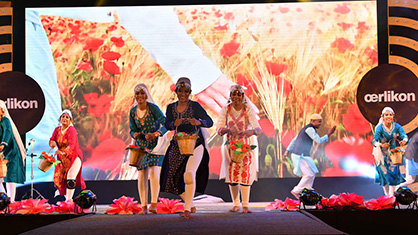
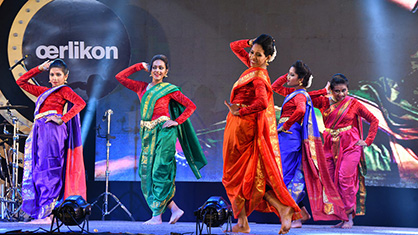
Both technology symposiums were each accompanied by a cultural highlight. In Daman, a musical and dance performance showcased the history of Kashmir, while the ‘Amar Sonar Bangla’ program entertained the attendees in Kolkata. Here, Debabrata Ghosh, General Manager Sales at Oerlikon Textile India Ltd., demonstrated particular commitment and created both programs with the internationally-renowned ‘Sukalyann d’entourage’ dance studio in Mumbai and Toronto.