[pageLogInLogOut]

#Software

Black Friday review and forecast - What business strategy will fashion brands adopt?

Now well known in France and eagerly awaited by consumers, this year’s Black Friday event is fast approaching. Scheduled on November 27, twenty-seven days before Christmas, this day of promotionaloffers is one of many, including Black Friday Week (November 23–30), Black Friday and Cyber Monday (November 30), ensuring that in-store and online deals won’t be lacking.

But is this commercial highpoint in the year truly a business opportunity? What is the game plan for brands? Retviews, a fashion brand data analysis solution acquired by Lectra, has deciphered the special offers proposed in the ready-to-wear sector and particularly the fast fashion segment, to highlight the main lessons to be learned to optimize purchases during this period. 

Review of Black Friday promotional strategies

Fashion brands generally schedule targeted sale campaigns during the week of Black Friday and offer an additional one-time savings event the following weekend. Cyber Monday, the last day of discounts offered exclusively online, is an opportunity for brands to add new incentives to stimulate sales on their e-commerce

In 2019, from the Monday to Thursday preceding Black Friday, fashion market players carried out a different promotional campaign daily (similar to Amazon’s Prime Day event).

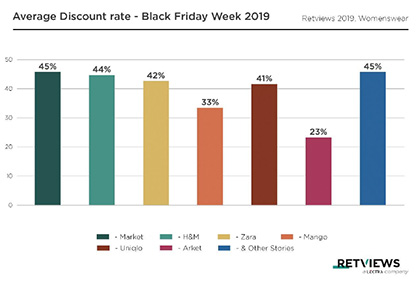
On Black Friday last year, retailers chose two options: low discounts (20-30%) on their entire collection (the choice of H&M), or higher discounts of 40–50% on a selection of articles (the choice of Zara).

During the weekend that followed, some continued their promotions, relying on an abundance of shoppers.

Mango, for example, offered a 30% discount on its entire collection Friday to Sunday included.

Cyber Monday, which closed this promotional period, allowed certain brands to liquidate part of their inventory by offering customers more interesting online discounts on a selection of items. 
© 2020 Lectra
© 2020 Lectra


Timing – key to success!

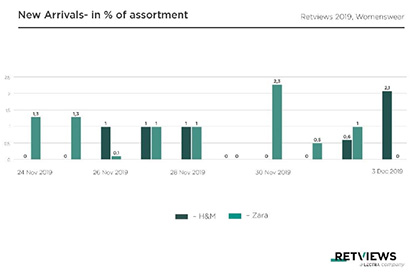
While brands prefer not to put their new collection on sale the week of Black Friday, Zara chose a different strategy in 2019 to give itself a head start on the market. The brand implemented a bold marketing campaign, putting its entire new collection online the very next day (Saturday being a high-traffic day in e-commerce).

Market timing is an important part of Inditex’s strategy, as confirmed by its subsidiary Zara, which went as far as to allow its customers to prepare and save their shopping carts a few hours before the savings event was launched. 
© 2020 Lectra
© 2020 Lectra


What is the forecast for Black Friday 2020?

According to FoxIntelligence, in 2019 Black Friday and Cyber Monday generated 167% sales growth. However, trends during the same period in 2020 will logically be affected in Europe by the crisis.


In the current context, a large number of consumers worldwide do not plan to return to stores in the near future. Nevertheless, a positive effect of lockdown on consumption has been an 11% increase in France in  e-commerce purchases of clothing and footwear, although spending in brick and mortar stores decreased 26% (Source: Institut français de la mode, September 2020).

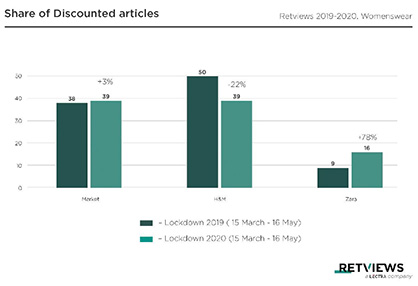
During lockdown in France between mid-March and mid-May 2020, Retviews teams noted a slight increase in the number of discounted items up from 2019 at the same period. As a result, retailers tapped into their promotional budget for that year. This finding could have an impact on whether or not pre-Black Friday and Cyber Monday sales activity is lower in volume in 2020 than it was in 2019.

“The central issue to date is inventory management, on the one hand, and preserving margins on the other,” says Katia Cahen, Marketing Intelligence Director at Lectra. “If a brand has inventory to sell from previous collections, particularly the 2020 spring-summer collection, heavily impacted by lockdown store closures and a relatively weak recovery, it will offer generous deals on certain product categories. If inventories have been more aptly managed, and the fall-winter collection better planned, the brand will run fewer promotional campaigns, with more modest discounts on a limited category of products,” the goal being to safeguard margins on products and categories which are ‘bestsellers’ outside of promotional periods. 
© 2020 Lectra
© 2020 Lectra


Retviews data indicates that Zara is likely to use the same strategy as last year, and that companies like H&M, which did not offer significant discounts during lockdown (22% fewer items were discounted compared to the same period in 2019) should be monitored closely. Brands that have not overspent their annual promotional budget in the spring could very likely offer greater markdowns on Black Friday.

According to Retviews analyses, the sales strategies of ready-to-wear companies on Black Friday are expected to be similar to those of last year. One of the only predicted differences is that brands preferring a significant discount strategy are expected to have a smaller panel of heavily promoted items than in 2019.

As Katia Cahen points out: “H&M, which traditionally has far more immobilized inventory than Zara (a $4 billion inventory challenge, revealed in 2019), will probably be inclined to run more promotions than Zara again this year. This assumption needs to be qualified, however, due to the acceleration of an eco-responsible strategy on the part of the brand to manage its inventory differently and gradually abandon a highly incentivizing sales policy. "

More News from Lectra Deutschland GmbH

#Industry 4.0 / Digitalization

Mango joins TextileGenesis pioneering traceability solution, a Lectra company, for a transparent value chain

Mango, one of the leading international fashion groups, has joined TextileGenesis, the pioneering traceability solution for the fashion and textile industries, to trace their natural and animal fibers, synthetics, man-made cellulosic fibers and leather. TextileGenesis, a Lectra company, offers a complete and secure cutting-edge technology with its six-dimensional (6D) offering and unique “fiber forwards” approach. Mango, has long been committed to maintaining a fully transparent supply chain, and TextileGenesis will reinforce this commitment.

#Textiles & Apparel / Garment

New Retviews study by Lectra: the luxury market in 2025, between margin protection strategies and new iconic pieces

After more than a decade of uninterrupted growth, the luxury fashion market is now experiencing a more pronounced slowdown. Global luxury goods sales have fallen from €369 billion in 2023 to €364 billion in 2024 (according to Bain & Co.), exposing the vulnerabilities of a model long supported by aggressive price increases.

#Recycling / Circular Economy

Recover and TextileGenesis collaborate to verify supply chain integrity of recycled materials

RecoverTM, a global producer of recycled cotton and cotton-blend fibers, has commenced a traceability collaboration with TextileGenesis, a Lectra company, to digitally track its recycled waste materials across the entire textile value chain.

#Industry 4.0 / Digitalization

Lectra launches the Observatory of innovation and transformation in the fashion, furniture and automotive markets

As a leader in technology solutions accelerating the transition of fashion, furniture and automotive companies to Industry 4.0, Lectra announces the launch of its Observatory to mark its 50th anniversary. The Observatory will focus on innovations and changes in the fashion, furniture and automotive markets, to help these sectors stay informed and adapt to new opportunities. The Lectra Observatory’s first white paper on the advent of Industry 4.0 is already available online.

More News on Software

#Software

Tunicotex Group boosts OTDP to 85%, cuts planning time by 25% & expands production capacity by 40%

Coats Digital is delighted to announce that following the implementation of FastReactPlan, leading Tunisian premium knitwear manufacturer, Tunicotex Group, has significantly improved its on-time delivery performance from 75% to 85%, reduced planning time by 25%, minimised delays and penalty costs, and unlocked 40% additional capacity to take on more customer orders and support sustained business growth.

#Industry 4.0 / Digitalization

Suzhou Tianyuan boosts costing accuracy to 98% with Coats Digital’s GSDCost

Coats Digital is delighted to announce that Suzhou Tianyuan Garments Co., Ltd., a leading manufacturer of high-quality sportswear and functional apparel for global brands such as Adidas, FILA, ANTA, and The North Face, has achieved remarkable productivity and cost management improvements following the implementation of Coats Digital’s award-winning method-time-cost optimisation solution, GSDCost.

#Software

Textile Solutions Group appoints Anton Hofmeier as Group CEO

TSG strengthens Group-level coordination and aligns ERP, CAD, MES and shop-floor execution to deliver faster, lower-risk improvements for textile manufacturers.

#Software

Embee International Selects Coats Digital’s GSDCost Solution to Drive Accuracy, Efficiency, and Global Competitiveness

Coats Digital is pleased to announce that leading global apparel manufacturer, Embee International Industries, has implemented Coats Digital’s GSDCost solution across its operations to eliminate inaccurate costing, streamline production processes, and boost competitiveness in international markets. The move forms a key part of Embee International’s digital transformation strategy to drive greater efficiency, improve quality, and strengthen partnerships with its portfolio of top global brands.

Latest News

#Functional Fabrics

“Action helps us change what we do!”

DAY 0 takes place deliberately before PERFORMANCE DAYS begins. It is conceived as a space for reflection, dialogue and active engagement — a moment to pause before the fair, rethink established systems and address sustainability not as a trend, but as a fundamental transformation challenge. Under the guiding metaphor “Turn the Tap Off”, DAY 0 focuses on root causes rather than symptoms, systemic change rather than isolated solutions, and collective responsibility rather than individual silos.

#Textiles & Apparel / Garment

Pets in fashion: functional and sustainable textiles find new market at Intertextile Apparel

China’s pet economy is booming, especially amongst younger generations, and pet apparel – from designer outfits to functional garments – was a RMB 3.5 billion (over USD 500 million) market in 2024, growing more than 20% annually¹. To help exhibitors harness this trend, Intertextile Shanghai Apparel Fabrics – Spring Edition 2026 will launch the Pet Boutique, presenting a range of innovative, sustainable materials that prioritise both functionality and comfort for pets.

#Sustainability

VAUDE eliminates PFAS from all products

PFAS (per- and polyfluoroalkyl substances) are now detectable worldwide – in drinking water, soil and the human body. These so-called “forever chemicals” are considered hazardous to health and potentially carcinogenic, as they do not break down and remain in the environment permanently. Despite these risks, PFAS are still used in a wide range of products. More than 15 years ago, VAUDE made a strategic decision to gradually eliminate PFAS from all product categories.

#Man-Made Fibers

Lenzing AG to become majority owner of TreeToTextile AB and accelerates industrialization of new fibers

The Lenzing Group is taking another strategic milestone by acquiring a controlling majority in the Swedish innovation company TreeToTextile AB. This step strengthens Lenzing’s position as a leading provider of sustainable, wood‑based specialty fibers and expands its innovation pipeline with a highly scalable, patent‑protected technology platform. The transaction is executed through the issuance of new shares.

TOP