[pageLogInLogOut]

#Research & Development

Keep away from cords and drawstrings!

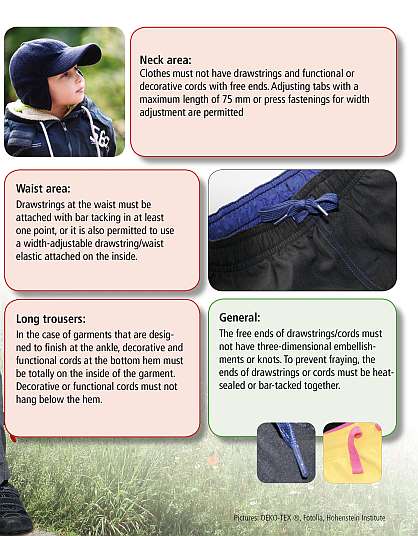
Clothing needs to be designed with safety in mind if escalators and playgrounds are not to become a death trap for children. The DIN EN 14682 standard "Safety of children's clothing - Cords and drawstrings on children's clothing" contains recommendations how garments for kids aged up to 14 years should be designed.

It is frightening how many recall campaigns are listed on the information page of the European Union(1)  for products presenting a risk of strangulation or serious injury. In the past fatalities and major injuries have unfortunately occurred time and time again due to the use of unsuitable closures on children's clothing. A fact that is barely recognised in the public debate surrounding the safety of textiles. Instead, the focus falls here on possible contamination with harmful substances.

Christiane Schulze from the Hohenstein Institute in Bönnigheim is pressing for even greater caution in the interest of children: "Most textiles on the market are now tested for harmful substances, as for example under OEKO-TEX® Standard 100. And there has been a significant fall in the number of complaints involving this aspect. I am hoping to see a similar positive trend where the Cord Regulations are concerned."

Christiane Schulze's team of staff are also making a contribution here, working on behalf of manufacturers and trading companies: They examine clothing designed for children and adolescents in relation to the DIN EN 14682 safety norm before manufacturing starts, so avoiding product recalls from the outset.

(1)

http://ec.europa.eu/consumers/safety/rapex/alerts
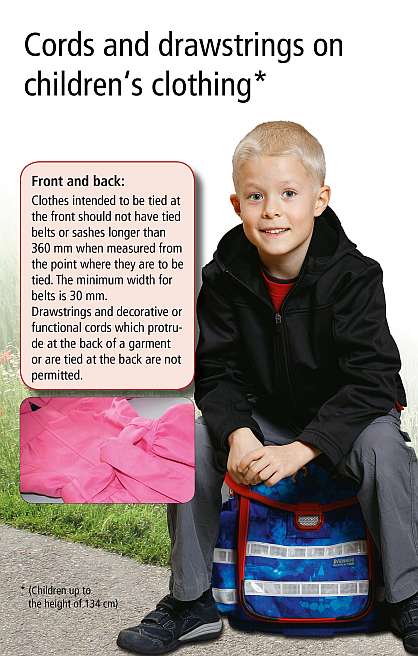
© Hohenstein Institute ® The ends of drawstrings/cords on children's clothing must not have knots or other decorative features. Safe alternatives are heat-sealing or bar-tacking the ends of such cords. Zips must not exceed a total length of 75 mm.

More News from Hohenstein Institute

#Research & Development

A smarter way to verified Chemical Compliance

Hohenstein and GoBlu Drive Innovation in Sustainable Supply Chain Management As regulatory demands, customer expectations, and sustainability goals continue to grow, the ability to manage chemical compliance and data across complex supply chains has become critical. Hohenstein and The BHive® by GoBlu are initiating a strategic partnership to enhance chemical management in the textile sector. The collaboration delivers more than just a service – it provides an integrated, future-ready solution for brands, manufacturers and suppliers seeking trusted chemical management and credible sustainability.

#Research & Development

Hohenstein achieves GLP Certification for Medical Device Testing

Since the middle of July, the testing service provider Hohenstein has been certified to conduct medical device testing in accordance with the internationally recognised Good Laboratory Practice (GLP) standard. This certification comprehensively covers chemical, physical and biological safety testing of medical devices.

#Research & Development

Hohenstein supports Global Textile Scheme Initiative

Global testing and research provider Hohenstein has acquired shares in Global Textile Scheme GmbH (GTS). In this way, Hohenstein aims to support GTS in harmonizing and automating data exchange along the entire supply chain. The aim of the GTS initiative is to create an international standard for handling structured product data in the textile and apparel industry.

#Research & Development

Hohenstein releases 2024 sustainability report

Responsible action is a defining value for Hohenstein, a global testing and research provider. Their 2024 Sustainability Report provides transparency through documented progress and detailed insights into how sustainability is embedded. It covers both the existing sustainability measures at the German headquarters and the company's goals for 2025 and beyond. The direct and indirect greenhouse gas emissions (Scope 1, 2 and 3) of all its locations worldwide were recorded for the first time.

More News on Research & Development

#Research & Development

The region of renewable raw materials: Central German Alliance for Bioplastics

The development of sustainable plastic solutions is rapidly gaining importance in light of global environ- mental pollution, dwindling fossil resources and ambitious climate protection targets. As part of the re- gional alliance RUBIO, which brings together 18 partners from central Germany and the Berlin-Branden- burg area, the bio-based and biodegradable plastic polybutylene succinate (PBS) was comprehensively investigated, starting with the raw material, through the manufacturing process, to industrial application.

#Nonwoven machines

Cooperation in the field of meltblown laboratory technology

The Nonwoven Institute (NWI) at North Carolina State University and Oerlikon Nonwoven will be collaborating in the field of meltblown laboratory technology in the future. This was announced by Professor Raoul Farer, Executive Deputy Director of the NWI and Professor at the Wilson College of Textiles at North Carolina State University, and Dr. Ingo Mählmann, Sales Director Nonwoven at Oerlikon Neumag, during this year's ITMA Asia and CITME in Singapore.

#Recycling / Circular Economy

European research project addresses textile waste through integrated recycling technologies

A major European research initiative coordinated by Fraunhofer UMSICHT has been launched to develop integrated solutions for textile waste recycling. The AUTOLOOP project aims to create a comprehensive system that could process 1.24 million tonnes of textile waste annually by 2050, whilst potentially creating over 130,000 green jobs across the EU. This project aims to develop, test and integrate automated sorting, tracing, and closed-loop recycling technologies for polyester-based textiles (NRT), addressing the pressing challenge of textile waste management.

#Research & Development

Feasibility study shows potential to convert textile waste into PHB bioplastic

Textile waste could serve as a valuable source of raw materials for sustainable plastics in the future, according to the joint TexPHB feasibility study conducted by the Fraunhofer Institute for Applied Polymer Research IAP, Beneficial Design Institute GmbH and matterr GmbH. The study will be presented to the public for the first time at a network meeting on 25 November 2025 at the State Chancellery in Potsdam.

Latest News

#Recycling / Circular Economy

Advanced Recycling Conference 2025 fuels innovation across key waste streams

The Advanced Recycling Conference (ARC) 2025 brought together nearly 220 experts from 28 countries to spotlight pioneering advancements and foster industry collaboration in recycling across diverse waste streams including plastics, textiles, automotive and other materials.

#Dyeing, Drying, Finishing

Navis TubeTex announces U.S. partnership with Icomatex

Navis TubeTex, a global leader in advanced dyeing and finishing machinery solutions, is pleased to announce a new partnership with Icomatex (www.icomatex.com), a respected European manufacturer of high-quality stenters and textile finishing equipment. Under this agreement, Navis TubeTex will exclusively represent the Icomatex stenter line in the United States.

#Recycling / Circular Economy

ADVANSA launches ADVA®tex: A new step toward textile-to-textile recycling

ADVANSA has introduced ADVA®tex, a new filling fibre made entirely from recycled pre-consumer textile waste, positioning the material as a significant step forward in textile-to-textile (T2T) recycling. The fibre is designed for use in duvets, pillows, mattresses, and furniture applications and is available in three versions.

#Knitting & Hosiery

KARL MAYER celebrates 35 years of EL pattern drive

KARL MAYER is celebrating an anniversary this year: on 30 November 1990, the first warp knitting machine with electronic guide bar control, the KS 4 EL, was delivered – another milestone for patterning. As early as 1980, the SU gearbox with the MRS42SU had initiated the transition from mechanical chains to digital data.

TOP