[pageLogInLogOut]

#Research & Development

Europe is committed to recycling end-of-life wind turbine blades
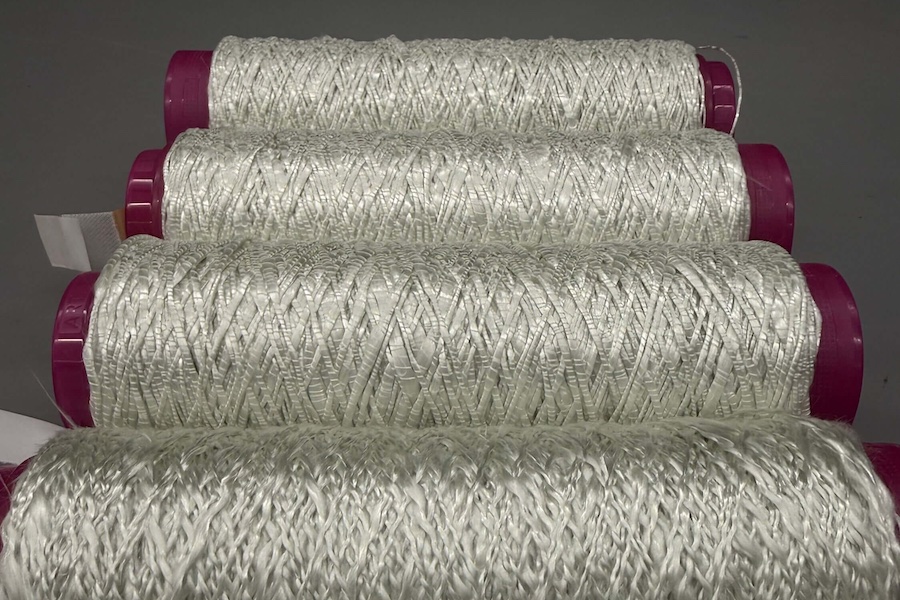
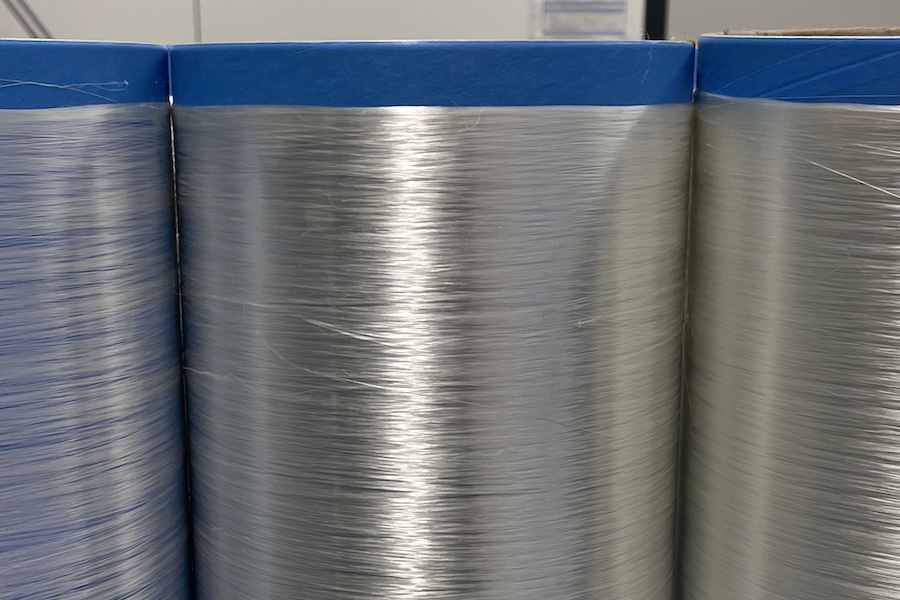
Yarns manufactured from recycled glass fibers. Photo: DITF
Starting in 2026, Europe’s wind energy industry has committed itself to ensuring that wind turbine blades do not end up in landfills once they reach the end of their service life. The EU-funded research project REWIND is exploring ways to reuse this composite waste. The German Institutes of Textile and Fiber Research Denkendorf (DITF) are one of 13 project partners from seven countries.


REWIND stands for Efficient Decommissioning, Repurposing and Recycling to increase the Circularity of End-of-Life Wind Energy Systems. The project partners are developing basic technologies and processes for the dismantling, recycling, and reuse of composite materials. The goal is to make wind turbine blades recyclable instead of sending them to landfills or incinerating them.

The consortium has validated a model that can predict the mechanical behavior of recovered materials with an accuracy of over 90%. This makes them suitable for demanding applications, such as in electric vehicles or as insulation material.

At the DITF, yarns and fabrics are developed from both glass and carbon fibers recycled by the project partners for use in new components or repair kits for wind turbines. In an initial step, the recycled fibers were examined, primarily to determine which processing methods they are suitable for.

The research team is pursuing two different approaches. In the first process route, the recycled glass fibers are processed into high-value textile reinforcements. To do this, the fibers are pre-opened, carded, spun into yarns, and then processed into fabrics that are reinforced in both one or two directions. A first milestone has been the development of a recycled glass fiber yarn (rGF/polyamide-6 yarn) with a fiber volume content of around 40%, which is suitable for thermoplastic composite applications, such as structural components in automotive engineering.

Furthermore, the researchers succeeded in producing a yarn consisting of as much as 98% recycled glass fibers (rGF). The yarn was then used to manufacture a woven fabric with parallel fiber orientation (UD fabric). This demonstrated for the first time that specifically oriented textile reinforcement structures made from recycled glass fibers can be produced, which are optimally adapted to mechanical loads.

The second process route investigates the processing of long-fiber delamination (LFD) tapes - which are planed directly from wind turbine blades - into UD fabrics. These LFD tapes represent a novel class of semi-finished textile products manufactured from fully cured recycled glass-fiber-reinforced plastic (GFRP). Currently, research is conducted to determine the extent to which these intermediate products are suitable as high-performance reinforcement structures for fiber-reinforced composites.

Partners:

AIMPLAS

TECKNIKER

IPC – Centre Technique Industriel de la Plasturgie et des Composites

Miljøskærm

Hochschule Pforzheim – Gestaltung, Technik, Wirtschaft und Recht

Deutsche Institute für Textil – und Faserforschung Denkendorf (DITF)

Alke Electric Vehicles

Suez Group

Bcircular

Composite Patch

R-Nanolab

CiaoTech-Gruppo PNO

AEMAC.


More News from Deutsche Institute für Textil- und Faserforschung Denkendorf

#Research & Development

Smart textiles reversibly change shape in an energy-efficient manner in response to ambient temperature

Self-actuating textile structures are used in a wide range of applications, such as medical technology, automation, architecture, agriculture, and the apparel industry. An example is the use of shading nets in greenhouses, which can be deployed and retracted depending on the sunlight intensity. The German Institutes of Textile and Fiber Research Denkendorf (DITF) are developing textiles based on shape-memory polymers with reversibly controllable geometry.

#Research & Development

ALADIN paves the way for circular and demand-driven textile production in Europe

Textile production can be organized sustainably by utilizing short supply chains and preventing overproduction. This can already be achieved today by intelligently connecting and efficiently utilizing existing infrastructure. At the same time, production becomes circular when innovative technologies and materials are used that enable high-quality recycling. The ALADIN research project, launched in May 2026 and co-funded with five million euros under the EU Horizon Europe program, is creating the conditions for this.

#Research & Development

Textile climate control system in workwear – exhibition at the 2026 SME Innovation Day!

Conventional protective workwear often reaches its limits during strenuous physical activity. In particular, the transport of sweat and excess body heat poses a problem. The German Institutes of Textile and Fiber Research (DITF) conducted research on flow-optimized, air-conducting textile structures that enable targeted climate control directly on the body. These structures can be integrated straight into protective work garments. The textile climate control system supports the body’s natural thermoregulation. This contributes to improved workplace safety and comfort.

#Techtextil 2026

Stylish design made from sustainable materials – two DITF research projects receive Techtextil Innovation Awards

Materials made from domestic, renewable raw materials reduce CO₂ emissions, prevent microplastics from entering the environment, and close the material cycle. The German Institutes for Textile and Fiber Research Denkendorf (DITF) are developing nature-based alternatives to synthetically produced and predominantly petroleum-based materials. Two research projects have received a prestigious Techtextil Innovation Award. NUO Flexholz and the lignin-coated material FormLig demonstrate that sustainable concepts can meet high standards of functionality and design. Both projects were carried out in close collaboration with industry.

More News on Research & Development

#Research & Development

Novel flame-retardant and recyclable fiber-reinforced composite

Airplanes and passenger trains must meet strict safety requirements, including fire safety standards. This calls for materials that are flame-retardant, lightweight, robust, and scalable. Empa researchers, in collaboration with their industry partner Elantas, have now succeeded for the first time in making such a material – a composite – fully recyclable.

#Research & Development

From smart jackets to laser technology: Mona Neubaur explores Textile Factory 7.0

As part of her summer tour, North Rhine-Westphalia’s Minister for Economic Affairs and Climate Action, Mona Neubaur, visited Textilfabrik 7.0 in Mönchengladbach to experience the project’s innovations first-hand. Under the motto “smart and clean”, the visit focused on innovative technologies and sustainable alternatives for textile production - from smart jackets to the decolourisation of textiles using fungal cultures.

#Research & Development

MELANGE starts with a co-creative design workshop at Aalto University to shape the visual identity of this new project transforming colouration in textiles

Over the next three years, MELANGE will lower the environmental impact of interior textile production by moving colour design to the beginning of the manufacturing process. This Horizon Europe project officially started on 1 August 2026, and will be publicly launched on 27 August 2026.

#Research & Development

Outdoor Industry Association completes Clean Heat CoLab initiative

The Outdoor Industry Association (OIA) has completed its multi-year Clean Heat CoLab initiative, bringing together outdoor brands and technology experts to accelerate the adoption of electrified process heating in textile manufacturing. The collaboration focused on reducing emissions from thermal processes such as dyeing, washing and finishing, which remain among the most carbon-intensive stages of textile production.

Latest News

#Weaving

Lindauer DORNIER GmbH welcomes new apprentices and dual-study students

For 22 new “DORNIER Talents”, these days mark the beginning of a new chapter at Lindauer DORNIER. For the family-owned company, in-house training is a key pillar in developing skilled professionals and retaining them within the company for the long term.

#Raw Materials

Cotton Brazil Dialogues 2026 concludes with 50 international participants immersed in Brazilian cotton production

The Cotton Brazil Dialogues concludes its 2026 edition after a series of technical visits to farms, cotton gins and reference centers, as well as workshops focused on Brazilian cotton production. A total of 50 participants from 14 countries took part in the field trips. The initiative is led by the Brazilian Association of Cotton Growers (Abrapa) and the National Association of Cotton Exporters (Anea), with support from the Brazilian Trade and Investment Promotion Agency (ApexBrasil).

#Composites

WHILL selects Teijin’s tough, lightweight Carbon Fiber Composite for new last-mile mobility

Teijin Limited announced today that WHILL Inc., a global leader in inclusive mobility technology, has selected Sereebo® P CFP series, a carbon fiber-reinforced thermoplastic (CFRTP) material, for key structural components of the upcoming WHILL Model C Lite. Sereebo® P CFP series provides high strength, light weight, design flexibility and system cost advantages to the Model C Lite, which is a battery powered, single-seat, last-mile device. This new model combines maneuverability with light weight and one-handed folding to ensure ease of handling and operation.

#Textile chemistry

ZymoChem secures $4 million in renewed federal funding to advance U.S. biomanufacturing of critical materials and their supply chains

ZymoChem, the specialty chemicals company dedicated to bringing decarbonization, sustainability, and supply chain resiliency to the chemical industry through innovative biological manufacturing, today announced the resumption and expansion of its federal research portfolio. The company has been notified that previously paused work under a $5 million U.S. Department of Energy (DOE) program is officially back on, to be joined by continuing collaborations with three of the nation's premier national laboratories.

TOP