#Research & Development
POLYMERS-5B develops high-performance bio-based polyesters from agricultural waste
EU-funded research project combines enzymatic biorefinery technology with the recovery of valuable ingredients and polymer precursors from tomato and olive processing residues
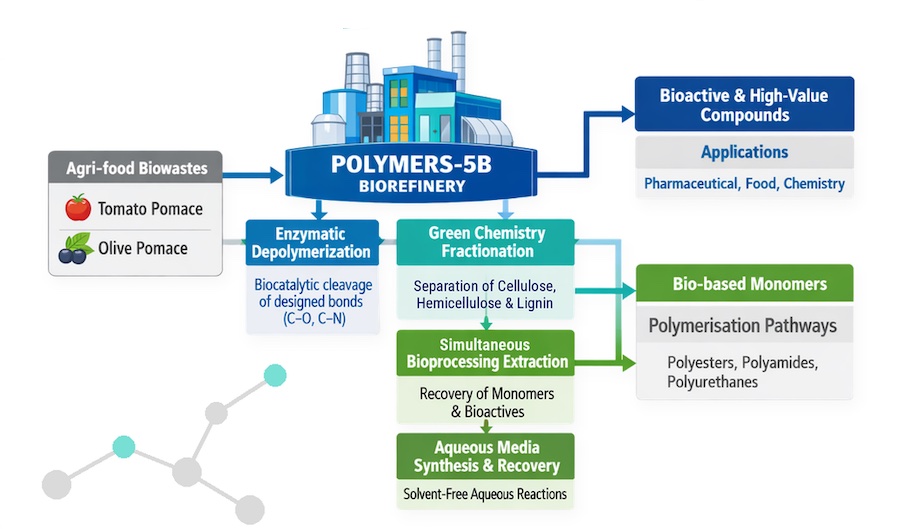
Tomato and olive processing generates substantial quantities of residual biomass each year. While these materials are often directed towards low-value recovery routes, POLYMERS-5B is investigating how they can be used more efficiently through a cascading process that extracts multiple valuable components.
The project focuses on recovering lycopene for food and nutraceutical applications, hydroxytyrosol-rich antioxidant extracts for cosmetics and wellness products, pectin for food formulations, and monomers and intermediates for high-performance bio-based polyesters.
Unlike conventional processes targeting individual products, the integrated biorefinery concept is designed to maximise the value recovered from each tonne of biomass through sequential processing steps.
Luis Fonseca, POLYMERS-5B coordinator at IST-ID / iBB, explains the approach: “Mediterranean agri-food industries generate significant volumes of tomato and olive residues every season. The core idea behind POLYMERS-5B is to treat these streams as secondary raw materials and recover several valuable products from the same biomass through an integrated biorefinery approach.”
Bio-based polyesters with improved thermal properties
A central research objective is the development of bio-based polyesters with properties suitable for more demanding applications.
According to the project consortium, the materials developed so far have achieved a glass transition temperature of approximately 80 °C, compared with 70 °C for a commercial reference material used in the evaluation.
However, further improvements in mechanical properties are required. The experimental polyesters currently achieve an elastic modulus of approximately 2 GPa, while commercial rigid bio-based benchmark materials reach values between 3.2 and 3.85 GPa.
The next development stage will therefore focus on increasing stiffness while maintaining the improved thermal properties.
Andrea Jester, Business Developer at NSBproject, comments on the results: “Heat resistance is often where bio-based plastics fall short, and ours already outperform a commercial reference. Once we close the gap on stiffness, these materials can start replacing fossil-based plastics in demanding, structural uses.”
Pilot production campaigns have already produced polyester monomers in reproducible batches of up to 15 kg. The process has reached Technology Readiness Level 5 (TRL 5), indicating that the technology has been validated in a relevant environment.
The project has also demonstrated the reuse of enzyme catalysts, an important aspect for the economic and environmental performance of enzymatic production processes.
Market opportunities for integrated biomass valorisation
A market analysis conducted within POLYMERS-5B using NSBproject's C-Tech Navigator® platform identified established commercial demand for the major product groups targeted by the project.
These include lycopene, hydroxytyrosol-based extracts and bio-based polymer materials.
According to the assessment, the global lycopene market is estimated at approximately USD 160 million, with annual growth exceeding 5%. Market estimates for hydroxytyrosol vary considerably, indicating a specialised but developing market segment.
The analysis also examined existing technologies and business models for biomass valorisation. Nine industrial and research organisations were assessed across four technology families.
No dominant commercial provider offering integrated on-site valorisation of tomato and olive pomace was identified in the targeted Iberian market.
The consortium sees the combination of several recovery processes within a single enzymatic cascade as a potential competitive advantage.
Integrating biorefineries into food-processing facilities
Rather than transporting agricultural residues over long distances, POLYMERS-5B is investigating a decentralised industrial model in which biorefinery operations are located directly alongside food-processing plants.
This approach could reduce transportation requirements, improve traceability and support regional circular-economy value chains.
The proposed business model is based on on-site processing services, with tomato pomace processed directly at the production facility and olive pomace sourced within a radius of approximately 25 kilometres.
Stored biomass and alternative agricultural residues, including grape and orange processing by-products, could provide additional feedstock outside the main processing seasons, which typically last five to six months.
Riccardo Varotto, Project Manager at NSBproject, highlights the importance of industrial validation: “Our analysis shows that all the molecules targeted by POLYMERS-5B are already traded in established markets. What remains largely unavailable is transparent evidence on biomass utilisation, processing economics and delivered costs. We believe that demonstrating these parameters at industrial scale could become a key differentiator for the next generation of circular bioeconomy business models.”
Presentation at Ecomondo 2026
The POLYMERS-5B consortium will present its research and market findings at Ecomondo 2026 in Rimini.
The presentation, entitled “Circular Bioplastics from Mediterranean Waste: High-Performance Polymers via Cascaded Biorefinery and Enzymatic Polycondensation”, was selected as one of 27 oral presentations in the exhibition's “Plastics, bioplastics & textiles” track.
The presentation will take place on 3 November 2026 at 12:30 in Room Tiglio, Hall A6, Rimini Expo Centre.
POLYMERS-5B is a 48-month European research project running from June 2024 to May 2028. It is funded under HORIZON-JU-CBE-2023 and supported by the Circular Bio-based Europe Joint Undertaking and its members. The project is coordinated by IST-ID.
Further information: www.polymers-5b.eu