[pageLogInLogOut]

#Research & Development

Smart textiles reversibly change shape in an energy-efficient manner in response to ambient temperature
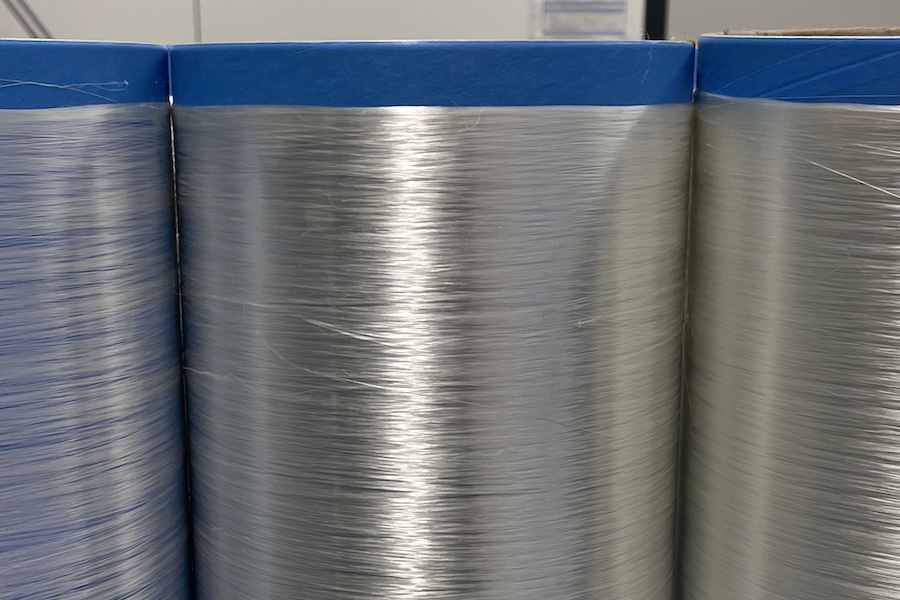
Multifilament yarns made from two-way shape-memory polymers. Photo: DITF © 2026
Self-actuating textile structures are used in a wide range of applications, such as medical technology, automation, architecture, agriculture, and the apparel industry. An example is the use of shading nets in greenhouses, which can be deployed and retracted depending on the sunlight intensity. The German Institutes of Textile and Fiber Research Denkendorf (DITF) are developing textiles based on shape-memory polymers with reversibly controllable geometry.

Changes in the shape of conventional textiles are often controlled by external mechanical components, such as motors. This increases the total weight, energy consumption, and thus also the costs.

Shape-memory polymers can respond to changes in their environment with a preprogrammed deformation. So-called 2-way shape-memory polymers (2W-SMP) even allow reversible shape changes. Textiles made from these materials open up new possibilities for developing energy-efficient textile actuators.

In a joint research project, the DITF, in collaboration with the Fraunhofer Institute for Applied Polymer Research (IAP), are developing multifilament yarns made from thermoplastic 2-way shape-memory polymers. These yarns exhibit a reversible and reproducible change in length that is controlled solely by temperature changes. When the temperature rises, the yarns shorten; when they are cooled, their length increases. Unlike one-way shape-memory polymers, no external deformation is required to achieve reversible shape change (actuation).

To enable the textiles to be used at room temperature, spinnable 2W-SMP fibers with transition temperatures of approximately 30 °C and 60 °C were first synthesized. Subsequently, suitable spinning parameters - such as spinning temperature, spinneret diameter, and take-up speed - were determined to enable the production of multifilament yarns, first using a Spin Line rheometer and then on a pilot plant.
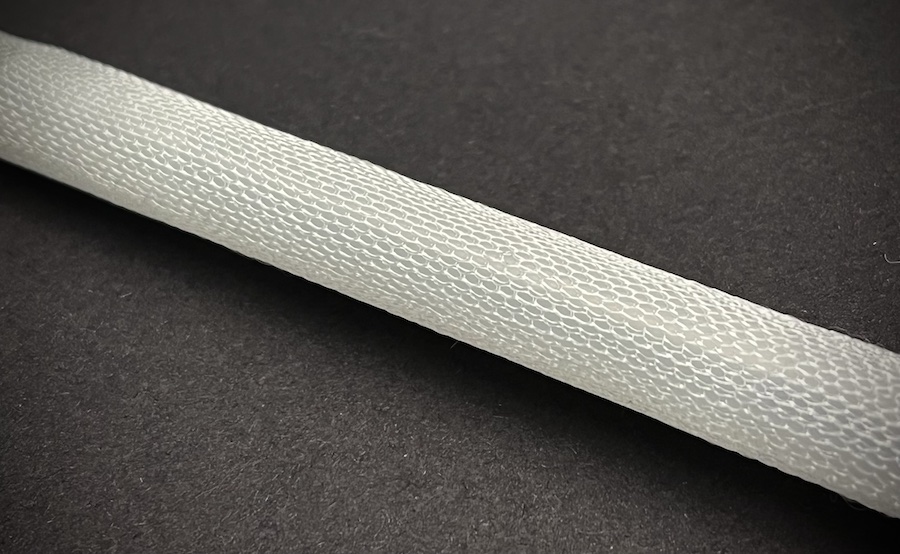
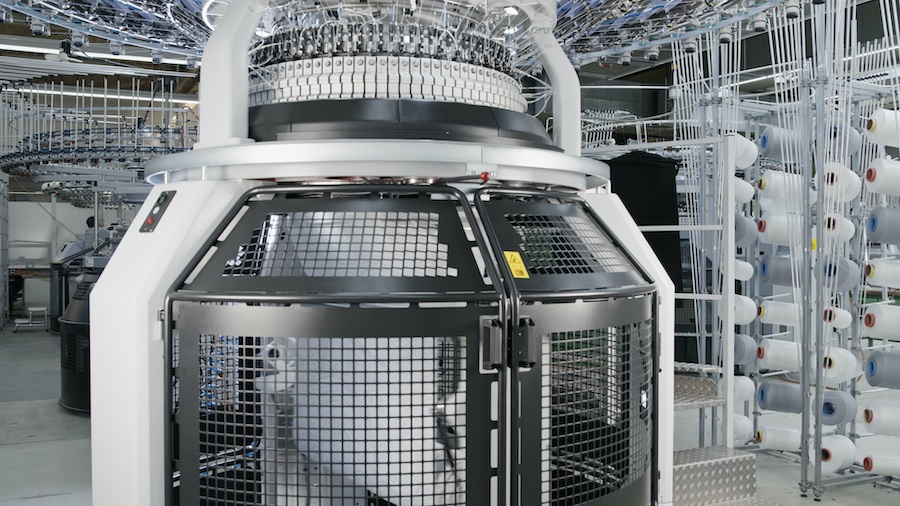
Circular-knit fabric made from multifilament yarns based on two-way shape-memory polymers. Photo: DITF © 2026


Finally, the influence of the spinning parameters on the thermal actuation of the produced yarns was investigated. Therefore, their dimensional stability was determined. If the dimensional stability is 100%, the yarn returns to the same length every time the corresponding temperature is reached. Thermal actuation was also determined by the reversible change in elongation of the yarns during temperature changes. Multifilament yarns were produced with a dimensional stability of over 99% at 60°C and a reversible change in elongation of 16% at a winding speed of 1,500 m/min. This shows that these materials can be produced cost-effectively.

As next steps in the project, researchers will investigate how the yarns can be processed into textiles and how they can be thermomechanically recycled at the end of their service life. Based on these studies, it is possible to assess the extent to which the new material is suitable for industrial production and which applications are feasible. For example, in the future, an agricultural textile made of shape-memory polymers could be produced that automatically adjusts its air and light permeability to changing weather conditions, thereby creating an ideal environment for plant growth.

IGF Project 01IF23512 N was funded by the Federal Ministry for Economic Affairs and Energy as part of the Program for the Promotion of Joint Industrial Research (IGF), based on a resolution of the German Bundestag.
More News from Deutsche Institute für Textil- und Faserforschung Denkendorf

#Research & Development

Europe is committed to recycling end-of-life wind turbine blades

Starting in 2026, Europe’s wind energy industry has committed itself to ensuring that wind turbine blades do not end up in landfills once they reach the end of their service life. The EU-funded research project REWIND is exploring ways to reuse this composite waste. The German Institutes of Textile and Fiber Research Denkendorf (DITF) are one of 13 project partners from seven countries.

#Research & Development

ALADIN paves the way for circular and demand-driven textile production in Europe

Textile production can be organized sustainably by utilizing short supply chains and preventing overproduction. This can already be achieved today by intelligently connecting and efficiently utilizing existing infrastructure. At the same time, production becomes circular when innovative technologies and materials are used that enable high-quality recycling. The ALADIN research project, launched in May 2026 and co-funded with five million euros under the EU Horizon Europe program, is creating the conditions for this.

#Research & Development

Textile climate control system in workwear – exhibition at the 2026 SME Innovation Day!

Conventional protective workwear often reaches its limits during strenuous physical activity. In particular, the transport of sweat and excess body heat poses a problem. The German Institutes of Textile and Fiber Research (DITF) conducted research on flow-optimized, air-conducting textile structures that enable targeted climate control directly on the body. These structures can be integrated straight into protective work garments. The textile climate control system supports the body’s natural thermoregulation. This contributes to improved workplace safety and comfort.

#Techtextil 2026

Stylish design made from sustainable materials – two DITF research projects receive Techtextil Innovation Awards

Materials made from domestic, renewable raw materials reduce CO₂ emissions, prevent microplastics from entering the environment, and close the material cycle. The German Institutes for Textile and Fiber Research Denkendorf (DITF) are developing nature-based alternatives to synthetically produced and predominantly petroleum-based materials. Two research projects have received a prestigious Techtextil Innovation Award. NUO Flexholz and the lignin-coated material FormLig demonstrate that sustainable concepts can meet high standards of functionality and design. Both projects were carried out in close collaboration with industry.

More News on Research & Development

#Research & Development

MELANGE starts with a co-creative design workshop at Aalto University to shape the visual identity of this new project transforming colouration in textiles

Over the next three years, MELANGE will lower the environmental impact of interior textile production by moving colour design to the beginning of the manufacturing process. This Horizon Europe project officially started on 1 August 2026, and will be publicly launched on 27 August 2026.

#Research & Development

Outdoor Industry Association completes Clean Heat CoLab initiative

The Outdoor Industry Association (OIA) has completed its multi-year Clean Heat CoLab initiative, bringing together outdoor brands and technology experts to accelerate the adoption of electrified process heating in textile manufacturing. The collaboration focused on reducing emissions from thermal processes such as dyeing, washing and finishing, which remain among the most carbon-intensive stages of textile production.

#Research & Development

ADD-ITC 2026 publishes preliminary conference program

The organizers of the Aachen-Dresden-Denkendorf International Textile Conference (ADD-ITC) 2026 have released the preliminary program for this year's event, which will take place on November 26–27, 2026, at the International Congress Center Dresden. The conference is expected to attract between 500 and 700 participants from industry, research, and academia.

#Research & Development

Networking Day 2026: Industry stakeholders unite around textile recycling

In 2026, the Industry Research Group (IRG) Polymer Recycling once again brought together some of the key stakeholders in textile recycling for its annual Networking Day. This year, the event took place at EREMA’s premises in Ansfelden, Austria. It brought together key players from across the textile recycling value chain for a day of structured exchange and in-depth discussions.

Latest News

#Yarn & Fiber

Expansive innovations converge in Shanghai as Yarn Expo Autumn 2026 opens doors next week

With just days to go, industry enthusiasm is building for the opening of Yarn Expo Autumn, Asia’s premier yarn and fibre trade fair, running from 25 – 27 August at the National Exhibition and Convention Center (Shanghai). Across 27,000 sqm in Hall 8.2, buyers will find nearly 600 exhibitors from 14 countries and regions, spread across seven specialised zones that range from cutting-edge man-made and regenerated fibres to time-honoured cashmere and silk. Beyond the extensive sourcing options, a fringe programme of trend showcases, presentations and product launches rounds out the three¬day event with design, innovation and market intelligence.

#Carpets

DOMOTEX Southeast Asia 2026 - Building the Gateway to ASEAN's fast-growing flooring market

From 11–13 November 2026, the inaugural DOMOTEX Southeast Asia will take place at BITEC (Bangkok International Trade & Exhibition Centre) in Bangkok, Thailand. Jointly organized by GLOBUS Events Limited and Hannover Milano Fairs Shanghai Ltd., with Worldex G.E.C. Co., Ltd. as the local partner, the exhibition marks the expansion of the internationally recognized DOMOTEX brand into Southeast Asia. As the newest addition to the global DOMOTEX portfolio, the exhibition has been developed specifically to serve the rapidly evolving ASEAN market, creating a dedicated business event for the flooring and interior finishing industry.

#Sustainability

Execs help steer Cascale’s consumer goods agenda in Athens

The 2026 Cascale Annual Meeting, taking place September 15–17 in Athens, Greece, will convene leaders from across the global consumer goods value chain to tackle one of the industry’s defining questions: how to accelerate meaningful, system-wide transformation. Guiding those conversations as this year’s co-chairs are Sean Cady, vice president, global sustainability, responsibility, trade, and government affairs at VF Corporation, and Dr. Delman Lee, vice chair at TAL Apparel Limited.

#Textile processing

YKK launches no. 3 size of QuickFree® click-TRAK® magnetic zipper globally

YKK Corporation (Headquarters: Chiyoda-ku, Tokyo; President: Koichi Matsushima; hereafter, YKK) has begun the global rollout of the No. 3 size of its QuickFree® click-TRAK® Magnetic zipper, expanding availability beyond China for the first time. While maintaining the same functionality and ease of operation, the No. 3 size is approximately 60% the size of the No. 5 size *1. This enables applications in lightweight garments, sportswear, hooded apparel, and other similar uses.

TOP