#Research & Development
Tire wear, particle analysis, test bench development, material development
TERIS reaches milestone: Fraunhofer consortium develops new standards for tire analysis
The project “Technology Platform for Tire Abrasion and the Identification of Its Emissions in Road Traffic (TERIS)” is making significant strides in tire and rubber-compound development. With the first milestone achieved and the project reviewed, the first important step has been successfully completed. This was also confirmed by the advisory board, composed of industry experts, which typically oversees such projects.
New standards for laboratory analysis and prediction of tire wear
The combination of different collection and measurement methods enables precise analysis of both suspended and settling particle fractions. In parallel, tribological models were developed that shed light—both experimentally and theoretically—on the relationship between load parameters, material properties, surface structure, and particle formation. This enables real-world abrasion processes to be specifically replicated in the laboratory.
A test chamber specialized in accelerated aging enables preconditioning of samples in a targeted and reproducible manner under environmental stress, thereby also investigating the influence on abrasion behaviour.
A major advancement is the development of an optical detection system that uses artificial intelligence to precisely identify and classify surface structures. The approach has already been validated using substitute materials and will be applied to real rubber samples in the next phase.
The consortium has also designed a test bench concept that combines the generation of rubber abrasion under multiaxial loading, targeted particle detection, and the integration of optical sensors in a laboratory setup.
A combination of weathering and chemical analysis of volatile organic compounds (VOCs) generated by tire abrasion enables assessment of the environmental impact of particles.
The results provide the basis for an accelerated, practical, and well-founded evaluation of new rubber compounds in the laboratory. Tire manufacturers, testing services, and environmental agencies are thus provided with tools that enable them to specifically reduce emissions, evaluate new products more quickly, and meet the requirements of the Euro 7 standard.
Detailed information on the interim results:
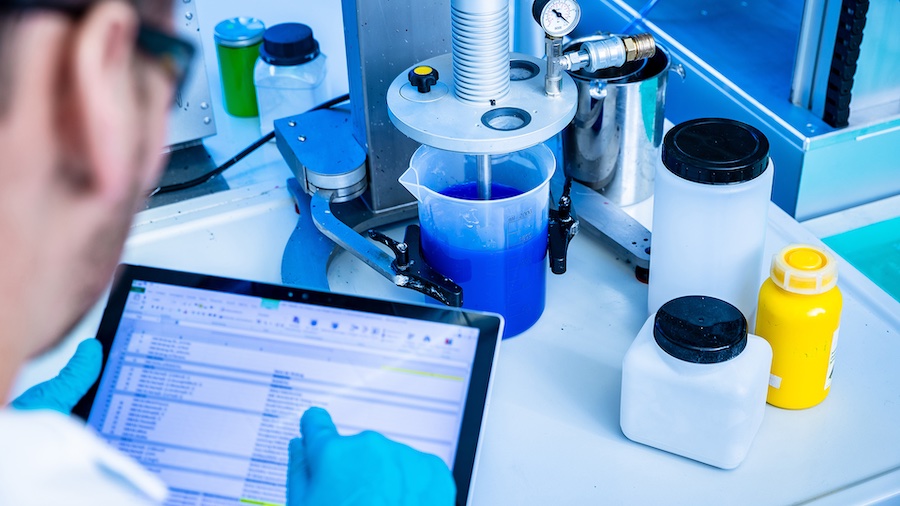
Researchers at Fraunhofer LBF have developed the basic concept for an abrasion machine that generates and collects realistic tire abrasion on rubber samples. Various test benches were analyzed, and requirements derived from real-world driving data were adapted to laboratory conditions. The machine design allows for the adjustment of a wide range of parameters to influence tire abrasion. Particle collection and detection are handled by other APs. To analyze the degradation behavior of tire abrasion under environmental stress, a methodology for weathering the abrasion is being developed. This will enable the collection and detection of volatile organic compounds (VOCs) under UV exposure. The measurement methodology is being further optimized to enable the identification and quantification of VOCs. Both work packages lay the groundwork for evaluation and standardization.