[pageLogInLogOut]

#Research & Development

Hohenstein and DuPont are developing innovative tests for ballistic protective vests
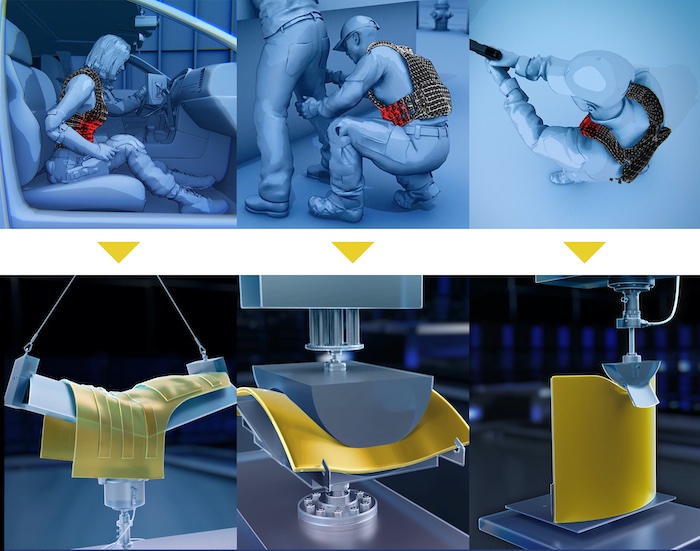
Testing laboratory Hohenstein and DuPont have collaborated to develop three innovative and reliable test methods for soft ballistic inserts. Maximizing the comfort and mobility of body armour, such as bulletproof vests, is key to the performance and endurance for law enforcement and military personnel. The new methods address the disconnect in existing tests with real body movements and positions.
Testing laboratory Hohenstein and DuPont have collaborated to develop three innovative and reliable test methods for soft ballistic inserts: The Lower Costal Bending (LCB) test, the Double Curvature Compression (DCC) test and the Edge Pressure (EP) test. Picture: Courtesy of DuPont ©2024


An interdisciplinary and intercompany team of DuPont and Hohenstein experts developed the test methods, which guarantee a reliable assessment of the specific ergonomic comfort characteristics. “It is in the DNA of Hohenstein to get as close as possible to the user’s reality,” said Dr. Jan Beringer, Senior Scientific Expert at Hohenstein. “With dedicated wear trials, possible discomfort and movement restrictions were determined. Then, leveraging on decades of expertise, tests and equipment to simulate the wearer's experience were designed, in close collaboration between DuPont and Hohenstein.”

"To meet the critical needs of law enforcement and military personnel, maximizing comfort and flexibility in soft ballistic solutions is essential. Developing test methods to evaluate pain and mobility constraints is an important first step. By leveraging Hohenstein's recognized expertise in textile and wearability, we can advance these solutions to the industry and enhance wearer comfort, allowing personnel to perform their duties with greater efficiency," said Christophe Djololian, Global Market Development Leader at DuPont.

Three Comfort and Mobility Tests

The Lower Costal Bending (LCB) test replicates the bending movement of an upper body. On duty, movements involving multiple bends lead to energy loss and accelerated exhaustion for the wearer. The LCB test quantifies lost energy due to the stiffness of a ballistic garment.

To maximize mobility, ballistic solutions must adapt to the wearer's body. The Double Curvature Compression (DCC) test replicates the shape of a curved torso and uses digital imaging to assess the gear’s adaptability and mobility in applicable user situations.

Where the edges of a ballistic vest meet the body - on the lower abdomen, neck or arm - the pressure can cause discomfort. The Edge Pressure (EP) test replicates the shape of the arm and the curvature of a ballistic vest. The EP test quantifies discomfort generated at localised pressure points.

The three test methods to characterize Comfort & Mobility constraint for soft ballistic applications are available from Hohenstein. “Depending on the requirements, we offer different solutions,” explains Dr. Jan Beringer. “Certified third party and independent testing can be carried out by the experts in Hohenstein's PPE labs, on specially designed equipment. The test devices are also available for purchase to facilitate product development by body armour manufacturers and solution assessment by end-users.”



More News from Hohenstein Institute

#Research & Development

A smarter way to verified Chemical Compliance

Hohenstein and GoBlu Drive Innovation in Sustainable Supply Chain Management As regulatory demands, customer expectations, and sustainability goals continue to grow, the ability to manage chemical compliance and data across complex supply chains has become critical. Hohenstein and The BHive® by GoBlu are initiating a strategic partnership to enhance chemical management in the textile sector. The collaboration delivers more than just a service – it provides an integrated, future-ready solution for brands, manufacturers and suppliers seeking trusted chemical management and credible sustainability.

#Research & Development

Hohenstein achieves GLP Certification for Medical Device Testing

Since the middle of July, the testing service provider Hohenstein has been certified to conduct medical device testing in accordance with the internationally recognised Good Laboratory Practice (GLP) standard. This certification comprehensively covers chemical, physical and biological safety testing of medical devices.

#Research & Development

Hohenstein supports Global Textile Scheme Initiative

Global testing and research provider Hohenstein has acquired shares in Global Textile Scheme GmbH (GTS). In this way, Hohenstein aims to support GTS in harmonizing and automating data exchange along the entire supply chain. The aim of the GTS initiative is to create an international standard for handling structured product data in the textile and apparel industry.

#Research & Development

Hohenstein releases 2024 sustainability report

Responsible action is a defining value for Hohenstein, a global testing and research provider. Their 2024 Sustainability Report provides transparency through documented progress and detailed insights into how sustainability is embedded. It covers both the existing sustainability measures at the German headquarters and the company's goals for 2025 and beyond. The direct and indirect greenhouse gas emissions (Scope 1, 2 and 3) of all its locations worldwide were recorded for the first time.

More News on Research & Development

#Research & Development

Kick-off for the Textile Production of the Future: Establishment of a Textile Technology and Development Centre in Mönchengladbach, Germany

The Institut für Textiltechnik (ITA) of RWTH Aachen University, together with its partners, is pleased to announce that it has received approval for its joint initiative, ‘Textile Factory 7.0’. The goal of the project is the establishment of a technology and development centre for the textile industry in Mönchengladbach.

#Research & Development

Bio-based fibers with good flame retardancy

Fibers made from bio-based plastics reduce dependence on fossil raw materials and promote the circular economy. The covalent bonding of flame-retardant additives can open the way for these fibers to enter the mass market.

#Research & Development

Exchange data between textile companies openly, securely and cost-effectively without a central platform – ITA makes it possible

The Institut für Textiltechnik (ITA) of RWTH Aachen University has launched a new demonstrator for an open and secure data space in the textile industry at the Digital Innovation Centre Europe (DICE). For the first time, the demonstrator shows directly and clearly how companies can share their data securely with each other without the need for a central platform. Data exchange is based on shared, freely usable technical foundations.

#Research & Development

Sustainable athletic wear made from bio-based Polyethylene

Conventional sports textiles made from petroleum-based synthetic fibres are to be replaced in the future by sustainable, bio-based, cooling textiles. Polyethylene, previously used mainly in the packaging industry, is thus qualified for use in textiles and, as a bio-based drop-in solution, offers a cost-effective, sustainable alternative for the future.

Latest News

#Sustainability

VAUDE eliminates PFAS from all products

PFAS (per- and polyfluoroalkyl substances) are now detectable worldwide – in drinking water, soil and the human body. These so-called “forever chemicals” are considered hazardous to health and potentially carcinogenic, as they do not break down and remain in the environment permanently. Despite these risks, PFAS are still used in a wide range of products. More than 15 years ago, VAUDE made a strategic decision to gradually eliminate PFAS from all product categories.

#Man-Made Fibers

Lenzing AG to become majority owner of TreeToTextile AB and accelerates industrialization of new fibers

The Lenzing Group is taking another strategic milestone by acquiring a controlling majority in the Swedish innovation company TreeToTextile AB. This step strengthens Lenzing’s position as a leading provider of sustainable, wood‑based specialty fibers and expands its innovation pipeline with a highly scalable, patent‑protected technology platform. The transaction is executed through the issuance of new shares.

#

Better Cotton Initiative marks certification anniversary with progress update and accreditation

One year since becoming a certification scheme, the Better Cotton Initiative (BCI) has announced that more than 3,000 supply chain actors have been certified. At farm level, more than 30% of farms and producer units supplying BCI Cotton have received a positive audit outcome.

#Raw Materials

Cotton Incorporated appoints Bev Sylvester as Chief Marketing Officer

Cotton Incorporated announces the appointment of Bev Sylvester as chief marketing officer. In this newly created role, Sylvester will oversee Cotton Incorporated’s marketing strategy, brand positioning, consumer engagement and global outreach to increase demand for cotton and strengthen its relevance in the marketplace.

TOP