[pageLogInLogOut]

#Research & Development

More sustainability in the polymer industry – Fraunhofer PAZ inaugurates expansion building
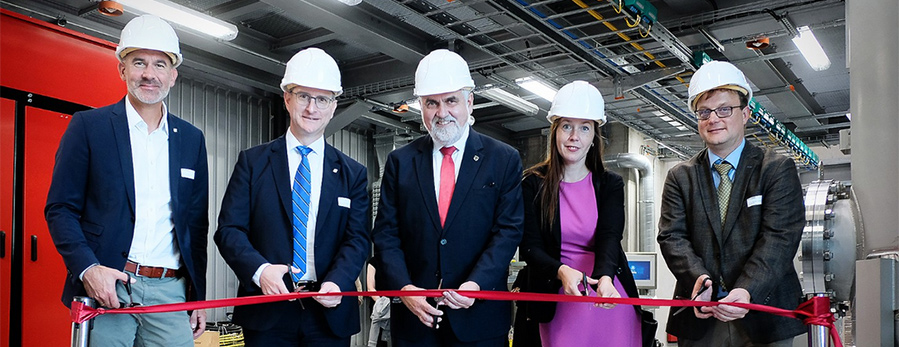
© Fraunhofer IAP, Photo: Till Budde
Prof. Klingner, Director of Research of the Fraunhofer-Gesellschaft, Prof. Böker, Director of the Fraunhofer IAP, Minister of Science Prof. Willingmann, Head of Department of Internal Administration and Public Order of the Saalekreis district Kleinert and Prof. Bartke, Director of the Fraunhofer PAZ jointly inaugurated the extension building of the Fraunhofer PAZ.
The new expansion building of the synthesis plant of the Fraunhofer Pilot Plant Center for Polymer Synthesis and Processing PAZ in Schkopau was ceremonially inaugurated on September 21, 2023. With an additional area of approximately 550 m2, the building provides space for new equipment and processes. Research and development work focuses on innovative synthetic rubbers and energy-efficient synthesis processes.

The new building was financed with around 7 million euros from funds provided by the European Union (ERDF), the Ministry of Science, Energy, Climate Protection and the Environment of the state of Saxony-Anhalt and the German Federal Ministry of Education and Research.

The Fraunhofer PAZ in Schkopau combines the expertise in polymer synthesis of the Fraunhofer Institute for Applied Polymer Research IAP (Potsdam) and in polymer processing of the Fraunhofer Institute for Microstructure of Materials and Systems IMWS (Halle/Saale) as a joint facility. With the possibility of transferring processes to industrial pilot scale, innovative and tailor-made polymer solutions for various industrial sectors are developed here and scientific findings are put into practice. Applications range from (bio)plastics and elastomers to functional polymers for applications in areas such as automotive engineering, electronics, medical technology, packaging and more. These polymer materials play a crucial role in the implementation of global goals such as the energy transition, the promotion of a future-oriented mobility and bioeconomy, and the strengthening of sustainability.

In the Fraunhofer PAZ's synthesis department, experts develop new processes and polymer materials and transfer them from laboratory to pilot plant scale. The new building opens up a multitude of potentials.

Today, it was inaugurated with a ceremony in the presence of Prof. Dr. Armin Willingmann, Minister for Science, Energy, Climate Protection and the Environment of the State of Saxony-Anhalt, Christina Kleinert, Head of the Department of Internal Administration and Public Order of the Saalekreis district, and Prof. Dr. Raoul Klingner, Director of Research, Fraunhofer-Gesellschaft, as well as renowned guests from industry, science and politics.

Minister Willingmann said: "Saxony-Anhalt combines tradition and modernity when it comes to plastics. Polymers have been produced and processed in Schkopau for 85 years; even today, our state is one of the world's leading centers of expertise in this field. A very central component is the Fraunhofer Pilot Plant Center, which conducts research on the plastics of the future with international relevance. The researchers in Schkopau focus primarily on sustainability. The expansion of the Fraunhofer PAZ thus strengthens our research landscape and is also an investment in a more climate-friendly economy."


More sustainable polymer synthesis up to the ton scale

Prof. Alexander Böker, the director of the Fraunhofer IAP, explained: "With state-of-the-art pilot plants, we can synthesize sample quantities of polymers up to the ton range at the Fraunhofer PAZ and thus support our regional, national and international customers in advancing new products and processes. In this way, we build an important bridge between research and industrial application. We place particular emphasis on establishing sustainable processes and materials and making an important contribution to a future-oriented circular economy."

"In addition to using renewable raw material sources, a key concern for us is to increase the resource and energy efficiency of our procedures and production processes. This also includes measures to avoid or at least reduce the use of environmentally harmful solvents. We are significantly expanding these focal points with the expansion of the synthesis pilot plant, thus creating an important building block on the path to greater sustainability in the polymer industry," added Prof. Michael Bartke, who heads the Fraunhofer PAZ.

As part of the expansion of activities, the Fraunhofer IAP has created six new positions in the area of synthesis at the Fraunhofer Pilot Plant Center PAZ. In perspective, the expansion enables the entry into parallel operation of the pilot plant and thus the increase of the research volume.

A tour of the Fraunhofer PAZ pilot plants is possible, among other things, as part of the Fraunhofer Technology Day "Scale up Green Chemistry NOW" on November 29, 2023.




More News from TEXDATA International

#Recycling / Circular Economy

textile.4U publishes special edition “Top 100 Textile Recycling Companies 2025”

With a comprehensive 176-page special edition, textile.4U is dedicating its latest issue entirely to one of the most dynamic and influential topics in today’s textile industry: textile recycling. The new issue, published exclusively in high-quality print, presents the Top 100 textile recycling companies researched and selected by TexData – organizations that already play a key role in the transition to circular textiles or are expected to have a significant impact in the near future.

#Recycling / Circular Economy

Responsible Textile Recovery Act of 2024 signed by Governor

Senator Josh Newman (D-Fullerton) is proud to announce that Senate Bill 707 (SB 707), the Responsible Textile Recovery Act of 2024, has been signed into law by the Governor of California, Gavin Newsom. This groundbreaking legislation establishes the country’s first Extended Producer Responsibility (EPR) textile recycling program, marking a significant step forward in the state’s efforts to combat waste and promote sustainability.

#Textiles & Apparel / Garment

Modtissimo promotes sustainability with 28 coordinates in the Green Circle

Modtissimo is proving more and more to be a textile and clothing show that delivers the latest innovations in the area of sustainability, with the iTechStyle Green Circle being the main showcase for companies' creations. In this 60+4 edition, taking place on 12 and 13 September, 28 coordinates will be exhibited in a section organised by CITEVE and curated by Paulo Gomes.

#Europe

The EU and Egypt team up to mobilise private sector investments at Investment Conference and sign a Memorandum of Understanding underpinning €1 billion in macro-financial assistance for Egypt

At the EU-Egypt Investment Conference, co-organised by the EU and the Government of Egypt on 29-30 June, the EU and Egypt are teaming up to intensify private sector investments in Egypt. They are also signing a Memorandum of Understanding (MoU) for the disbursement to Egypt of up to €1 billion in Macro-Financial Assistance.

More News on Research & Development

#Research & Development

Kick-off for the Textile Production of the Future: Establishment of a Textile Technology and Development Centre in Mönchengladbach, Germany

The Institut für Textiltechnik (ITA) of RWTH Aachen University, together with its partners, is pleased to announce that it has received approval for its joint initiative, ‘Textile Factory 7.0’. The goal of the project is the establishment of a technology and development centre for the textile industry in Mönchengladbach.

#Research & Development

Bio-based fibers with good flame retardancy

Fibers made from bio-based plastics reduce dependence on fossil raw materials and promote the circular economy. The covalent bonding of flame-retardant additives can open the way for these fibers to enter the mass market.

#Research & Development

Exchange data between textile companies openly, securely and cost-effectively without a central platform – ITA makes it possible

The Institut für Textiltechnik (ITA) of RWTH Aachen University has launched a new demonstrator for an open and secure data space in the textile industry at the Digital Innovation Centre Europe (DICE). For the first time, the demonstrator shows directly and clearly how companies can share their data securely with each other without the need for a central platform. Data exchange is based on shared, freely usable technical foundations.

#Research & Development

Sustainable athletic wear made from bio-based Polyethylene

Conventional sports textiles made from petroleum-based synthetic fibres are to be replaced in the future by sustainable, bio-based, cooling textiles. Polyethylene, previously used mainly in the packaging industry, is thus qualified for use in textiles and, as a bio-based drop-in solution, offers a cost-effective, sustainable alternative for the future.

Latest News

#Functional Fabrics

“Action helps us change what we do!”

DAY 0 takes place deliberately before PERFORMANCE DAYS begins. It is conceived as a space for reflection, dialogue and active engagement — a moment to pause before the fair, rethink established systems and address sustainability not as a trend, but as a fundamental transformation challenge. Under the guiding metaphor “Turn the Tap Off”, DAY 0 focuses on root causes rather than symptoms, systemic change rather than isolated solutions, and collective responsibility rather than individual silos.

#Textiles & Apparel / Garment

Pets in fashion: functional and sustainable textiles find new market at Intertextile Apparel

China’s pet economy is booming, especially amongst younger generations, and pet apparel – from designer outfits to functional garments – was a RMB 3.5 billion (over USD 500 million) market in 2024, growing more than 20% annually¹. To help exhibitors harness this trend, Intertextile Shanghai Apparel Fabrics – Spring Edition 2026 will launch the Pet Boutique, presenting a range of innovative, sustainable materials that prioritise both functionality and comfort for pets.

#Sustainability

VAUDE eliminates PFAS from all products

PFAS (per- and polyfluoroalkyl substances) are now detectable worldwide – in drinking water, soil and the human body. These so-called “forever chemicals” are considered hazardous to health and potentially carcinogenic, as they do not break down and remain in the environment permanently. Despite these risks, PFAS are still used in a wide range of products. More than 15 years ago, VAUDE made a strategic decision to gradually eliminate PFAS from all product categories.

#Man-Made Fibers

Lenzing AG to become majority owner of TreeToTextile AB and accelerates industrialization of new fibers

The Lenzing Group is taking another strategic milestone by acquiring a controlling majority in the Swedish innovation company TreeToTextile AB. This step strengthens Lenzing’s position as a leading provider of sustainable, wood‑based specialty fibers and expands its innovation pipeline with a highly scalable, patent‑protected technology platform. The transaction is executed through the issuance of new shares.

TOP