[pageLogInLogOut]

#Research & Development

Making the most of sustainable biomass – certification schemes and labels developed in new EU research projects

nova-Institut GmbH announces its participation in two new HORIZON Europe projects – STAR4BBS and BIORECER – which both focus on the development of innovative certification schemes and labels for bio-based feedstock.

Following a successful kick-off meeting in Berlin in September 2022, the new HORIZON Europe research project STAR4BBS sets out to improve sustainability certification schemes (SCS) and labels to support the transition towards a sustainable bio-based economy. Besides identifying suitable indicators, the project focusses on developing a novel biomass monitoring system. The latter supports the assessment of the effectiveness and robustness of established international and EU SCS and B2B labels and their associated traceability systems applicable to biological feedstock, bio-based materials and products.

The knowledge generated will provide the basis for the urgently needed harmonisation of schemes, and increase the transparency of global and EU trade flows.

Shedding light on the biomass label landscape through novel monitoring systems

With industry actors striving to achieve sustainability goals, the bio-based economy is becoming an increasingly important pillar for the transition towards a renewable carbon and zero-pollution economy. To fully realise its potential, guidance is needed to help industry and other actors along the value chain chose best possible solutions for their sustainability goals. This is particularly important in light of an increasing number of international and national regulations, initiatives and agreements related to sustainable biomass and bio-based materials and products that intensify pressure.

In this context, SCS and labels can provide valuable guidance. However, over the past decade an unprecedented landscape of different certification schemes and labels has emerged. While the proliferation of schemes and labels is generally viewed as positive, it has led to an excessive competition between different schemes. This has created confusion for potential users along the value chain, and has increased green washing potential, raising questions about the effectiveness and robustness of current certification schemes. Indicators and the innovative monitoring system developed in STAR4BBS will address these issues and provide evidence and recommendations to encourage the implementation of effective and robust SCS and labels by multiple different stakeholders.


Testing nova´s Biomass Utilisation Factor (BUF) in the BIORECER project

In the course of the following years, nova-experts participate in further EU-projects focussing on certification schemes, e.g. the HORIZON Europe project BIORECER. The project aims at assessing the best possible environmental performance and traceability of biological feedstocks used in the bio-based industry. BIORECER will evaluate the impact of current and established certification schemes on consumers and bio-based industry stakeholders. Furthermore, the project will examine the acceptance of novel value chains from biological feedstocks, including residual feedstock and waste.

The project will further test the suitability of Biomass Utilisation Factor (BUF), developed by nova-Institute in several European research project and finally published in July 2022. This novel indicator enables to capture the circularity of biomass under consideration of both the cascading use principle and the efficiency of the biomass utilisation. The concept is used to calculate how often and how efficient a material is kept in use, starting with the initial biomass input in the first product stage to its use in potential further product stages. BIORECER will validate the effectiveness of BUF and other indicators within four bio-based value chains: pruning from trees, waste from fruit and olive processing, by-products from cereal crops and by-products from fodder and industrial crops. 

Find the full publication on the Biomass-Utilisation Factor and other nova publications at https://renewable-carbon.eu/publications/.  



STAR4BBS (Grant Agreement Number 101060588) and BIORECER (Grant Agreement Number 101060684) both receive funding from the European Union's HORIZON Europe Framework Programme.
More News from TEXDATA International

#ITM 2026

ITM 2026: The new geography of textile production

New production hubs are emerging across North Africa and Central Asia, while Türkiye is accelerating its transformation toward higher-value, technology-driven and more sustainable textile manufacturing.

#Research & Development

“Production is a product”

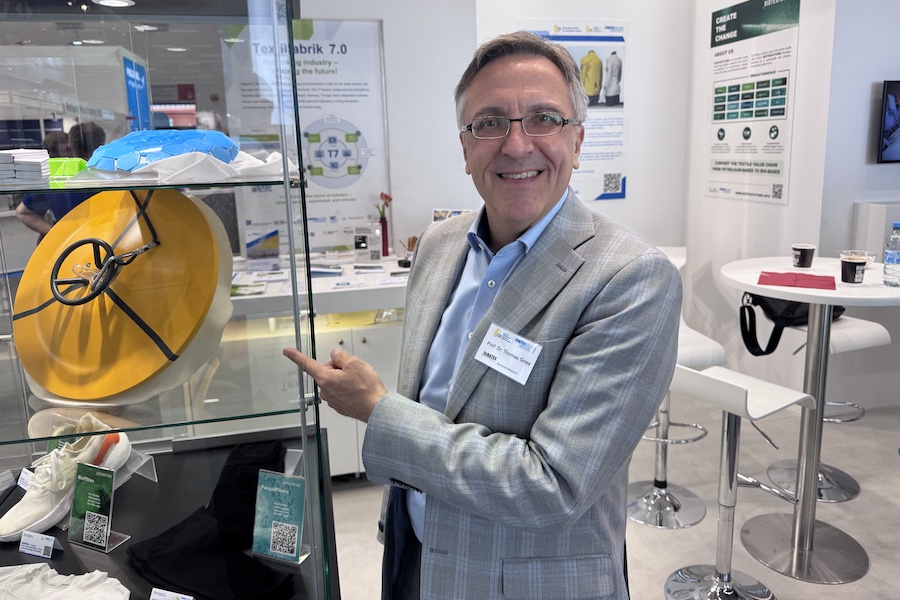
From technical textiles and AI-driven robotics to the limitations of textile circularity: Professor Dr Thomas Gries looks back on more than two decades of development at ITA Aachen. In the interview, he explains why production technology remains a decisive success factor, discusses international collaborations and innovation ecosystems, and shares his views on the transformation of production landscapes and the challenges facing an increasingly regulated industry.

#Knitting & Hosiery

“We need to move away from the price trap and return to a value-driven mindset.”

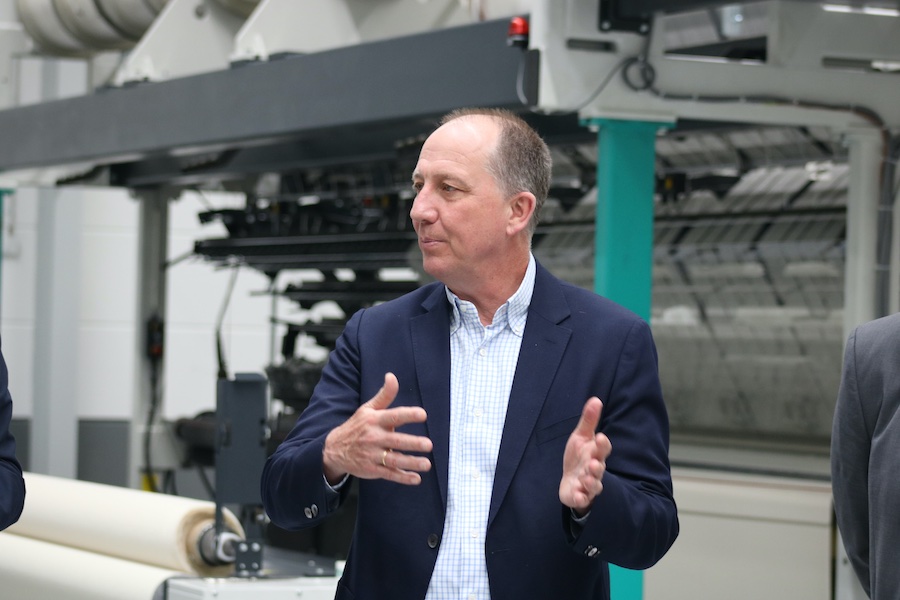
With its new Textile Innovation Center, KARL MAYER is sending a strong signal for innovation, collaboration, and the future of textile applications. In this interview, Karl Josef Mayer discusses new opportunities in warp knitting, the processing of staple fibres, recycling, the changing role of machinery manufacturers, and why the textile industry must once again focus more strongly on the value of textiles. by Oliver Schmidt

#Associations

“Innovation, resilience and international experience remain the great strengths of the Swiss textile machinery industry”

Geopolitical uncertainty, growing competitive pressure from China, new free trade agreements and the shift towards a circular economy are currently reshaping the global textile industry. In this interview, Cornelia Buchwalder discusses the current mood within the Swiss textile machinery sector, the industry’s distinctive innovative strength, new market opportunities in India and Asia, and the technological trends that could shape the upcoming trade fair cycle leading up to ITMA 2027.

More News on Research & Development

#Research & Development

TCLF: Resilient value chains in times of crises

The textiles, clothing, leather and footwear (TCLF) industry was at the centre of the webinar “Resilient value chains in times of crises”, which took place on 28 April 2026. Global supply chains continue to face increasing pressure, raw material dependencies are growing and economic uncertainties are affecting the entire sector.

#Research & Development

Textile climate control system in workwear – exhibition at the 2026 SME Innovation Day!

Conventional protective workwear often reaches its limits during strenuous physical activity. In particular, the transport of sweat and excess body heat poses a problem. The German Institutes of Textile and Fiber Research (DITF) conducted research on flow-optimized, air-conducting textile structures that enable targeted climate control directly on the body. These structures can be integrated straight into protective work garments. The textile climate control system supports the body’s natural thermoregulation. This contributes to improved workplace safety and comfort.

#Research & Development

Elastic yarns to become more recyclable and environmentally friendly in future

On 29 April 2026, ITA student Tobias Dickmeiß was awarded a sponsorship prize by the Wilhelm Lorch-Stiftung for his innovative approach, to replacing conventional elastane with elastic yarns made from thermoplastic copolyester elastomers (TPC). Thanks to their thermoplastic nature and compatibility with typical polyesters used in the textile industry, elastic TPC yarns offer improved recyclability. Furthermore, the use of the melt-spinning process in yarn production eliminates the need for solvents that are harmful to the environment and human health.

#Research & Development

Walter Reiners Foundation Prize awarded to three ITA graduates

Sabina Dann, Lukas Balon and Annegret Storm from the Institut für Textiltechnik (ITA) of RWTH Aachen University were awarded the Walter Reiners Foundation Prize by the German Engineering Federation (VDMA) for their master’s and bachelor’s theses. Peter Dornier, Chairman of the Walter Reiners Foundation, presented the awards during Techtextil at the VDMA stand in Frankfurt am Main, Germany.

Latest News

TOP