#Recycling / Circular Economy
STADLER: collaboration across the value chain is key to achieving a circular economy
“The pressure to reduce waste, recycle more, and move towards a closed-loop circular economy is unprecedented,” states Willi Stadler, CEO of the STADLER Group. “At STADLER, we believe that for progress to be made towards this goal, the effective collaboration of all the members of the value chain is essential – this means the involvement and coordination of industry associations, authorities at local and government level, the European Commission, research institutes and universities, designers and users of the products and packaging, suppliers of sorting plants and technologies like us, and the recycling industry as whole. As a plant and equipment manufacturer, STADLER’s primary role in the chain is to support the recycling industry with our high-performance sorting systems. We believe that, in doing this, we can make a big difference by acting as a link between key elements of the value chain.”
STADLER is constantly searching for new ways of helping the recycling industry expand its scope and effectiveness. To this end, it takes part in research projects to explore solutions to recycle more materials from different waste streams. “Working with partners, such as universities and research institutes, significantly strengthens our position as a plant and equipment manufacturer. It drives innovation by providing access to research and multidisciplinary expertise. Thereby our products can be improved. Since innovation is key in our industry, this is a very important factor,” explainsJulia Stadler, CDO of the STADLER Group.
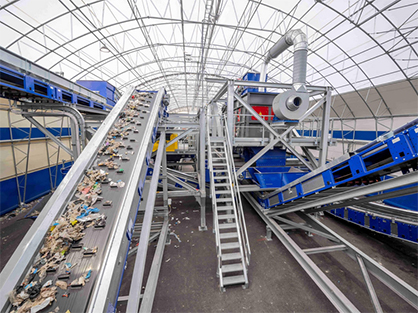
Collaborations across the recycling chain drive progress towards the circular economy
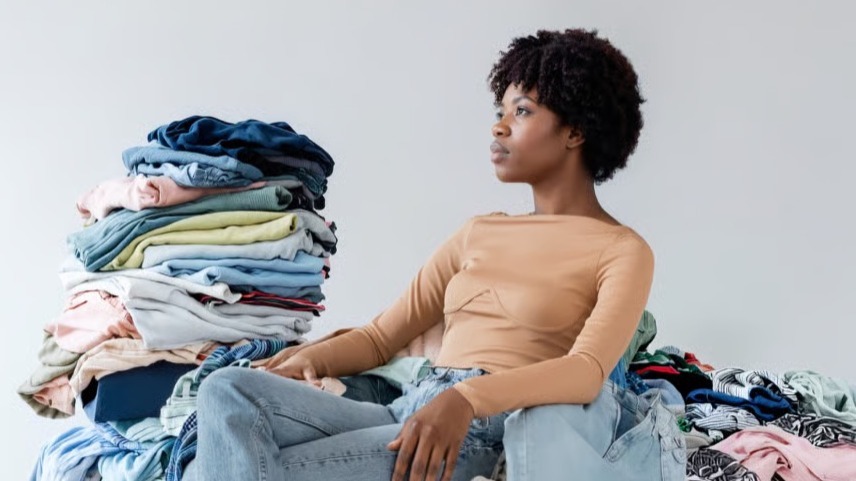
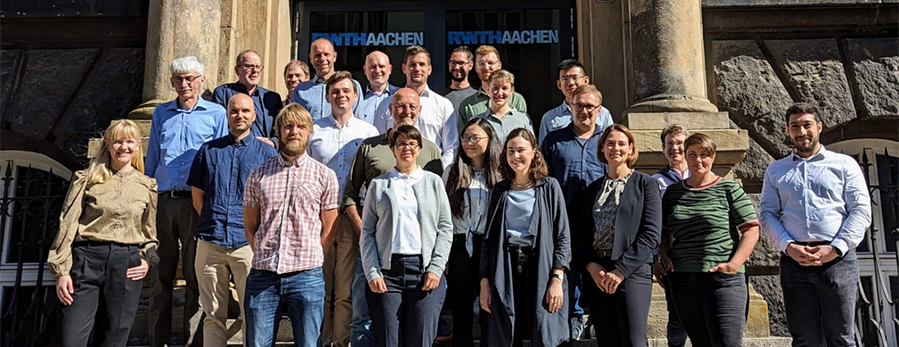
STADLER’s research collaborations break new ground in a wide range of fields, also helping to develop solutions for materials that present complexity for the recycling process. This is the case with textiles, which pose a challenge for recycling due to the extreme variety of materials and are currently predominantly incinerated or sent to landfill. STADLER has designed and built the first industrial-scale fully automated mixed textile waste plant in the world in Sweden and is actively involved in further research. It is taking part in projects such as “EOL-Model”, in which it is playing a key role in tests conducted at the Institute of Textile Technology (ITA) at RWTH Aachen University in collaboration with several companies along the textile recycling chain. The project uses near-infrared (NIR) spectroscopy to analyse textiles with a focus on mixed materials containing polyester. Amrei Becker, researcher at the ITA, explains: "Our tests were made possible thanks to STADLER. We were supported in the evaluation by the company's experienced employees and were thus able to show that the NIR spectra of blended textiles actually differ and that different blends, for example, polyester and cotton, can be detected with accuracy in the low percentages."
Paper is another material that presents its own challenges, and STADLER’s work with RWTH Aachen University on the EnEWA project, which started in 2021, is contributing to unlocking the untapped potential of obtaining recyclable paper from the lightweight packaging, residual and commercial waste streams.
STADLER is also very active in researching other sectors, such as plastic waste, where the process is well established, but still presents large potential for further improvement. STADLER is one of 18 research institutes, associations, and industrial partners participating in the ReVise-UP project funded by the German Federal Ministry of Education and Research (BMBF). The objective of the project, which started in September 2023, is to improve the process efficiency of mechanical recycling of post-consumer plastic packaging waste through intelligent material flow management. It uses inline sensor technologies to track the path of plastic packaging after its use phase. ReVise-UP aims to achieve its objective by developing and demonstrating sensor-based material flow characterization methods on an industrial scale, with the recorded data streams intended to create incentives for better collection and recyclate quality.
STADLER is also collaborating with the international consultancy RecycleMe with the aim of determining the recyclability of packaging in a unique alliance along the recycling value chain. Through this partnership, STADLER’s Test and Innovation Centre in Slovenia offers customers of RecycleMe the opportunity to analyse the sorting behaviour of their packaging under current and real-life conditions. "Our cooperation with STADLER allows us to conduct sorting tests under the best conditions, using the latest technology, simulating the sorting process in practice and with representative packaging quantities," says Sabrina Goebel, Managing Director at RecycleMe. "This will enable us to further increase the quality of the results in our recyclability analysis and optimization of packaging."
Plastic food packaging is another area that presents particular challenges for the recycling process because it often consists of multiple layers of different polymers, each contributing a specific functionality to the overall packaging. The strong physical attachment of these layers means that separation to polymer level is not always possible, hindering mechanical recycling. Today, the main valorisation of these multilayer packages is through incineration with energy recovery. STADLER is taking part in a new Flemish project, Multi2Recycle (coordinated by Pack4Food), to evaluate the recyclability of multilayer flexible food packaging materials in function of their composition and the resulting shelf life of food products. Value chain thinking is central to the Multi2Recycle project.
STADLER’s wide-ranging approach to the global plastic waste issue extends beyond the established waste collection channels. In November 2023, it started a collaboration with everwave, the German start-up with the mission of combating plastic waste in rivers and oceans. The aim is to combine STADLER’s solutions in plant engineering with everwave’s holistic approach to protecting the environment from waste with a focus on emerging and developing countries. In this collaboration, STADLER will develop and test a flexible solution for a mobile sorting container in order to set up a low-threshold infrastructure for waste management.
Developing the experts of the future
Working with universities and schools is also important for STADLER, not only as an accelerator of innovation but also as a contribution to developing the experts of the future. These initiatives take different forms – from delivering lectures and seminars to creating practical and engaging learning experiences.
STADLER collaborates with several schools in Altshausen, where the company is headquartered. Willi Stadler explains: “Initiatives such as our new “Wissensfabrik” – The Knowledge Factory – joint project with the Herzog-Philipp-Verbandsschule elementary and middle schoolenable us to give children and young people an understanding of STEM professions. The majority of our apprentices come from these local schools, and the children of today are our experts of tomorrow. That’s why it is so important that we support the local and regional schools. The environmental problems and challenges must be approached in a future-oriented way and that is how we at STADLER act in everything we do.”
Another example of educational collaborations is the STADLER Summer School. The first edition was held at the company’s Test and Innovation Centre in Slovenia in September 2023 in partnership with Lindner Recyclingtech, TOMRA Recycling and STEINERT. During the 5-day session, the 15 participating students, coming from 7 universities, had the opportunity to independently set up and operate a complete process chain to convert the input material into appropriate product fractions. “The students’ and our partners' commitment to innovation in sorting technology, resource efficiency and recycling equipment made this program exceptional,” comments Willi Stadler.
A holistic approach to contributing towards the circular economy
STADLER’s wide-ranging collaborations stem from its holistic view of the roadmap to the circular economy, which it believes requires the active participation and coordination of the different players in the recycling chain.
“As 2023 comes to an end and I look back at what we have achieved, I am proud of the work that STADLER has done in collaboration with so many great partners and institutions. I want to thank them all for giving us the opportunity to be a part of all these projects and work together to make the circular economy a reality,” concludes Willi Stadler.