[pageLogInLogOut]

#Associations

“Innovation, resilience and international experience remain the great strengths of the Swiss textile machinery industry”
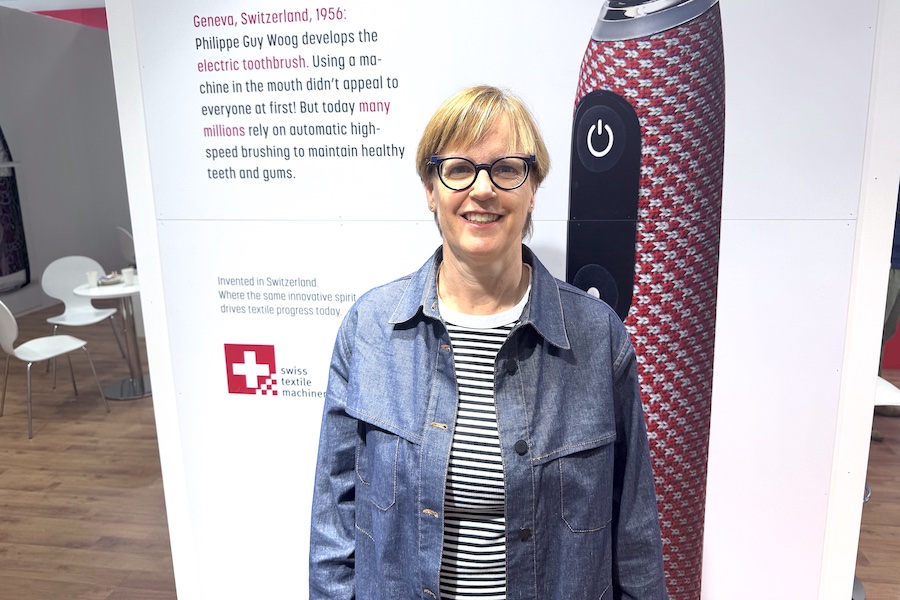
Cornelia Buchwalder © 2026 TexData International
Geopolitical uncertainty, growing competitive pressure from China, new free trade agreements and the shift towards a circular economy are currently reshaping the global textile industry. In this interview, Cornelia Buchwalder discusses the current mood within the Swiss textile machinery sector, the industry’s distinctive innovative strength, new market opportunities in India and Asia, and the technological trends that could shape the upcoming trade fair cycle leading up to ITMA 2027.

Interview

Cornelia Buchwalder

Secretary General

Swiss Textile Machinery Association / Swissmem

by Oliver Schmidt

1. Ms. Buchwalder, after several months of sabbatical, you recently returned to your role as Secretary General of Swiss Textile Machinery. Looking at the Swiss textile machinery industry with a bit of distance, how would you describe the current mood in the sector – and what developments have stood out to you most?

Naturally, my return was initially overshadowed by current geopolitical developments. I came back at the beginning of March – exactly at a time when new uncertainties were emerging and the global environment had once again changed noticeably. For an internationally oriented industry such as Swiss textile machinery, developments like these have an immediate impact on supply chains, investment decisions and overall market sentiment.

What stood out to me most among our member companies was a remarkable level of resilience and a continued positive spirit. The economic situation remains challenging, without question. Many markets are still characterised by caution, and uncertainty makes long-term planning difficult. Nevertheless, companies are continuing to move forward consistently. Projects are there, initial signs of recovery are becoming visible, and topics such as automation, digitalisation and more sustainable production processes continue to be actively advanced.

What also impresses me is the attitude of many companies. Despite all the challenges, the focus remains clearly on solutions, innovation and customer needs. Especially in times like these, that is anything but self-evident – and in my view, it is also one of the particular strengths of the Swiss textile machinery industry.


2. The global textile industry continues to operate in a challenging environment shaped by geopolitical tensions, changing trade relations and a high degree of uncertainty. How is this situation currently affecting Swiss textile machinery manufacturers?

Uncertainty is probably the greatest challenge at the moment. Many companies tell me that even a difficult situation would be easier to manage if it were at least stable and predictable over a longer period of time. That is exactly what is often missing today. Trade relations can change within a matter of weeks, new tariffs are introduced or withdrawn again, political tensions influence investment decisions – and all of this makes strategic planning extremely difficult.

Naturally, this situation directly affects customers’ willingness to invest. In many markets we still see a cautious approach, while overcapacities and weaker demand continue to weigh on parts of the industry. In Switzerland, there is the additional challenge of the strong Swiss franc, which repeatedly creates further pressure for export-oriented companies.

Despite these challenges, I currently sense a slightly more positive mood among many of our member companies. Developments are certainly coming from a low level and definitely not with any sense of euphoria, but initial signs of recovery are visible. There are more project discussions again, more concrete enquiries and, in some cases, the first positive signals in incoming orders.


3. Swiss companies have played an outstanding role in the international textile machinery industry for decades. How can this strong industrial cluster be explained – and what still distinguishes Swiss textile machinery today?

Interestingly, the origins of the Swiss textile machinery industry go back a very long way and are also linked to the international trade policies of that period.

During Napoleon’s Continental Blockade, many machines could no longer be imported from England, which at the time was regarded as the leading textile nation. Swiss textile companies therefore began developing their own machines or repairing and improving existing equipment. Over time, this led to the development of an independent mechanical engineering expertise that became firmly established in Switzerland.

Of course, this industry could also have disappeared again over time. Instead, an exceptionally strong industrial ecosystem developed over many decades. This includes not only the machinery manufacturers themselves, but also specialised suppliers, a strong academic and research landscape, and the typical Swiss engineering expertise that is also well known from other industries.

Another key factor is the strong international orientation. Switzerland never had a sufficiently large domestic market to focus only on local demand. Swiss companies therefore had to think internationally and establish global trade relationships at a very early stage. This export-oriented mindset has shaped the Swiss textile machinery industry for generations and has certainly contributed to the exceptional international experience many companies possess today.

Added to this are factors such as quality, precision, reliability and long-term thinking. At the same time, companies have repeatedly had to adapt to changing market cycles, technological shifts and global transformations over the decades. In my view, this combination of innovative strength, specialisation and international experience explains very well why Swiss textile machinery continues to hold such a strong global position today.

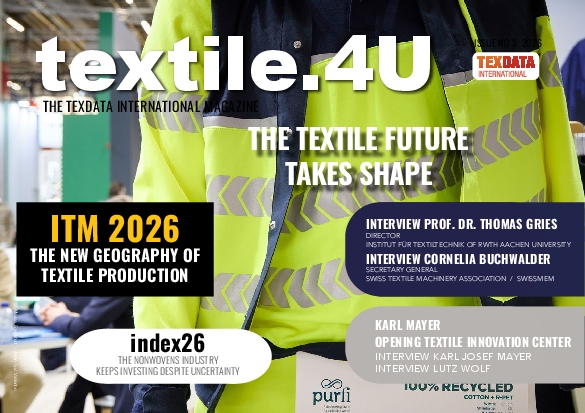
The full article can be read in the latest issue of textile.4U, available for free download here:
More News from TEXDATA International

#ITM 2026

ITM 2026: The new geography of textile production

New production hubs are emerging across North Africa and Central Asia, while Türkiye is accelerating its transformation toward higher-value, technology-driven and more sustainable textile manufacturing.

#Research & Development

“Production is a product”

From technical textiles and AI-driven robotics to the limitations of textile circularity: Professor Dr Thomas Gries looks back on more than two decades of development at ITA Aachen. In the interview, he explains why production technology remains a decisive success factor, discusses international collaborations and innovation ecosystems, and shares his views on the transformation of production landscapes and the challenges facing an increasingly regulated industry.

#Knitting & Hosiery

“We need to move away from the price trap and return to a value-driven mindset.”

With its new Textile Innovation Center, KARL MAYER is sending a strong signal for innovation, collaboration, and the future of textile applications. In this interview, Karl Josef Mayer discusses new opportunities in warp knitting, the processing of staple fibres, recycling, the changing role of machinery manufacturers, and why the textile industry must once again focus more strongly on the value of textiles. by Oliver Schmidt

#Technical Textiles

“ We have multiple companies and divisions operating in textiles, and we decided to integrate them into one platform. ”

At Techtextil 2026, the Aditya Birla Group presented its textile activities as a unified platform for the first time. In this interview, Kapil Agrawal, Business Head Textiles, Acrylic Fibres & Overseas Spinning, explains how the group is expanding from traditional textile products towards integrated technical textile solutions, circularity and higher-value applications – and outlines the role India could play in scaling fibre-to-fibre recycling in the years ahead.

More News on Associations

#Associations

Mongolia: Workshop on Italian textile technologies kicks off in Ulaanbaatar

The workshop dedicated to Italian textile technologies will kick off in Ulaanbaatar from 21 to 23 June 2026. Focused on the most advanced innovative solutions for the textile industry, the initiative will bring together 13 Italian textile machinery manufacturers, confirming the growing interest in strengthening industrial cooperation between the two countries and highlighting Mongolia’s strategic importance for Italian textile machinery producers.

#Associations

Towards pragmatic and harmonised labelling in the EU

EDANA, alongside 14 European associations, urges the European Commission and Member States to adopt a pragmatic approach for the future harmonised packaging labels, in line with the EU’s agenda for the EU Single Market, simplification and competitiveness. The system should rely on text-free pictograms, available in achromatic or monochromatic versions matching the packaging palette, with the possibility of using digital labelling as a core element. Our associations represent manufacturers of consumer goods across Europe.

#Associations

Textile PRO Forum calls for greater harmonisation of textile EPR systems across Europe

The Textile PRO Forum has published a new analysis highlighting the need for greater harmonisation of textile Extended Producer Responsibility systems across Europe. The document, Toward harmonised Textile EPR Systems in Europe: analysis and recommendations, presents the results of work carried out by Workstream 1 of the Textile PRO Forum, led by Dr. Eng. Viola Corbellini, Strategic Development and Innovation Expert at Erion Textiles, and Eng. Luca Campadello, General Director at Erion Textiles. The workstream focused on reducing administrative burden for textile producers by identifying areas where procedures could be better aligned across countries.

#Associations

Mario Jorge Machado re-elected President of EURATEX

The EURATEX General Assembly has re-elected Mario Jorge Machado as President of EURATEX, renewing its confidence in his leadership at a crucial moment for the European textile and clothing industry. The sector is facing rising costs, global competitive pressure and an increasingly challenging transition towards sustainability and digitalisation.

Latest News

#Research & Development

2026 general meeting of the Friends and Supporters of RWTH Aachen at ITA

The Friends and Supporters of RWTH Aachen e. V. (proRWTH) looked back on a successful year of support at their 2026 general meeting. The meeting took place at Institut für Textiltechnik (ITA) of RWTH Aachen and was combined with a joint session of the Executive Board and the Administrative Board. Before the general meeting began, participants were given a guided tour of ITA, providing them with fascinating insights into current research and development topics in textile engineering.

#Natural Fibers

Cotton ConneXions Insight to Impact brings supply chain leaders together around cotton innovation

Cotton Incorporated’s Cotton ConneXions Insight to Impact brought together more than 300 industry leaders from 140 companies across 10 countries, including more than 45 top global brands and sourcing organizations, underscoring strong global interest in cotton-rich product development, sourcing and supply chain collaboration.

#Knitting & Hosiery

Footwear innovation enabled by warp knitting technology– insights from New Balance

The future of the athletic shoe is increasingly being shaped on warp knitting machines. For KARL MAYER, the footwear industry is one of the most important growth markets – and one of the sectors where innovative textiles can realize their full potential. In his keynote address at the opening of KARL MAYER’s TEXTILE INNOVATION CENTER in Obertshausen in April, Vishnu Prakash Muthusamy, Senior Textile and Materials Engineer at New Balance, explained the opportunities that warp knitting technology opens up for performance, sustainability, and faster development processes, and why textile manufacturers are transitioning from suppliers to development partners.

#Natural Fibers

Cashmere specialist joins AbTF Board of Trustees

The Aid by Trade Foundation (AbTF) is pleased to welcome Brian Yu, the chief executive officer of the Artwell Group, to its board of trustees. As CEO, Brian Yu developed Artwell into the world’s largest supplier of responsibly produced cashmere knitwear.

TOP