[pageLogInLogOut]

#Recycling / Circular Economy

Managed workwear services are providing a blueprint for the circular textile economy
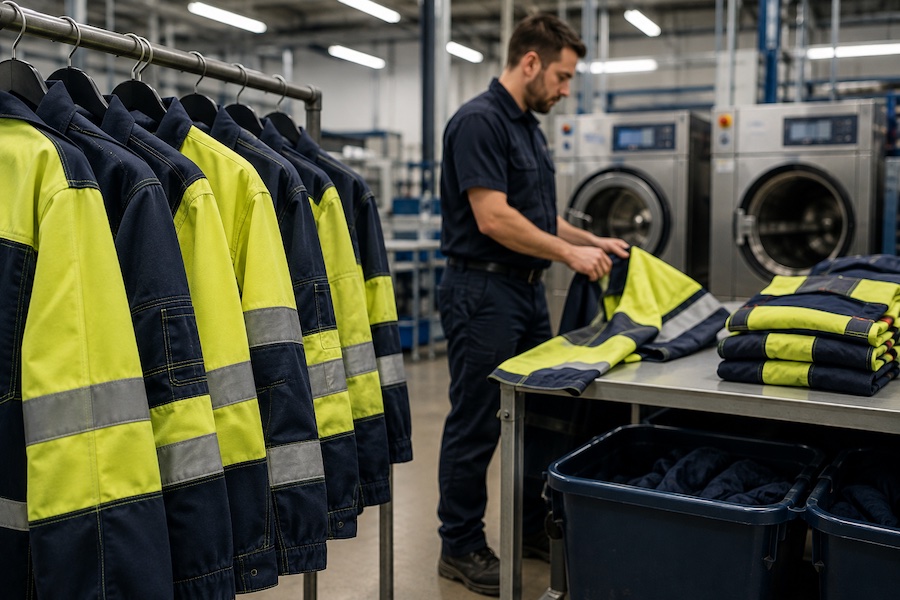
Workwear services © 2026 TexData International
Managed workwear service providers are demonstrating how commercial success and circularity can go hand in hand by extending garment lifespans through repair, laundering, reuse and recycling, according to “Managed workwear services—a circular textile economy ahead of the game”, a new 14‑page report from the global business information company Textiles Intelligence.


Across Europe, a number of companies have transformed workwear from a manufacturing business into one based on managed services. Rather than just supplying garments, these companies retain ownership of the garments throughout their working lives, taking responsibility for tracking, laundering, repairing, replacing and, ultimately, recycling.

As a result, these companies have created one of the textile industry’s most mature examples of a circular business model.

Unlike conventional apparel manufacturers, managed workwear service providers generate value by extending the useful life of every garment for as long as possible. Consequently, garments are designed to withstand hundreds of industrial laundering cycles, to provide comfort, to maintain compliance with safety standards, and to be easy to repair.

At the same time, managed workwear service providers have evolved into highly sophisticated logistics businesses. Technologies such as radio frequency identification (RFID), automated sorting systems and digital inventory management enable garments to be tracked throughout their service lives, thereby helping to maximise garment longevity, reduce operating costs and minimise environmental impact.

By retaining ownership of garments from manufacture to end-of-life recovery, managed workwear service providers have developed a complete business model for traceability, maintenance and recycling in a form which much of the wider apparel industry is only just beginning to establish. Actively driving this business model are several leading European companies, including Alsico, CWS Workwear, Elis, Fristads, Lindström, Mascot and Mewa.

As a result, managed workwear services provide one of the clearest examples of how circularity can be achieved on a commercial scale. And while this business model is not directly applicable to every sector of the apparel industry, it demonstrates that retaining ownership of garments creates strong commercial incentives to maximise durability, facilitate repair and recover valuable materials.

“Managed workwear services—a circular textile economy ahead of the game” is available for purchase from the global business information company Textiles Intelligence and costs £198 (UK), Euro355 (Europe, Middle East or Africa) or US$465 (Americas or Asia Pacific). For further information or to purchase this report, visit https://bit.ly/4fFEEVT 


More News from Textiles Intelligence Ltd

More News on Recycling / Circular Economy

#Recycling / Circular Economy

Eco-design as the foundation of circular textiles

Based on the results of an extensive European analysis, the Erasmus+ project Skills4Circularity is currently developing three practice-based training modules covering recycling technologies, eco-design for the circular economy and sustainable manufacturing. This was preceded by a comprehensive company survey and a joint analysis conducted by the project partners under the leadership of IVGT. The results show that the greatest challenges lie not so much in a lack of technology as in skills gaps.

#Recycled Fibers

Usha Yarns secures growth equity investment from Fullerton Carbon Action Fund

Usha Yarns Limited (“Usha Yarns”), a producer of high-quality recycled yarns with advanced, well established production processes, announced a growth equity investment from the Fullerton Carbon Action Fund (“Fullerton”), a private equity strategy managed by Fullerton Fund Management that backs established mid-market companies across Emerging Asia to accelerate decarbonisation.

#Recycling / Circular Economy

German 'ZOLL' turns end-of-life uniforms into valuable raw materials

Together with CWS Workwear, the German Customs Administration is extending the life cycle of service uniforms through reuse, recycling and material recovery, demonstrating how circular economy principles can be successfully implemented in the public sector while delivering significant savings.

#Recycling / Circular Economy

Indorama Ventures advances circularity tthrough PETValue Philippines' “Zero Waste to Landfill Partnership” with Republic Cement

Indorama Ventures Public Company Limited, a global sustainable chemical company, is advancing the circular economy through a new Zero Waste to Landfill initiative at its recycling site PETValue Philippines, further demonstrating how collaboration across industries can maximize resource efficiency and reduce waste.

Latest News

#Raw Materials

Cotton Brazil Dialogues field trip brings international stakeholders closer to Brazil’s cotton production chain

How do you build trust across the global textile value chain? By opening the farm gates. This is the principle behind the Cotton Brazil Dialogues. At the end of July, the programme welcomed its first group of international participants for a five-day immersion into Brazilian cotton production, combining field visits with technical workshops to showcase the quality, sustainability, innovation and traceability behind one of the world’s leading cotton origins.

#ITMA Asia + CITME 2026

ITMA ASIA + CITME 2026 Shanghai showcases intelligent and sustainable manufacturing

From 20 to 24 November 2026, the textile machinery industry will gather in Shanghai for ITMA ASIA + CITME 2026, Asia’s leading business platform for textile machinery, to be held at the National Exhibition and Convention Center (Shanghai). The exhibition will occupy seven halls, with a total gross exhibition area of about 180,000 square metres. The exhibition has expanded by 10% over the last edition which reflects the continued industry interest in the region.

#Knitting & Hosiery

The new RJ 4/2 EL revolutionizes body mapping and expands creative possibilities – from smart lingerie to sporty athleisure designs

With the addition of another member to its successful RASCHELTRONIC® family, KARL MAYER is opening up new possibilities for creative product development for warp knitting mills and brands. The RJ 4/2 EL offers with two stitch-forming Jacquard bars entirely new design options for functional sportswear and bi-elastic lingerie. Available in gauges E 28 and E 32, this new model helps manufacturers set their collections apart from the competition. The fine E-32 gauges, in particular, impress with their clean surface, a pleasantly soft feel, and an exceptionally elegant look.

#Technical Textiles

AUDI E5 earns Whole-Cabin OEKO-TEX® STANDARD 100 certification, reinforcing a new benchmark for healthier vehicle interiors

Following the successful certification of the AUDI E7X, the AUDI E5 has now achieved OEKO-TEX® STANDARD 100 certification for its entire vehicle cabin, making it the world's second vehicle to receive whole-cabin certification. With this latest achievement, AUDI remains the only automotive manufacturer whose complete model portfolio has obtained OEKO-TEX® STANDARD 100 certification for whole-cabin interiors.

TOP