#Recycling / Circular Economy
Skills4Circularity
Eco-design as the foundation of circular textiles
New training modules for the textile transformation
To address these gaps, three training modules, each comprising four learning chapters, have been planned. The content of the first module, ‘Recycling Technologies’, has now been developed and tested in practice in collaboration with industry representatives. The aim of the first module is to impart knowledge of legal requirements, material sorting and the processing of textile waste.
Building on this, the content of the second module, ‘Eco-design for the Circular Economy’, was developed and discussed with industry representatives in a series of workshops. The module demonstrates how foreseeable regulatory requirements can already be translated into concrete design decisions for textiles today. It explains the use of life cycle assessment (LCA) in the selection of materials and processes, as well as the implementation of traceability along the textile value chain. At the same time, it illustrates how product decisions influence the subsequent reuse, repair and recycling of textiles.
The second module follows on directly from the fourth chapter of the first module, which deals with coordination along the textile recycling chain. Whilst that chapter focuses on collaboration along the value chain, the focus here shifts to product development as a key driver for the circular economy. Closed-loop material cycles require not only close coordination of material information, logistics and organisational processes, but also product design that is geared towards the circular economy from an early stage. The module demonstrates how the necessary conditions can be established as early as the development phase to ensure that textiles can be reused, repaired or recycled in the highest-value applications after their initial use.
From eco-design regulations to concrete textile design requirements
Ecodesign is increasingly becoming a binding regulatory requirement. Companies can already prepare for the key foreseeable regulatory requirements and integrate them into product development. The political and regulatory framework is provided by the UN 2030 Agenda, the European Green Deal, the Circular Economy Action Plan, the EU Strategy for Sustainable and Circular Textiles, and the legal instruments derived from these: the Waste Framework Directive, REACH and the Ecodesign for Sustainable Products Regulation (ESPR). Furthermore, Extended Producer Responsibility (EPR) is bringing greater focus on companies’ responsibility for the end-of-life phase of their products.
Although specific limit values and product-specific requirements for textiles have yet to be established, the future requirements are already becoming clear. These include, amongst other things, durability and reliability, reparability and reusability, design for recyclability, the avoidance of substances of concern, as well as traceability and transparent product information, including through the Digital Product Passport (:). A large proportion of a product’s environmental impact is determined as early as the design phase. Decisions regarding materials, construction and manufacturing processes should therefore take the entire life cycle into account – from the selection of raw materials through to manufacture and use, right through to reuse, repair and recycling.
Life Cycle Assessment as a Basis for Decision-Making
Life Cycle Assessment (LCA) is the internationally recognised method for assessing the environmental impacts of textile products. It examines the potential environmental impacts of a product over its entire life cycle or a defined part thereof. A prerequisite for reliable results is a clear definition of the scope of the analysis (system boundaries), for example from raw materials to the end of a product’s life, or for individual process steps. The method, standardised in accordance with EN ISO 14040/14044, comprises the definition of the objective and scope of the study, the preparation of the life cycle inventory, the assessment of environmental impacts, and the interpretation of the results.
LCA is based on two key steps: the Life Cycle Inventory (LCI) and the Life Cycle Impact Assessment (LCIA). In the LCI, all material and energy flows – such as raw materials, energy input, emissions and waste – are systematically recorded and allocated to the individual process steps. In the LCIA, these data are allocated to various environmental impact categories, such as climate change, water consumption, resource consumption or toxicity, and assessed. It is only through the interplay of these two steps that a sound assessment of environmental impacts is possible, laying the foundation for well-informed decisions regarding material selection, product development and the design of production processes.
The results of a LCA show that environmental impacts arise throughout the entire textile value chain – from fibre production through spinning, weaving or knitting, finishing, garment manufacturing and transport, right through to use and end-of-life. Individual process steps must therefore not be assessed in isolation, but must be considered within the context of the entire product life cycle in order to reliably identify the significant environmental impacts and their causes.
Environmental impacts vary depending on the fibre and the production stage. Whilst energy consumption, fossil raw materials and emissions are the main concerns for synthetic fibres, water consumption, land use, and fertilisers and plant protection products play a particularly important role in the case of natural plant-based fibres. The subsequent processing stages also have a significant influence on the environmental impacts of a textile product. At the end of a textile product’s life, various end-of-life options are available – including reuse, mechanical or chemical recycling, incineration or landfill – which differ significantly in terms of their environmental impacts. These differences should be taken into account as early as the product development stage in order to support subsequent reuse and recycling as effectively as possible.
Traceability along the textile value chain
Traceability is a key prerequisite for the circularity of textiles. It supports compliance with regulatory requirements, creates transparency along the entire textile value chain and makes it possible to track materials and products throughout their entire life cycle. At the same time, it provides the reliable data needed to substantiate environmental impacts and sustainability claims. Given the complexity of global supply chains, implementing traceability poses significant challenges for companies. At the same time, it is becoming an important competitive factor and a fundamental prerequisite for a circular textile economy.
Traceability cannot be limited to individual production steps. Rather, it must be established as an end-to-end information system covering the entire product life cycle – from raw material extraction through manufacture and use to reuse, repair and recycling. This requires uniform standards, reliable data and digital tools such as QR codes, RFID, blockchain or the Digital Product Passport (:), which support the exchange and provision of information. The groundwork for this is laid as early as the product development stage. This includes selecting materials suitable for recycling, clear material labelling, choosing traceable suppliers and taking regulatory requirements into account at an early stage.
End-of-life thinking – the foundation of circular textiles
The shift from linear to circular product development requires that the reuse, repair and recycling of a textile product be taken into account as early as the design phase. This so-called end-of-life thinking is thus evolving into a new guiding principle of product design.
Circular textiles require a holistic development approach: material selection, construction and product design must not only meet functional requirements, but also ensure a long service life and enable the subsequent reuse, repair or recovery of the materials. In future, companies will need to manage the conflicting objectives of functionality, safety, cost and circularity. Material blends, coatings or complex constructions can significantly complicate achieving the desired circularity.
The circular economy does not begin with recycling, but rather at the product development stage. Product design and LCA play a key role in this. They lay the foundations for assessing environmental impacts at an early stage, making conflicting objectives transparent, and developing textiles in such a way that they can be used for as long as possible and subsequently reused or recycled in the highest-value applications.
Three modules for the circular economy in textiles
Having covered the regulatory foundations of the circular economy as well as modern collection, sorting and recycling technologies in the first training module, the second module focuses on the requirements for circular product design. The focus is on the implementation of regulatory requirements, the use of Life Cycle Assessment (LCA) to select suitable textile materials and processes, traceability along the textile value chain, and taking the product’s eventual end-of-life into account as early as the product development stage. The third module, development of which will begin in autumn 2026, will address sustainable production and will complement the training series with content on resource-efficient production processes and their practical implementation within companies.
Further information is available at:
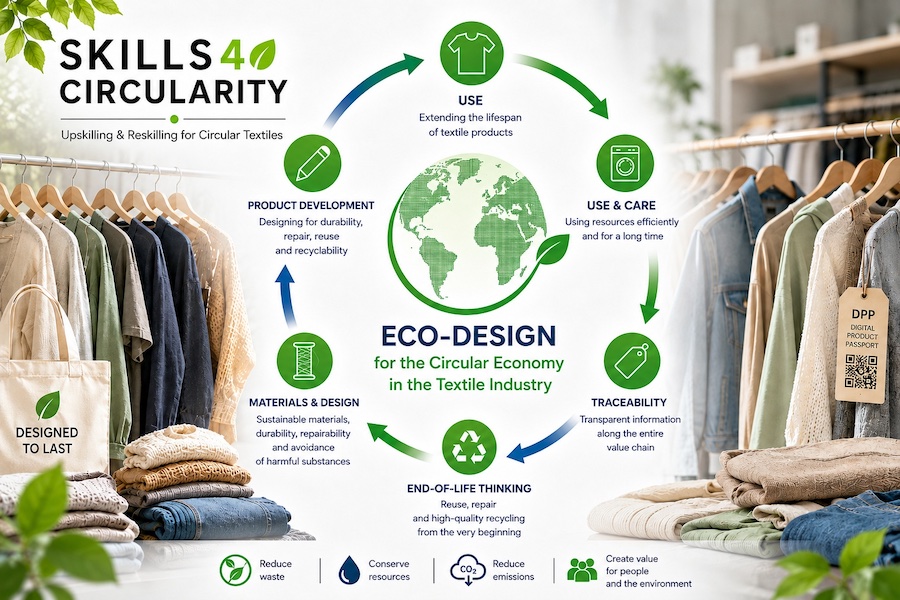
Skills4Circularity – an overview of the modules
Module 1: Recycling Technologies covers the fundamentals of the circular economy – from regulatory requirements through to collection and sorting, right up to mechanical, chemical and thermal recycling processes.
Module 2: Ecodesign for the Circular Economy demonstrates how textiles suitable for the circular economy are developed right from the product development stage – through ecodesign, the use of life cycle assessment (LCA), traceability and end-of-life planning.
Module 3: Sustainable Manufacturing covers resource-efficient production processes as well as strategies for reducing environmental impacts along the textile value chain.
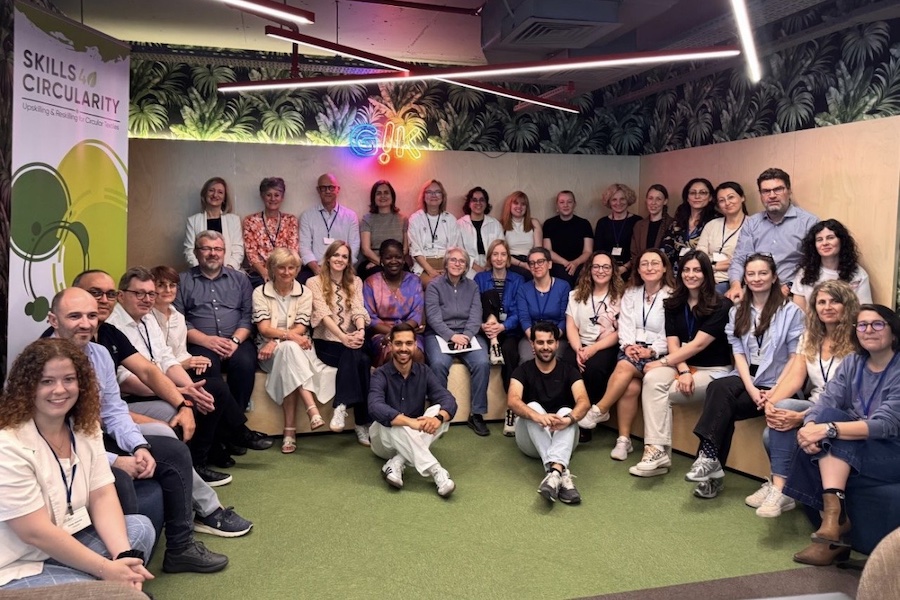
Recycling, traceability, eco-design and digitalisation are among the key future topics for the European textile industry. The Erasmus+ project Skills4Circularity, involving 21 partners from twelve countries, is investigating the skills required for this. The German Textile Finishing, Yarns, Fabrics and Technical Textiles Association (IVGT) is contributing the industry’s perspective to the project as the German sector partner.